Get Full Government Meeting Transcripts, Videos, & Alerts Forever!
Get email alerts on the Pensions Retiree Cola topic
No spam. Unsubscribe anytime.
Sonoma County supervisors weigh restoring retiree COLA as retirees, unions press urgency
Summary
After decades without an automatic cost‑of‑living adjustment, Sonoma County officials and the Sonoma County Employees’ Retirement Association presented options and legal questions for restoring a retiree COLA; retirees urged immediate relief during public comment.
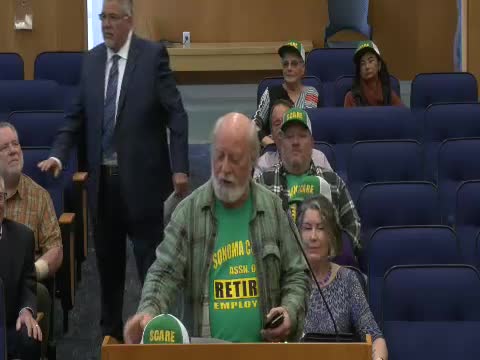
Dozens of retirees and union leaders urged Sonoma County supervisors Wednesday to restore a cost‑of‑living adjustment for retired county employees, while county staff and the county retirement system presented cost scenarios and legal questions for the board to consider.
The Board of Supervisors did not vote on a COLA but asked staff to pursue legal analysis, potential legislative fixes and funding options so the board can decide whether and how to move forward.
Retirees packed the board room during public comment, saying inflation and rising health care costs have eroded retirement incomes. “If the board goes forward with cutting the $500 a month that I get right now … it’s gonna be devastating,” said Bill Rabodka, a retired county employee and member of SCARE, the Sonoma County Association of Retired Employees.
Labor unions and retiree groups framed the proposal as restoring a long‑standing county practice: Julie Wine, chief executive officer of the Sonoma County Employees’ Retirement Association (SARA), told the board that Sonoma historically granted ad‑hoc COLAs from 1946 through February 2008, but a post‑2008 gating policy “inadvertently killed the COLA program.” Wine said SARA and county staff have formed a joint working group and produced actuarial modeling for several options.
Principal analyst Nicholas Klein of the County Administrator’s Office summarized four illustrative scenarios developed with SARA: a purchasing‑power COLA restoring retirees with at least a 20% loss to 80% of purchasing power (estimated at about $365 million present value); a hybrid purchase‑power COLA capped at 2% (lowest cost); a targeted purchasing‑power COLA limited to those who retired before Feb. 2003 (about $112 million); and a one‑time 2% across‑the‑board increase (about $45 million). Klein emphasized these were illustrative and that any COLA granted now would be 100% borne by the county because ad‑hoc COLAs have not been pre‑funded.
Supervisors pressed staff and SARA on options to target relief, caps and whether legislation would be required to limit eligibility. Supervisor David Rabbitt, a former retirement board trustee, and others noted PEPRA and County Employees Retirement Law restrictions that may limit some tailored approaches. Several supervisors said they wanted definitive legal guidance and a clear funding plan for any COLA before taking formal action.
The board’s preliminary direction was to: request county counsel and staff to analyze the legal issues and possible legislative remedies; evaluate funding paths including pension fund reserves, general fund implications and potential financing; and return with options and cost estimates for further direction. The board did not adopt a COLA or take formal binding action.
Background and next steps: Staff said the county’s proportionate share of retirement unfunded liability was $208 million per the Dec. 2023 valuation and that employer pension costs and a remaining pension obligation bond affect the county’s fiscal picture. SARA trustees described policy changes in 2003 and 2008 and said the retirement board amended its interest‑crediting and COLA policies in 2023–24 to enable collaboration with the county.
The board will receive follow‑up analyses requested Wednesday: a legal opinion about whether COLAs may be tailored by subgroup or capped by dollar amount, actuarial costings for preferred scenarios, and funding options including impacts to the general fund and other county budgets.