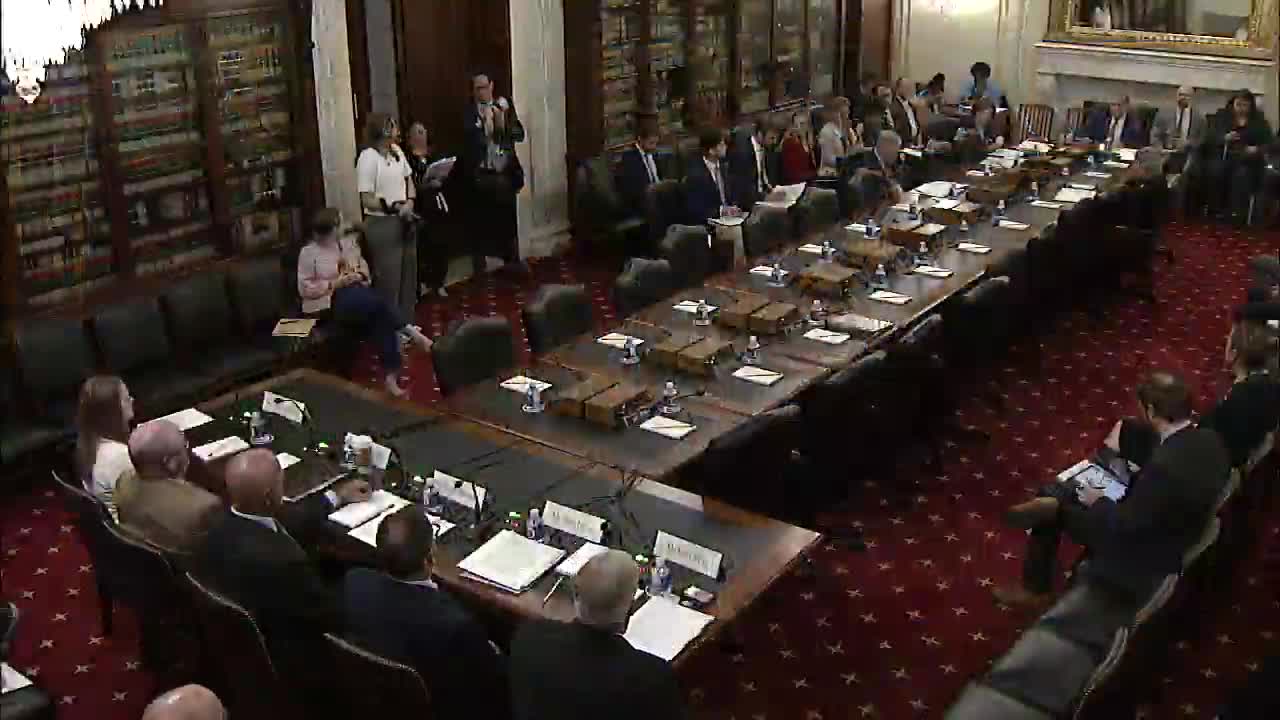
Senate Agriculture hearing: witnesses say conservation programs strained by staffing cuts and funding shortfalls
Get AI-powered insights, summaries, and transcripts
SubscribeSummary
Witnesses at a Senate Agriculture Committee hearing told senators that demand for voluntary farm conservation programs far outpaces available funding and technical assistance, and that recent workforce reductions at USDA agencies are slowing enrollments and deliveries of conservation practices.
At a Senate Agriculture Committee hearing witnesses from states across the country told senators that voluntary, locally led conservation programs are under strain because funding and staff at USDA have not kept pace with demand.
The testimony focused on technical assistance, program backlogs, and workforce reductions at the Natural Resources Conservation Service and Farm Service Agency that, witnesses said, are slowing enrollments and payments for programs such as the Environmental Quality Incentives Program (EQIP), the Conservation Stewardship Program (CSP) and the Conservation Reserve Program (CRP).
Why it matters: conservation programs in the farm bill pay for practice adoption and planning that producers say make farms more resilient, improve soil and water, and support wildlife habitat. Witnesses warned that without more staff and stable funding many producers will be unable to implement practices they have contracted to do.
Gary Blair, president of the National Association of Conservation Districts, told the committee that "technical assistance is the foundation of our conservation delivery system," and urged Congress to maintain local staffing and partnerships to serve producers. Blair said NRCS and local conservation districts are needed to tailor plans to producers' unique environmental and economic conditions.
Brad Doyle, a third‑generation farmer from Poinsett County, Arkansas, described using EQIP to build a 45‑acre reservoir on his operation and said the local accessibility of NRCS staff was essential: "The accessibility to the technicians, the planners, the the agents in the office was tremendous." Doyle also described long project timelines and supply issues tied to the COVID period that increased project costs.
Multiple witnesses cited a recent personnel reduction at NRCS and FSA. Pheasants Forever board member Lynn Churchman and others told the committee that almost 2,400 NRCS employees have separated and said that reported staffing cuts risk returning NRCS to FY2020 staffing levels. A national association witness said demand far outstrips available IRA and farm bill funds: IRA allowed NRCS to fund more applications, but that funding met only "43% of the $8,700,000,000 requested by producers," according to testimony.
Senator Amy Klobuchar (Ranking Member) said she is "concerned about the recent loss of 2,400 employees from NRCS, the pauses in funding, the cuts to technical assistance, and a troubling budget proposal," and urged inclusion of long‑term, stable funding in the next farm bill. Senators on both sides of the dais pressed witnesses on how to preserve local presence and technical capacity in rural offices.
Witnesses and senators discussed using public‑private partnerships and certified entities to extend technical assistance. Megan Dwyer, director of conservation and nutrient stewardship for the Illinois Corn Growers Association, pointed to the value of programs such as the Regional Conservation Partnership Program (RCPP) and precision conservation management efforts that leverage private dollars: she cited a partnership that returned $1.50 to farmers for every federal dollar invested.
Committee members also raised modernization proposals. Senator Joni Ernst described legislation to streamline and regularize NRCS conservation practice standards to speed approval and adoption of new practices. Witnesses urged maintaining voluntary, incentive‑based approaches and avoiding one‑size‑fits‑all mandates tied to other programs.
The hearing record shows broad agreement that conservation demand is high, that programs are oversubscribed, and that producers want certainty in payments and access to on‑the‑ground technical experts. No formal committee action or votes were taken at the hearing; senators kept the record open for five business days and adjourned the hearing.
Less critical details: witnesses noted that conservation programs represented a small share of overall 2018 farm bill spending (testimony cited about "7%"), and they urged Congress to consider folding unspent Inflation Reduction Act conservation funds into the farm bill baseline. Several witnesses urged Congress to protect or restore NRCS staffing and technical assistance funding so farmers could access and implement conservation contracts.