Get Full Government Meeting Transcripts, Videos, & Alerts Forever!
Get email alerts on the Oversight Weaponization topic
No spam. Unsubscribe anytime.
Oversight panel examines alleged DNR retaliation against Detroit Bridal Welfare Group director
Summary
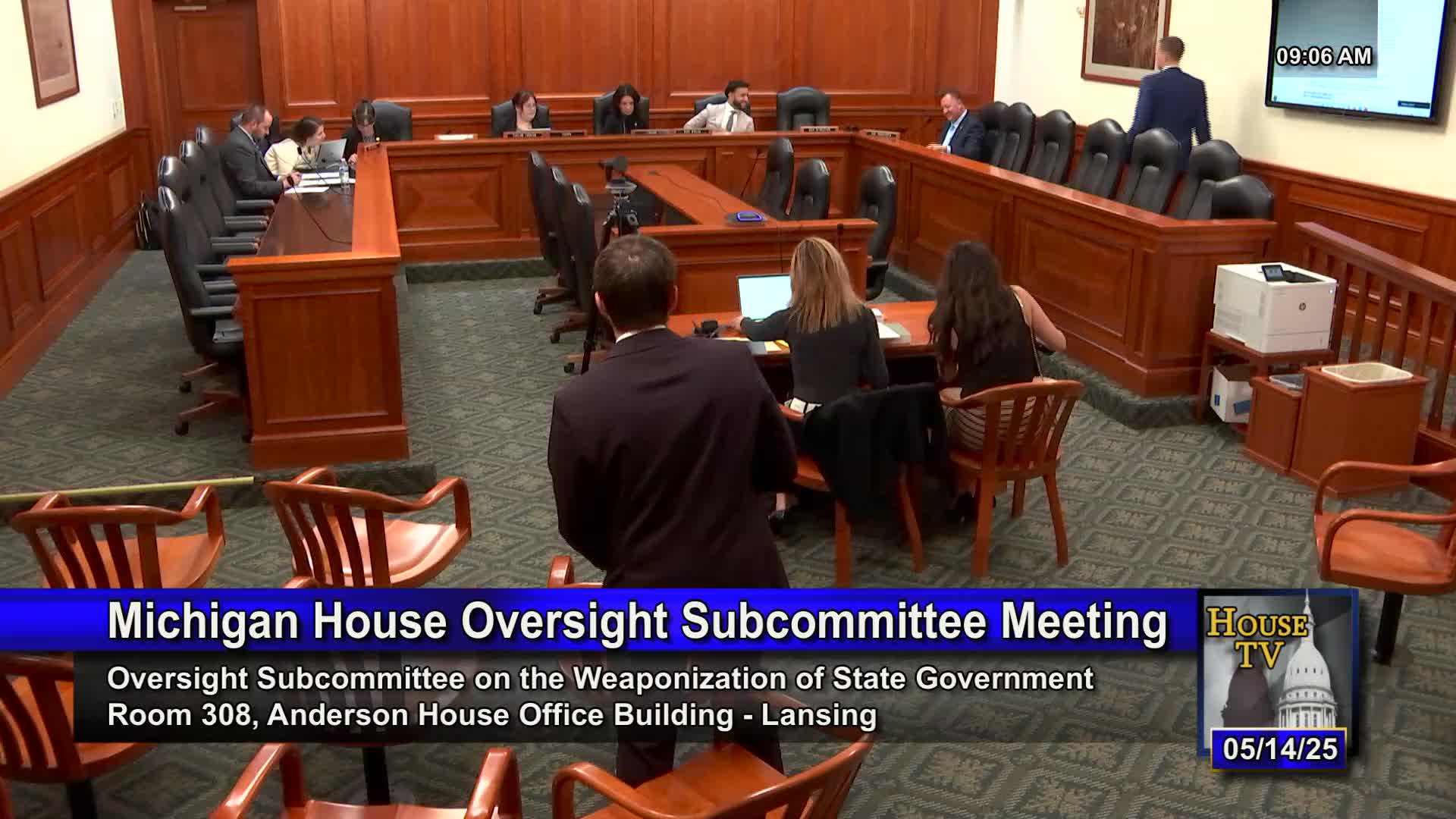
The Oversight Committee on Weaponization of State Government opened an investigation Tuesday into allegations that the Michigan Department of Natural Resources improperly targeted the Detroit Bridal Welfare Group and its director, Kelly LaBonte, after public criticism of state action in a 2018 Clarkston deer case.
LANSING — The Oversight Committee on Weaponization of State Government opened an investigation Tuesday into allegations that the Michigan Department of Natural Resources improperly targeted the Detroit Bridal Welfare Group and its director, Kelly LaBonte, after public criticism of state action in a 2018 Clarkston deer case.
The committee heard testimony that DNR employees sent internal messages suggesting the department ‘‘pull their rehab license’’ and that the agency repeatedly inspected, cited and sought revocation of LaBonte’s wildlife rehabilitation permit despite a 2023 administrative law judge ruling in her favor.
The case matters because LaBonte’s facility in Macomb County cares for roughly 1,000 wild animals a year and, committee members were told, a revocation would leave the county without a major rehabilitation center. ‘‘This is not a partisan issue. This is a constitutional issue. It's a matter of integrity, transparency, and accountability,’’ Chair Regas said when opening the hearing.
Attorney Celeste (counsel for LaBonte) told the committee she had compiled DNR emails and other documents she said demonstrate ‘‘a long running pattern of retaliation’’ after LaBonte and others publicly criticized the DNR’s response to starving deer kept in an enclosure near Clarkston. ‘‘The case I'm gonna tell you about today is probably 1 of the most disgusting cases of retaliation that I've seen in my experience,’’ Celeste said.
LaBonte, appearing by Zoom, described seven years of what she called harassment and frequent DNR inspections. ‘‘It has been 7 years of terror for me, and living every day in fear of, you know, a government agency is not a fun way to live,’’ she told committee members. She said the sanctuary, started in 2011 and expanded to a 25‑acre farm, is funded by donations and holds licenses from multiple agencies including the U.S. Department of Agriculture and the U.S. Fish and Wildlife Service.
Witnesses and counsel detailed a timeline the committee was shown in exhibits: a 2018 disagreement between LaBonte and DNR staff over how to help fenced, starving deer; emails from DNR staff in which one employee asked colleagues whether LaBonte ‘‘is a radical animal activist’’ and whether the agency could ‘‘pull their rehab license’’; surprise inspections in October 2018; criminal charges and a revocation proceeding under the Administrative Procedures Act; and a 90‑page ALJ opinion that largely sided with LaBonte.
Committee members were shown a May 2021 DNR message from a wildlife permit specialist asserting that ‘‘you cannot feed outside the rehab facility, that would be considered baiting,’’ language the panel heard was inconsistent with national rehabilitation guidance and with earlier DNR practice known as ‘‘soft release.’’ Celeste told members the DNR later amended the Wildlife Conservation Order to make that interpretation explicit after LaBonte prevailed at the administrative level.
Supporters who testified said the legal effort has been costly. LaBonte said she has spent about $150,000 of her retirement savings defending against the charges and missed many days of work; witness Shira Christiansen testified she estimated roughly $500,000 in costs associated with transcripts, attorney appearances and other agency expenses. ‘‘They've spent almost a half million dollars in a 13 day revocation case,’’ Christiansen said.
Committee questioning explored whether the DNR provided routine corrective‑action notices before pursuing criminal or revocation measures, and whether the department applied its rules consistently. Vice Chair Polotsky asked whether LaBonte ‘‘ever received any verbal or written notices of deficiencies before these charges were filed multiple years after the alleged incident?’’ LaBonte and her counsel replied no.
Members also raised public‑safety and animal‑welfare concerns described in testimony: a 2018 incident in which dozens of fenced deer were left starving after the landowner died, and an episode LaBonte described as a poaching incident near her facility that she said the DNR did not fully investigate. The committee heard that DNR officers arrived at LaBonte’s property for inspections with firearms holstered and that officers sometimes recorded staff and animals on video; witnesses said footage was later used in DNR proceedings.
The committee concluded by directing staff to request documents from the Michigan Department of Natural Resources and the Macomb County prosecutor’s office and to continue fact‑gathering. ‘‘If we find misconduct, we will recommend accountability. And if legislation reforms are necessary to protect whistleblowers and license holders from retaliation, we will pursue that as well,’’ Chair Regas said.
Formal committee business at the end of the hearing included the adoption of minutes from the May 7 meeting on a motion by Representative Wolford, which passed ‘‘hearing no objection,’’ and a motion by Representative Pulaski to excuse absent members, which also prevailed. The committee did not vote on sanctions or on statutory changes during the session.
The committee heard repeated statements that a DNR revocation would remove a key regional resource: the ALJ opinion cited by counsel said LaBonte’s facility ‘‘takes in more than 1,000 wild animals per year’’ and named specific investments — a $40,000 hospital structure and a $20,000 pond filter system — that would be lost if a revocation were sustained.
The panel said it will seek internal DNR emails and records, prosecutor’s office communications and other materials and may pursue legislative options depending on what the documents show. No criminal determinations or final regulatory outcomes were made by the committee at Tuesday’s hearing.
Members who wanted additional time for questions and further documents said they will convene follow‑ups as staff assembles the requested material.