Get Full Government Meeting Transcripts, Videos, & Alerts Forever!
Get email alerts on the Emergency Powers Pandemic Response topic
No spam. Unsubscribe anytime.
Michigan emergency laws gave executives broad unilateral power, witness tells oversight subcommittee
Summary
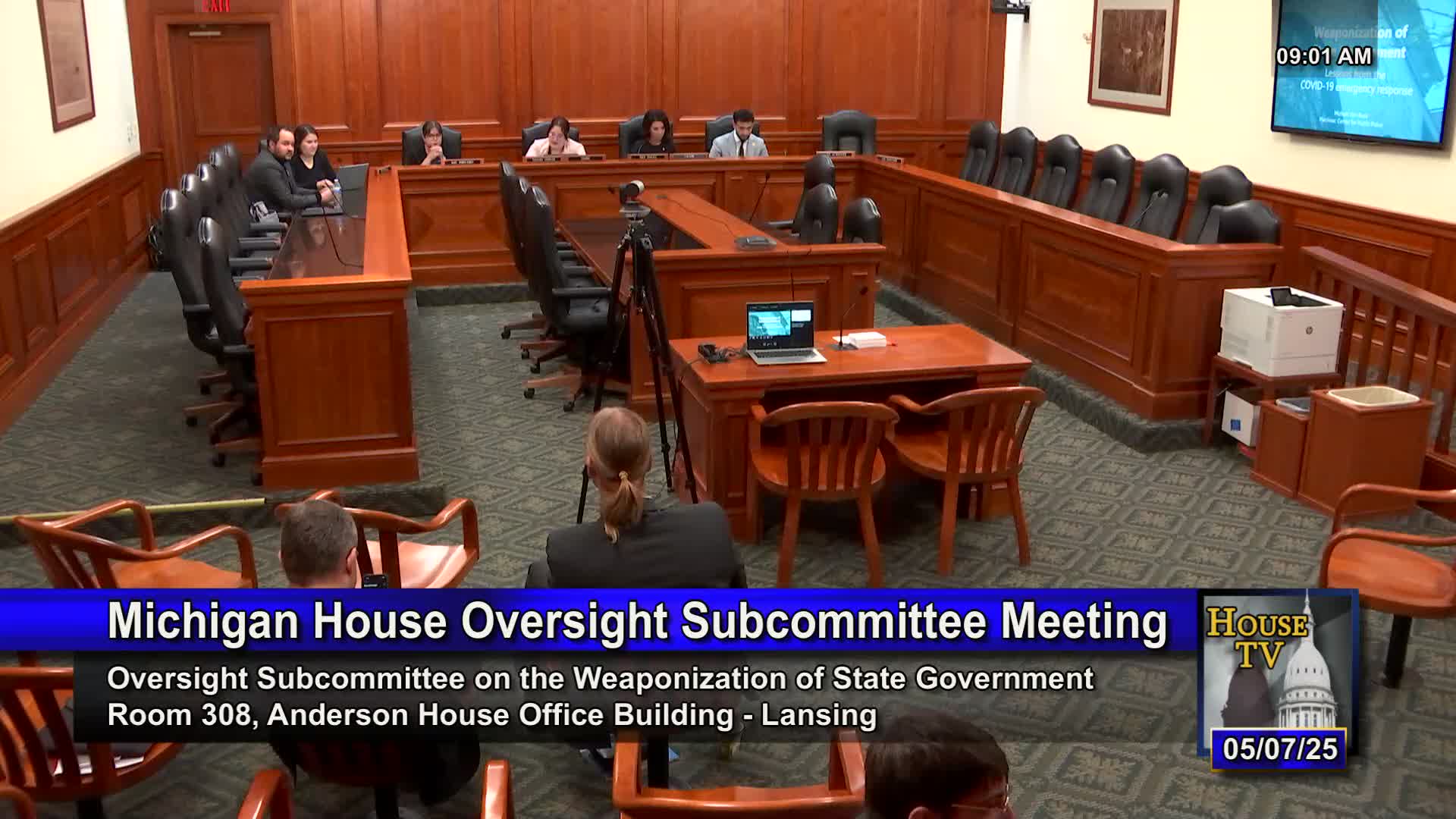
At a meeting of the Oversight Subcommittee on Weaponization of State Government, Michael Van Beek, director of research at the Mackinac Center for Public Policy, told lawmakers that broadly written Michigan statutes allowed state officials to exercise "unilateral" lawmaking authority during the COVID‑19 response and urged the Legislature to adopt a statutory pandemic plan.
At a meeting of the Oversight Subcommittee on Weaponization of State Government, Michael Van Beek, director of research at the Mackinac Center for Public Policy, told lawmakers that broadly written Michigan statutes allowed state officials to exercise "unilateral" lawmaking authority during the COVID‑19 response and urged the Legislature to adopt a statutory pandemic plan.
Van Beek told committee members that his review of Michigan law identified roughly 30 statutes that grant some form of emergency authority, but singled out three he called the most dangerous: epidemic powers in the Public Health Code, the Administrative Procedures Act’s emergency‑rule provisions and the governor’s authority under the Emergency Management Act of 1976. "Separation of powers guards against the weaponization of state government," Van Beek said, and he argued those three authorities were written so broadly that they could be triggered with minimal procedural checks.
Why it matters: Van Beek and several committee members said the combination of vague statutory triggers, long or open‑ended durations and minimal procedural requirements created legal and political controversy during the pandemic and left the public uncertain about when and how orders would end. The witness and multiple representatives also pointed to specific examples — MIOSHA emergency rules that regulated workplaces, a 2019 health‑department emergency action to ban flavored vaping products, and an October 2022 epidemic order that required nursing homes to offer COVID‑19 shots — as demonstrations of the statutes’ breadth.
Van Beek described the statutes’ mechanics and effects. Under the Emergency Management Act, he said, a governor may act unilaterally for 28 days before needing legislative approval, but the Legislature can extend that period without a statutory limit. Under the Administrative Procedures Act, agencies can promulgate emergency rules that have the force of law for up to a year, and those emergency rules may be issued when an agency "finds that the preservation of the public health, safety, or welfare requires promulgation of an emergency rule," language Van Beek characterized as undefined and therefore discretionary. On the Public Health Code’s epidemic authority — later cited in the hearing by Representative Wolford as MCL 333.2253 — Van Beek said the health director may issue orders with no clear definitions for terms such as "control," "necessary," "protect" or even "epidemic," and that several epidemic orders during the COVID period lacked expiration dates.
Committee members pressed Van Beek on the practical tradeoffs. Representative Pawlotsky asked whether "epidemic" is a scientific term and whether definitions already exist in administrative rules; Van Beek acknowledged that the health department has an administrative definition but said the Legislature should "put its stamp" on a statutory definition. Representative Shriver asked about repealing the APA; Van Beek said he was focused on the APA’s emergency‑rule provision and recommended adding procedural requirements and potentially shortening the one‑year window for emergency rules. Representative Regala asked whether the identity or party of an incumbent governor matters; Van Beek said that a preagreed statutory plan would reduce partisan variation by constraining discretionary action regardless of who holds the office.
Several members expressed concern about the legal clarity of the health‑department epidemic power. Van Beek said the Michigan Supreme Court had an opportunity to decide the constitutionality of the Public Health Code epidemic authority but declined to do so, creating a responsibility for the Legislature to act. He recommended a legislatively adopted pandemic plan that would define triggers for emergency authority, set durational limits, require specific procedures before orders are issued and create oversight and penalties for inappropriate use.
The presentation and subsequent questioning produced no formal committee votes on statutory text. Representative Wigala moved to adopt the minutes from an earlier meeting at the session’s start; the motion was adopted by unanimous consent. At the hearing’s close several members said the committee will pursue legislation to create a pandemic response plan and to tighten the triggers and procedural safeguards for emergency action.
The committee heard additional testimony and discussion about the difficulties of drafting prescriptive plans for unknown future pathogens, the role of public‑health expertise in executive decision‑making, and examples where ad‑hoc pandemic responses produced guidance inconsistent with industry standards. Van Beek said a statutory plan could and should incorporate expert input while setting procedural guardrails to protect separation of powers and individual liberties.
With no further business, Chair Regas adjourned the subcommittee.