Get Full Government Meeting Transcripts, Videos, & Alerts Forever!
Get email alerts on the Mphi Oversight topic
No spam. Unsubscribe anytime.
Lawmakers Press Michigan Public Health Institute on Funding, MDHHS Relationship and COVID Contracts
Summary
At a House Oversight Subcommittee hearing, Michigan Public Health Institute CEO Dr. Renee Branch Kennedy described MPHI’s statutory origin, heavy reliance on state and federal funding, affiliate staffing for MDHHS, and the institute’s role in COVID-era contact tracing contracts as lawmakers pressed for more details and documentation.
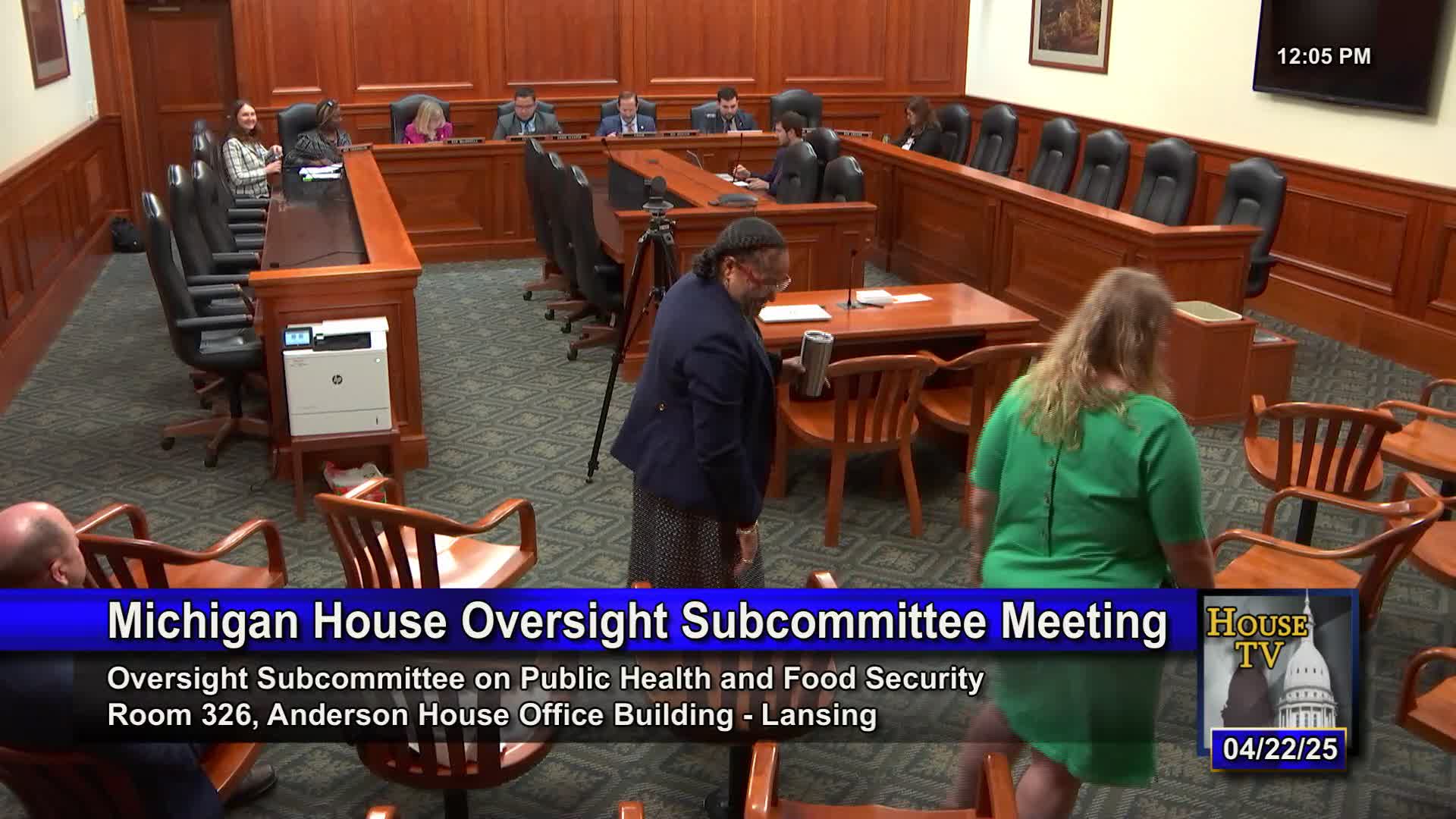
At a hearing of the House Oversight Subcommittee on Public Health and Food Security, lawmakers questioned the Michigan Public Health Institute’s structure, funding sources and role working with the Michigan Department of Health and Human Services.
Dr. Renee Branch Kennedy, CEO of the Michigan Public Health Institute, told the committee that MPHI was created by the legislature in partnership with the state to “extend [MDHHS’s] capacity to advance the likelihood that Michiganders would be healthy and well.” She urged legislators to view public health broadly, saying, “public health is what we as a society do together, do collectively to assure the conditions in which all people can be healthy.”
The institute’s funding and staffing arrangement drew sustained attention. Kennedy said about 86% of MPHI’s dollars now come from MDHHS and that roughly 55% of MPHI’s overall budget is federal funding, some awarded directly to MPHI and some routed through MDHHS. She described MPHI’s workforce as including a core staff at its Okemos campus and a large number of affiliate employees assigned to MDHHS to serve the department’s programs. “I can estimate… about 350” staff at the Okemos campus and “about… 600” affiliate staff assigned to the department, she said, and offered to provide precise figures to the committee.
Members pressed Kennedy on how those affiliate staff operate. She said affiliate employees are MPHI employees assigned to MDHHS and “work exclusively for the department,” receiving direction from MDHHS and, where appropriate, salary comparability and benefits aligned with state standards. Kennedy said MPHI works with MDHHS human resources and civil service to maintain salary comparability.
Lawmakers also asked about MPHI’s role during the COVID-19 pandemic. Kennedy said MPHI “facilitated contracts on behalf of Michigan Department of Health and Human Services” for contact tracing and related work, while the department made the decisions about how funds were distributed and which vendors to engage. She described MPHI’s role in those instances as “transactional as opposed to decisional.” She confirmed that MPHI has, at times, received stop-work orders from the state and stopped work on vendor contracts when MDHHS directed it to do so.
Representative McDonald described local impacts from federal funding reductions, saying two Oakland County programs for disease surveillance and long-term-care infection prevention “had been cut by $3,700,000.” Kennedy said MPHI’s budget is sensitive to federal reductions and that the institute is trying to mitigate service impacts by seeking other funding, transitioning staff to alternate sources where possible and pursuing philanthropic and nonstate contract opportunities.
On academic partnerships, committee members pressed for examples of MPHI work with universities. Kennedy described a range of ongoing projects—child death review, overdose fatality review, opioid task force work, epilepsy control, ACEs (adverse childhood experiences) initiatives, perinatal regional collaboratives and programs such as Senior Project FRESH—and said MPHI sometimes serves as primary applicant and sometimes as subcontractor with universities. She did not name a single active university-led grant during on-the-spot questioning but offered to deliver a detailed project list and funding breakdown to the committee.
Committee members asked about governance and oversight. Kennedy said MPHI was intentionally formed as an entity with an arm’s-length relationship to state government so it could pursue funding sources that some state agencies cannot, and that accountability and transparency were written into that arrangement. She said “it is in our bylaws, the director of MDHHS is the chair or their designee,” meaning the MDHHS director or a designee chairs MPHI’s board.
The subcommittee took no new formal action on MPHI at the hearing. Committee members requested that Kennedy provide precise staff counts, a detailed list of current projects involving universities and the institute’s recent deliverables report. The meeting approved routine minutes and excused absent members by unanimous consent before adjourning.