Get Full Government Meeting Transcripts, Videos, & Alerts Forever!
Get email alerts on the Public Safety Drones Counter Uas topic
No spam. Unsubscribe anytime.
Michigan oversight committee hears briefing on public‑safety drone use, flags gaps in detection, mitigation and supply chain
Summary
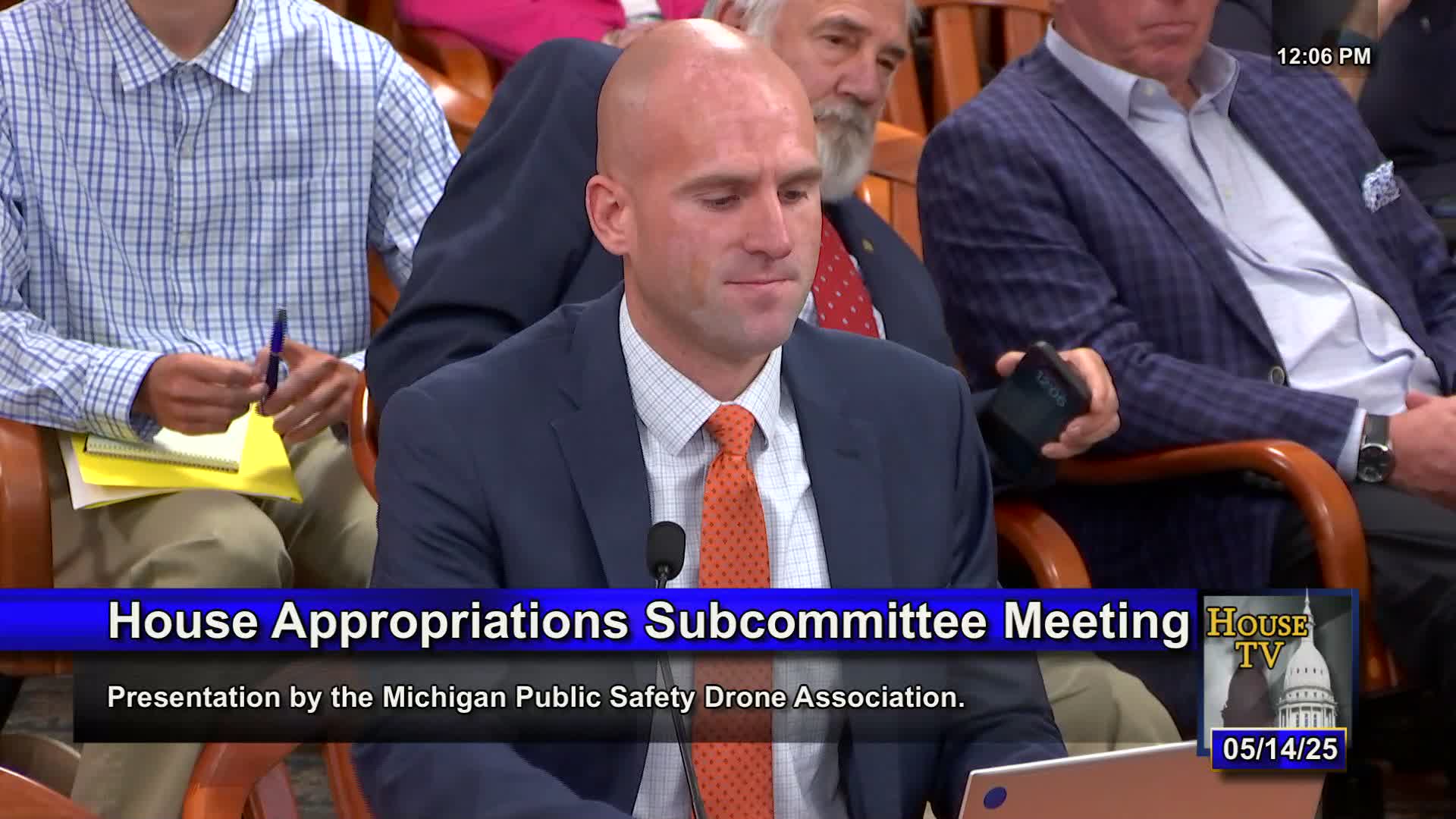
At a meeting of the Oversight - Homeland Security and Foreign Influence committee, members heard a briefing from Matt Rybar, president of the Michigan Public Safety Drone Association and vice president of remote operations at Unmanned Vehicle Technologies, on how public‑safety agencies across Michigan use drones and on gaps the state faces in detection, mitigation and supply‑chain resilience.
At a meeting of the Oversight - Homeland Security and Foreign Influence committee, members heard a briefing from Matt Rybar, president of the Michigan Public Safety Drone Association and vice president of remote operations at Unmanned Vehicle Technologies, on how public‑safety agencies across Michigan use drones and on gaps the state faces in detection, mitigation and supply‑chain resilience.
Rybar told the committee the technology “is a force multiplier” for search and rescue, tactical responses and disaster assessment but that Michigan lacks widespread counter‑UAS (unmanned aircraft systems) mitigation and that U.S. suppliers are still behind foreign manufacturers in cost and feature parity.
The discussion matters because local law enforcement and fire departments are increasingly deploying drones to locate missing people, provide scene intelligence and reduce risk to responders, while at the same time federal and state authorities debate how to secure critical sites and events from negligent or malicious drone activity.
Rybar, who described his background in electrical engineering, 11 years in law enforcement and running several drone programs including one he started in Kent County in 2017, said the Michigan Public Safety Drone Association now supports about 500 individual members and 120 organizations, runs regional training and plans to roll out an in‑state flight‑proficiency accreditation next month to provide agencies a standardized hands‑on credential.
He gave concrete examples of public‑safety use: Mason County located a 73‑year‑old woman lost in woods after a drone deployment; Roseville Police used a drone during an April tactical incident that the department said contributed to a suspect’s surrender; and more than 10 agencies used drones to inspect 800‑megahertz radio towers after recent Northern Michigan ice storms, work Rybar said helped restore communications during emergency response. Rybar noted the federal government had provided roughly $75,000,000 in aid for the ice‑storm response.
On counter‑drone capability, Rybar said Michigan has limited detection hardware concentrated at some stadiums and universities and “0 technology that can actually mitigate the drones” at state and local level. He explained that current mitigation authority resides at federal agencies and that Department of Energy, Department of Justice and Department of Homeland Security authorizations are required for takedown operations under existing law and policy.
Rybar described technical and policy steps agencies are using to reduce cybersecurity risk from foreign‑manufactured aircraft. He said vendors and agencies commonly use a device setting called local data mode and U.S.‑based software platforms (he cited DroneSense, and U.S. cloud providers such as AWS or Azure) to keep flight control and imagery within U.S.‑based systems. He recommended evaluating cybersecurity standards such as NIST and existing criminal justice information standards (CJIS) when procuring software.
Committee members pressed on several points: whether federal audits of manufacturers will change local practice; how mutual‑aid and memoranda of understanding handle drones operating across municipal or county lines; the feasibility and limits of geofencing; and how to prevent negligent recreational flights near sensitive sites such as Selfridge Air National Guard Base. Rybar said the FAA retains regulatory authority over aircraft once airborne and that mutual‑aid agreements largely govern cross‑jurisdictional deployments. He also said manufacturers have largely removed hard geofencing features and that many detection and mitigation technologies remain prohibitively expensive for most local agencies.
Members asked about vendor influence and procurement. Rybar said his employer, Unmanned Vehicle Technologies, represents a wide catalog of more than 50 manufacturers, “and we recommend products based on agency needs and constraints,” and that his company does not employ lobbyists. He also raised an example—an internal mailer incident tied to one U.S. manufacturer—that he said illustrated the need for vendor accountability and standards.
On supply‑chain resilience and domestic manufacturing, Rybar urged support for building a full U.S. unmanned aircraft ecosystem—everything from chips and batteries to airframes—and warned U.S. products are currently three to five times the cost and several years behind foreign competitors in feature parity. He said usable life for many current systems is roughly five to six years and cited one manufacturer that expects 5–10 years to produce a product meeting NDA‑style compliance needs.
The committee took no new regulatory votes or formal direction on drone policy at the session. The only formal action recorded during the meeting was adoption of the minutes of the May 7 meeting: Representative Meerman moved to adopt the minutes and, “hearing no objection,” the committee approved them.
The committee closed with members urging continued study and coordination with federal partners on counter‑UAS authority, procurement standards and statewide detection grants to help pool expensive equipment for regional sharing.