Get Full Government Meeting Transcripts, Videos, & Alerts Forever!
Get email alerts on the Unmanned Aerial Systems topic
No spam. Unsubscribe anytime.
State oversight panel hears testimony on drone capabilities, counter‑UAS gaps and supply‑chain risks
Summary
At a Wednesday hearing, Dakota Greenman of Westwood AI described commercial and military unmanned aerial system (UAS) capabilities, supply‑chain dependencies and counter‑UAS shortfalls; committee members pressed on vulnerabilities, regulation limits and potential funding paths.
At a Wednesday meeting of the House Oversight Committee on Homeland Security and Foreign Influence, a witness from Grand Rapids told legislators that commercially available drones and UAS (unmanned aerial systems) now deliver high‑resolution sensing and autonomous behavior that state and military officials must treat as both an economic opportunity and a security risk.
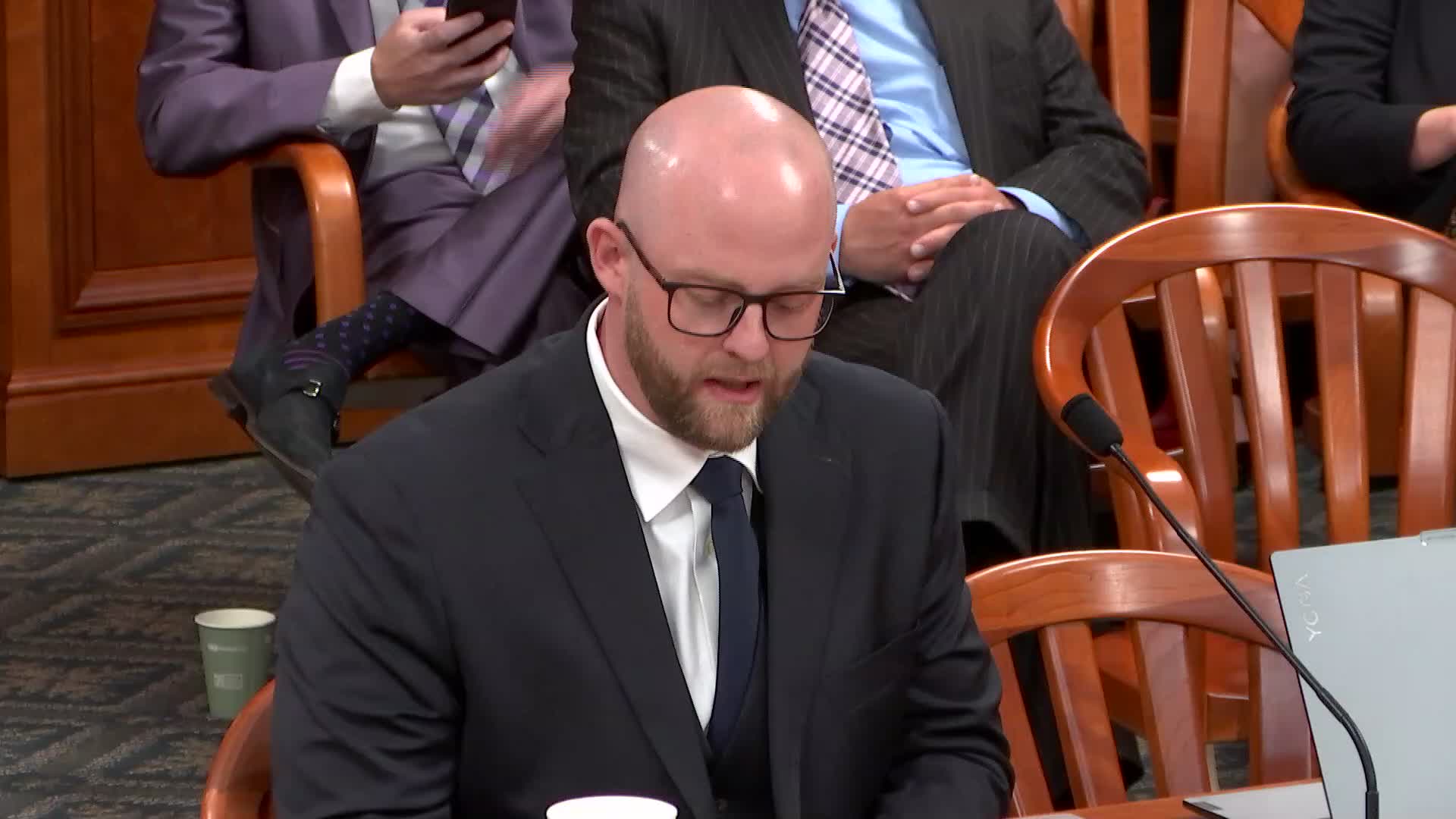
"If we fail to invest, streamline regulations, and push innovation forward, we risk being outpaced in the world of autonomous technology," Dakota Greenman, founder and CEO of Westwood AI, told the committee. Greenman described demonstrations of automated 3‑D mapping and object‑detection software, and warned that widely available sensors and open‑source code make advanced capabilities accessible to small teams or individuals.
The testimony framed three connected concerns: the expanding commercial uses and market growth for drones; reliance on foreign manufacturers and fragile supply chains; and a gap in practical, lawful counter‑UAS options available to military and law‑enforcement operators. Greenman said U.S. firms and researchers can build many mission applications but face commercial and liability barriers to competing with established foreign manufacturers.
Why this matters: UAS technologies now contribute to farming, infrastructure inspection, disaster response and law enforcement while also being used in modern conflicts. Committee members pressed whether Michigan and U.S. installations can lawfully and practically collect information about drones over sensitive sites or disrupt them. Greenman repeatedly said regulation — not just technology — limits what bases and local authorities can do today.
Greenman told the committee he has worked with the U.S. Air Force and Missile Defense Agency, and that Westwood AI partners with domestic manufacturers for hardware while building sensing and autonomy layers in software. He demonstrated an automated scan of the Capitol Building using a Skydio platform and an open‑source object‑detection interface, and described how the same methods can integrate EO (electro‑optical), thermal, LiDAR and acoustic sensors to produce detailed models and targeted measurements.
On market scale and manufacturing: Greenman cited industry forecasts and internal figures, saying the U.S. commercial drone sector is projected to reach roughly $52.5 billion by 2030 with a compound annual growth rate near 13 percent and that industry forecasts show global drone sector growth above 14 percent between 2025 and 2030. He also said FAA registrations approach 900,000 drones (about 340,000 commercial and 500,000 recreational in the FAA registry) and warned these registration counts exclude many off‑the‑shelf, unregistered airframes.
On foreign dependence and software controls: Greenman highlighted that much of the commercial fleet is produced by foreign manufacturers and said firmware updates, remote restrictions and features such as geofencing can change drone behavior after sale. He noted a vendor change in geofencing policy announced earlier in the year and raised a concern about vendor‑enabled emergency flight termination protocols, which he described as a remote disable capability built into some manufacturers' systems.
Counter‑UAS and operational limits: Committee members from both parties asked about practical countermeasures. Greenman said counter‑UAS is a "double‑edged sword": many mitigation techniques are technically feasible in controlled environments, but federal and aviation regulations limit who may collect data about U.S. personnel and when kinetic or non‑kinetic mitigation can be used. He described three mitigation categories: disruption-of-communications or code injection (non‑kinetic), seizure/remote landing, and kinetic engagement (shooting down or physically disabling aircraft), and noted collateral‑damage estimation (CDE) constrains kinetic options, especially against large numbers or swarms.
On vulnerabilities and sensors: Greenman walked the committee through sensor capabilities and potential misuses: LiDAR for precise structural mapping, thermal for detecting temperature differences (useful in roof inspections but also in reconnaissance), harmonic/acoustic sensing for occupancy or resonance detection, and electronic‑intelligence (ELINT) payloads or small relay devices (sometimes called "pineapple" routers) that can intercept or pass through wireless traffic. He said many of these sensors and payloads are small, inexpensive and commercially available.
On supply chains and batteries: Greenman described a recent supplier disruption tied to international sanctions that produced an immediate battery shortage for a U.S. manufacturer, and said battery technology is a persistent operational constraint. He told legislators that a typical demonstration flight might consume a large fraction of a single battery and that battery availability materially limits operational endurance.
On workforce and domestic innovation: Greenman urged greater support for small‑business innovation and workforce retention in Michigan, citing youth robotics programs and local competitions as sources of technical talent. He recommended incubator‑style support for problem sets that are solvable by small teams rather than always funding large, multi‑million‑dollar contracts.
Committee response and next steps: Members asked technical and policy questions about Arctic operations, hydrogen fuel cells, facial recognition, integration with other data sources, and the military's ability to act when a drone loiters over a base. Greenman said Westwood AI does not use facial recognition and does not integrate social‑media or private messaging data into its inspection software. The committee indicated it plans further hearings and to post Greenman's slide deck and video for public review.
Formal committee action: the committee took no legislative action on UAS policy at the hearing. The only formal vote recorded during the session was approval of the minutes from the April 30 meeting by unanimous consent.
The committee said it will bring additional testimony on drones, regulation and counter‑UAS options in future meetings as it examines how state and federal rules interact with operational needs for installations and critical infrastructure.