Get Full Government Meeting Transcripts, Videos, & Alerts Forever!
Get email alerts on the Overdose Prevention topic
No spam. Unsubscribe anytime.
Michigan chief medical executive urges wider naloxone access as fentanyl and xylazine drive overdoses
Summary
Dr. Natasha Bagdasarian told the House Oversight Subcommittee on Homeland Security and Foreign Influence that fentanyl is now involved in roughly 72% of overdose deaths in Michigan and pushed for broad naloxone distribution, while warning about emerging contaminants such as xylazine and a return of carfentanyl.
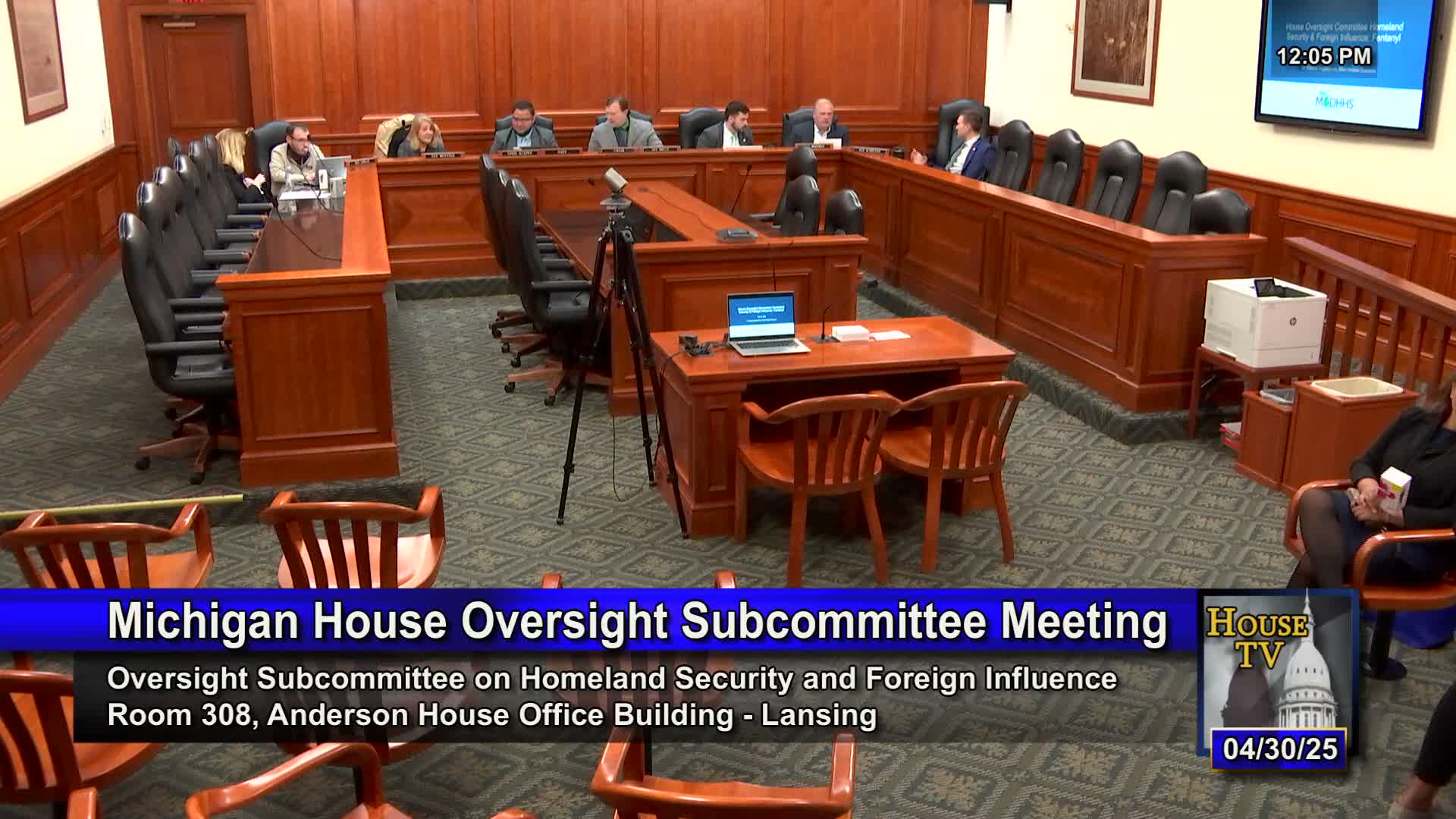
Dr. Natasha Bagdasarian, chief medical executive for the state of Michigan, told the House Oversight Subcommittee on Homeland Security and Foreign Influence at a committee hearing that fentanyl now figures in about 72 percent of overdose deaths in Michigan and that rapid expansion of naloxone distribution remains a top tool to prevent fatalities.
“Naloxone is a medication that directly reverses overdoses,” Bagdasarian said, describing the intranasal naloxone kit the state has distributed and the standing public-health policies that made broader access possible.
Bagdasarian summarized statewide data showing overdose deaths rose sharply after fentanyl entered the illicit supply and — while recent years show a decline from the peak — projected that Michigan would lose about 2,000 residents to overdose in 2024. She said that distribution and other programs funded through opioid settlement money have been central to reversing the trend: “A million kits have been distributed,” and, based on voluntary reports back to the state, “29,000 have been responsible for overdose reversals.”
The physician described how naloxone works and why the state chose a 4-milligram intranasal formulation for broad public distribution. She said paramedic data show an average of about 2.7 milligrams used intravenously in the field, roughly equivalent to the intranasal dose in the kits, and that most kits include two nasal sprays so a second dose can be given if needed.
Bagdasarian also warned committee members about non-opioid veterinary sedatives increasingly found mixed into the illicit drug supply. “Xylazine came out first. We started seeing Xylazine a few years ago. It’s actually a veterinary tranquilizer,” she said, and added that a related veterinary sedative (referred to in testimony as metatomidine) has been detected. Because those drugs are not opioids, naloxone does not reverse their effects. Bagdasarian said that, in the cases seen so far, xylazine or metatomidine have been mixed with fentanyl, and reversing the opioid component with naloxone can at least give a person a chance to survive.
She also noted a lower-volume reappearance of carfentanyl — an opioid used in veterinary medicine that is roughly 100 times stronger than fentanyl — and reiterated that, unlike xylazine, carfentanyl is an opioid and therefore responds to naloxone.
Bagdasarian described several state efforts to expand access: a 2017 standing order that removed the prescription requirement for naloxone; an online naloxone portal for free kits and mail delivery; placement of kits in public vending/dispenser boxes; and distribution through community partners including faith-based groups. She emphasized that naloxone is stable at room temperature and easy to use: “It’s just as easy” as many nasal sprays people use for other conditions.
On costs, Bagdasarian told the committee that the 4-milligram nasal product the state uses costs about $29 per unit when purchased at scale; she contrasted that with competing products promoted by pharmaceutical representatives, which she said are marketed at higher prices (examples cited in testimony were roughly $80 and $100 per unit for alternative higher-dose formulations). She framed the choice as a fiscal as well as medical judgment: using an effective, lower-cost product allows broader distribution from limited settlement funds while minimizing the risk of precipitating severe opioid withdrawal in reversal scenarios.
Committee members asked about geographic and age patterns; Bagdasarian said overdose deaths occur across urban and rural counties and that emergency-room visits show elevated rates among young women as well as an increase among older adults. She praised prevention messaging aimed at parents and teens, and she listed four pillars the state is prioritizing with settlement and other funds: prevention, harm reduction (including naloxone), treatment expansion, and recovery supports such as housing and transportation.
On funding, Bagdasarian said Michigan’s opioid settlement totals about $1.6 billion over 18 years and that roughly half of settlement dollars are allocated to counties while the other half is distributed by the state; she urged using those funds across the four pillars and for the long term.
Committee members asked about sources of fentanyl precursors; Bagdasarian said law enforcement reporting suggests many chemical precursors originate in China and undergo further processing elsewhere, but she said tracing international supply chains is outside her direct public-health remit.
Bagdasarian closed by offering to return with more detailed data on allocation and program outcomes. The presentation prompted questions from multiple representatives but produced no formal votes or committee directives recorded in the hearing.