Get Full Government Meeting Transcripts, Videos, & Alerts Forever!
Get email alerts on the Fentanyl topic
No spam. Unsubscribe anytime.
Berrien County officials tell state committee fentanyl is driving sharp rise in overdose deaths
Summary
Sheriff Chuck Hite and Capt. Sean Yek told the Committee on Homeland Security and Foreign Influence that fentanyl now accounts for the majority of major seizures in Berrien County, that overdose deaths have climbed to more than 60 in a recent year, and that enforcement, treatment and public-awareness steps are needed.
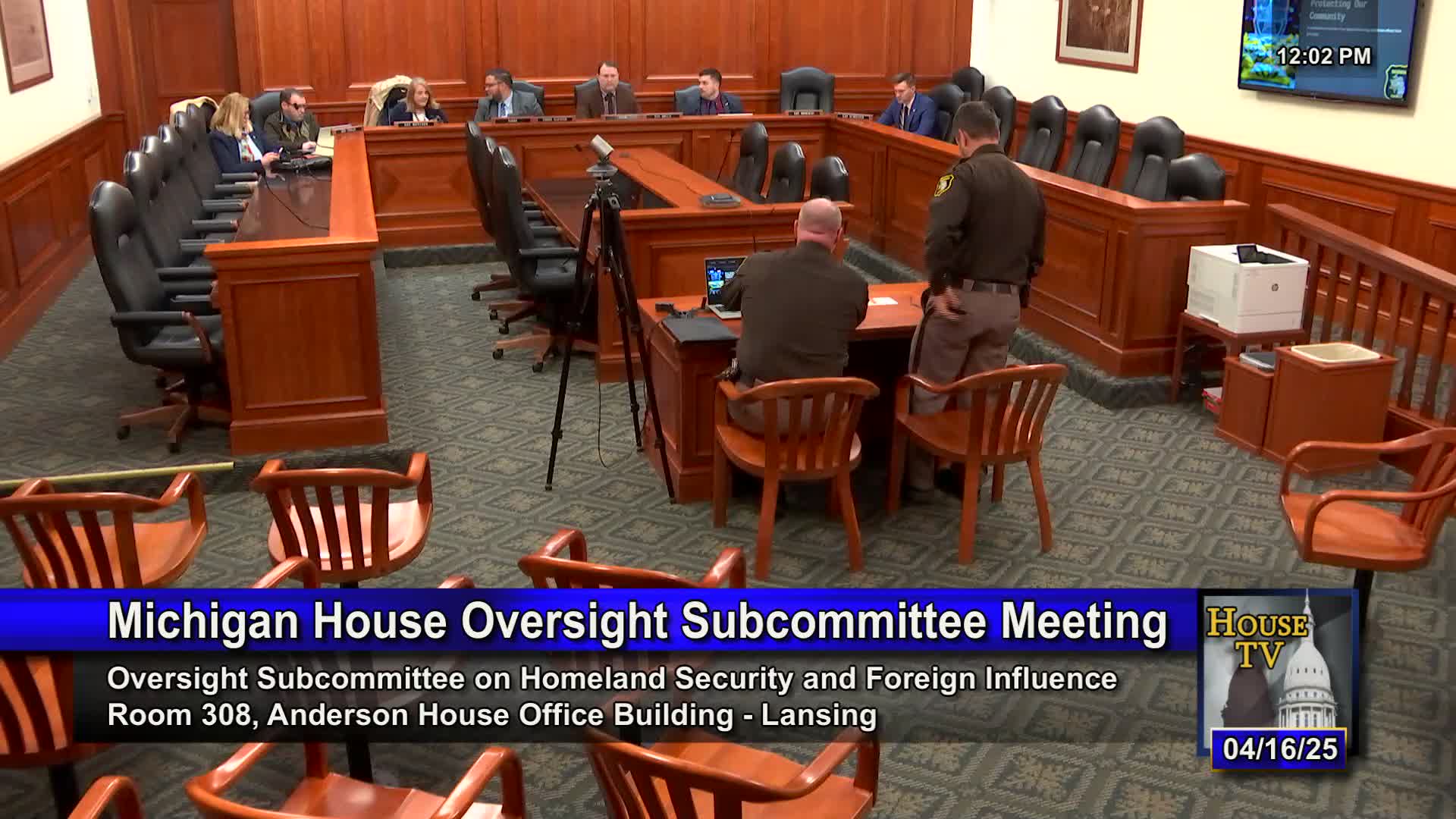
Sheriff Chuck Hite of Berrien County and Capt. Sean Yek told the Michigan House Committee on Homeland Security and Foreign Influence that fentanyl now accounts for the largest share of major drug seizures in the county and has driven a steep rise in overdose deaths.
The officials testified that law enforcement lab data and local seizure records show fentanyl has overtaken heroin and other opioids in Berrien County. Hite said fentanyl represented roughly 74% of the county’s top seizures and that the county registered more than 60 overdose deaths in its most recent high year; he said the county continued to see similar levels in 2025.
The committee hearing combined enforcement detail with public-health context. Capt. Sean Yek, who oversees the enforcement division’s narcotics work, described how fentanyl now appears in multiple forms — powder, disguised tablets and mixed with stimulants such as methamphetamine — and that mixtures increase the likelihood of fatal overdoses. Yek and Hite also described the emergence of xylazine, a veterinary sedative frequently mixed with fentanyl; they said naloxone (Narcan) reverses opioid effects but does not reverse xylazine.
Why this matters: Lawmakers pressed for ideas to reduce deaths and stop supply chains after Hite and Yek outlined how distribution has shifted. The witnesses said large shipments often move through commercial carriers and postal routes, with a regional mail-processing hub in Grand Rapids receiving much of the traffic that later moves into southwest Michigan. Hite and Yek described cooperation with federal partners — the Drug Enforcement Administration, the FBI and Homeland Security Investigations — and with the Michigan State Police and local departments through a regional task force known in the transcript as the Southwest Enforcement Team (SWEAT West).
Key facts and enforcement context reported to lawmakers: - Berrien County operates a regional enforcement team; the sheriff’s office said five personnel are assigned to the regional task force and several detectives work cases with the unit. - Local records submitted to the county drug lab show a major increase in fentanyl submissions beginning about 2020 and growing through 2024 and into 2025. - The sheriff’s office said fentanyl made up about 74% of the county’s largest seizures in the period shown in their presentation; heroin seizures have declined. - The county has implemented a pilot jail medication-assisted treatment (MAT) program offering medications such as buprenorphine (Suboxone) or methadone and is working with community partners on discharge planning for people leaving custody. - Officials reported seizures of counterfeit pills (branded to resemble prescription opioids such as oxycodone or Percocet) pressed to look like legitimate medicines; pill presses have been seized in regional investigations. - K‑9 teams and postal/parcel screening at the regional Grand Rapids processing center are part of local detection efforts; the sheriff’s office reported having three drug-detection dogs plus one explosive-detection dog.
Committee members asked how trafficking reaches Berrien County. Hite and Yek said traffickers use a variety of routes, including overland shipments and parcel services (U.S. Postal Service, UPS, FedEx), and that large wholesale shipments often originate outside the United States or in other states and move through third-party addresses. Hite said large seizures typically carry cartel markings that help investigators trace origin and distribution patterns.
On response strategies, witnesses and committee members discussed a mix of enforcement, sentencing policy, treatment and public outreach. Hite and Yek emphasized two recurring needs: sustained funding for multiagency enforcement and treatment resources for people with substance-use disorder. They also said community tips have produced leads in local investigations and recommended improved public awareness and reporting tools.
Committee discussion also covered technical and medical limits: naloxone is effective for opioid overdoses but will not reverse xylazine; some overdoses now require multiple naloxone doses because of high fentanyl potency; and roadside tests for nonalcohol impairment remain limited compared with breath alcohol testing.
Votes at a glance: The committee approved the minutes from its March 19 meeting by unanimous consent after Representative Shriver moved their approval and no objections were raised.
The testimony closed with committee members thanking the Berrien County officials and noting legislative options the committee could consider, including funding for enforcement and treatment, public-awareness campaigns, and changes to sentencing guidelines for high-volume distributors.