Get Full Government Meeting Transcripts, Videos, & Alerts Forever!
Get email alerts on the Committee Organization Agenda topic
No spam. Unsubscribe anytime.
House oversight subcommittee adopts regular meeting time, outlines plans on fentanyl, foreign influence
Summary
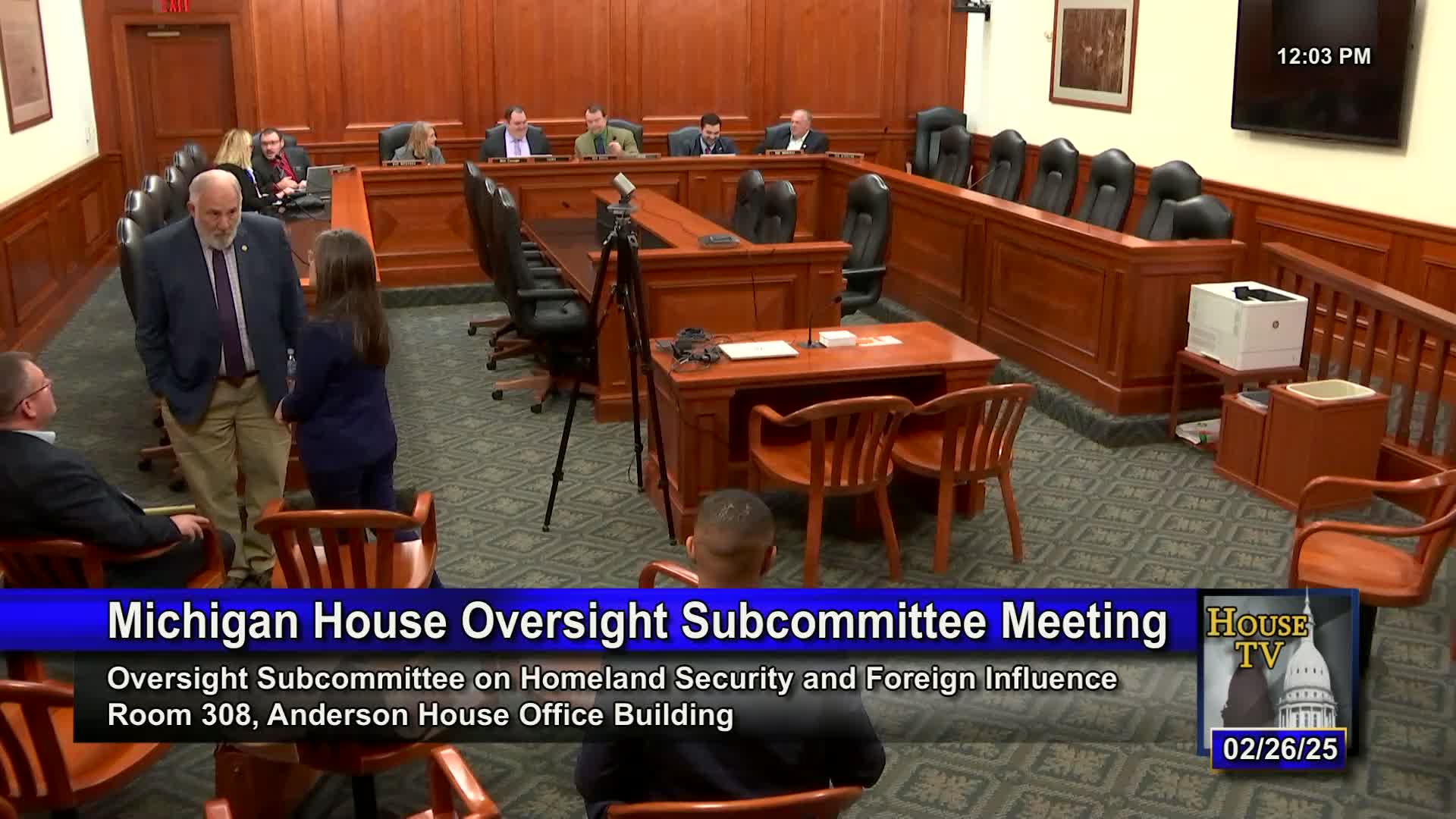
The House Oversight subcommittee on Homeland Security and Foreign Influence adopted a regular meeting schedule and previewed plans for a multiweek review of fentanyl and border security, foreign influence at Michigan institutions, and related topics including drones, AI and critical minerals.
The House Oversight subcommittee on Homeland Security and Foreign Influence voted to adopt Wednesday at noon in Room 308 of the House Office Building as its regular meeting day, time and place and used its organizational meeting to outline a multiweek agenda focused first on fentanyl and border security and on foreign influence issues.
The action to set a standing meeting time was moved by Representative Meerman and approved with a quorum of four members present; there were no nays. The committee then heard introductions from members and a series of planning remarks from lawmakers about topics the panel will pursue.
The nut graf: Committee leaders said the panel will hold several focused sessions over the coming weeks tying fentanyl enforcement to Michigan’s international borders and critical infrastructure, and will examine foreign influence risks at public institutions and in supply chains. Members described the panel as a vehicle for oversight and for developing possible policy recommendations and public awareness campaigns.
State Representative Denise Menser, who described personal ties to Selfridge Air National Guard Base, said the base delivers major economic impact to the region and urged vigorous support for it. “I will lie, cheat, and steal,” Menser said, adding she wants to help keep Selfridge viable and to secure a stronger fighter mission there. She also referenced the governor’s planned $26 million investment for the base.
Vice Chair Meerman said the committee matters to Michigan and to local security, and described recent federal warnings about foreign influence and cybersecurity as a reason for state-level attention. “We've got a problem,” Meerman said, adding that the panel should coordinate with federal and local partners.
Members outlined a near-term schedule: three committee meetings focused on fentanyl and the border, with U.S. Customs officials planned for the second week, the Michigan State Police for a subsequent session, then local sheriff departments (one rural, one urban) to provide local law-enforcement perspectives. The committee also intends to review trafficking issues, drones, artificial intelligence, cybersecurity, and “critical resources” such as water and mineral deposits that members said could be vulnerable to foreign influence.
Committee leaders said they will invite retired and recently retired military officials for readiness briefings; a retired Air Wing commander identified as Doug Slocum was named as a likely early presenter and members said they will try to secure Major General Paul Rogers for a future meeting. Members also discussed Northern Strike and Camp Grayling as state training assets they plan to visit or discuss.
On committee operations, members said they expect many meetings — roughly “25 to 30” sessions a year — and asked members to bring suggested witnesses and topics. The chair noted the panel will follow the House’s uniform committee rules specified in Chapter 4 of the House rules.
The meeting ended after a brief procedural motion to excuse absent members, which passed by unanimous consent. The committee adjourned and will reconvene at the adopted day, time and place.
Next steps: staff will schedule the planned presentations on fentanyl and the border, and committee members asked colleagues to propose topics and witnesses for future meetings.