Get Full Government Meeting Transcripts, Videos, & Alerts Forever!
Get email alerts on the Oversight Corporate Subsidies State Investments topic
No spam. Unsubscribe anytime.
Residents describe threats, secrecy and lawsuits after state-backed Goshen project faltered
Summary
Residents and local officials told a House oversight subcommittee that Michigan’s outreach to Goshen and related state incentives proceeded with little local transparency, prompting recalls, federal litigation and allegations of intimidation, data-sharing and environmental risk.
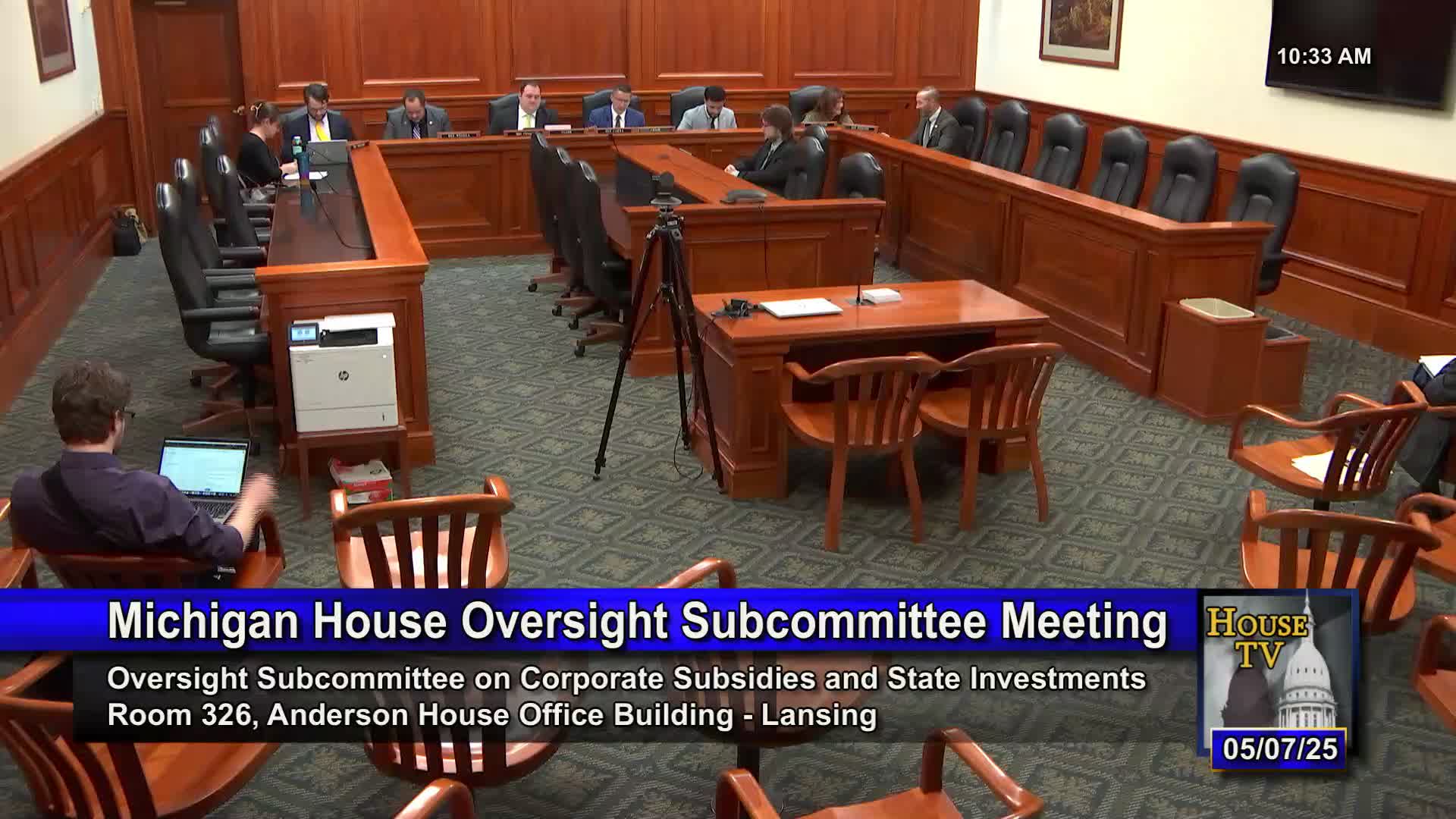
Lansing — Residents and local officials from Green Charter Township told the House Oversight Subcommittee on Corporate Subsidies and State Investments on Oct. 12 that the proposed Goshen project drew state attention and subsidies without meaningful local consent and sparked recalls and litigation.
The hearing featured testimony from Lori Brock, owner of Majestic Friesians, Jason Cruz, Green Charter Township supervisor, and community organizer Ormond Hook, who described a multi-year campaign of secrecy, alleged intimidation and what they called misleading public statements from project backers. “Please understand, this isn't a fight against a factory. It's the fight to preserve our very way of life,” Brock said.
Why it matters: Witnesses framed the dispute as an example of state economic-development incentives being applied to a project that many nearby residents opposed. They told the committee that state and quasi-state actors, including the Michigan Economic Development Corporation (MEDC) and regional development group The Right Place, promoted Goshen and that local officials initially presented the deal as effectively settled. Residents said that message undercut opportunities for public input and that some elected officials privately coordinated with company representatives.
What witnesses said: Brock said she and others first learned of the project only after wide circulation of a proposal and that local meetings were tightly controlled. She told the committee she and neighbors staged rallies and door-to-door surveys; she said a neighborhood survey her group conducted showed roughly 88 percent opposition, and she told the panel she and two others had polled 36 homeowners and found 30 opposed and 6 in favor. Brock said she received a letter reporting threats and alleged property damage tied to her public opposition and said she faced what she described as a campaign of intimidation that included false online reviews and alleged tampering with animals. “Any company that conspires with elected officials to silence and intimidate local residents who oppose their plans should not only be banned from receiving taxpayer dollars, but there should be also criminal penalties,” Brock said.
Township account: Supervisor Jason Cruz told the committee Green Charter Township has a population of about 3,200 and that Goshen had purchased property in the township and “wishes to build a roughly 270 acre battery component factory.” Cruz described a sequence of events he said began before public disclosure: he said Ferris State University pursued a $3 million MEDC grant to align training programs with the project, and he described changes at the university and pressure on local township operations after the project surfaced. Cruz said Goshen filed litigation against the township claiming a breach of contract related to a development agreement; he said a U.S. district judge granted an injunction and that the township appealed to the U.S. Court of Appeals, with arguments scheduled in Cincinnati the day after the hearing.
Community organizing and local outcomes: Organizer Ormond Hook said residents studied corporate filings and found references to Goshen High‑tech’s corporate governance, which he said showed ties to directives from the Chinese Communist Party as described in the company’s articles of association. Hook told the subcommittee that citizens organized rallies and petition drives, succeeded in recalling several township officials and elected new local leaders, and that “we now control Green Township, Big Rapids Township and the county commissioners,” a reference to the change in local officeholders after recall and subsequent elections.
Allegations, evidence and agency response: Witnesses provided the committee copies of text messages they said showed communications between a former Green Township supervisor, Jim Chapman, and Goshen representatives; Brock said one message called her an insulting name and that private records were circulated to discredit opponents. Committee members asked about disclosures of private health information and whether local prosecution had pursued charges; witnesses said they had provided materials to prosecutors and the state, but that local criminal and campaign-finance enforcement had not yielded results to their satisfaction. Brock told the panel that Green Charter Township had accumulated about $500,000 in legal fees related to the dispute and said the township was preparing federal litigation this week.
Process and zoning: Cruz said the township did not receive formal zoning change applications from Goshen and that property-permit filings with Macassa County were withdrawn before a planned county review meeting. He said the township has established a planning and zoning process and was updating its master plan to reflect residents’ priorities. Cruz said he favored local control: “No. I'm a local control guy,” he told the subcommittee when asked whether the state should override local zoning decisions.
State incentives and oversight questions: Testimony repeatedly raised the role of state economic-development incentives and the pace and secrecy of negotiations. Witnesses called for changes including bans on nondisclosure agreements for elected officials, more transparent vetting of projects, and stronger checks on how incentive decisions are made. Several committee members cited the case as an example of broader concerns about corporate subsidies and asked witnesses about the accuracy of public statements that local support existed and about whether environmental risks, including proximity to a major aquifer and the Muskegon River, had been adequately assessed.
Formal actions and next steps: Panel members and witnesses discussed ongoing litigation and the township’s appeal of a federal injunction; witnesses said Goshen initiated litigation and that the township plans to continue its appeal. Local leaders told the committee they had pursued recalls and regular elections to replace prior officials who they said had coordinated with Goshen; they said multiple recalls and elections had changed local representation. No new state action was adopted at the hearing.
What the committee did: The subcommittee took testimony and asked questions but made no motion to change any state action at the hearing. The panel’s members indicated interest in follow-up information about campaign-finance records, the status of federal litigation and any state agency reviews.