Get Full Government Meeting Transcripts, Videos, & Alerts Forever!
Get email alerts on the Advocacy Corporate Subsidies topic
No spam. Unsubscribe anytime.
Fund My Future tells subcommittee MEGA credits cost Michigan billions, divert funds from schools and roads
Summary
Representatives of Fund My Future told the Oversight subcommittee that MEGA tax credits amounted to billions in public cost, citing figures including $2 billion through the end of the decade and historical budget impacts; they urged redirecting funds to education and infrastructure.
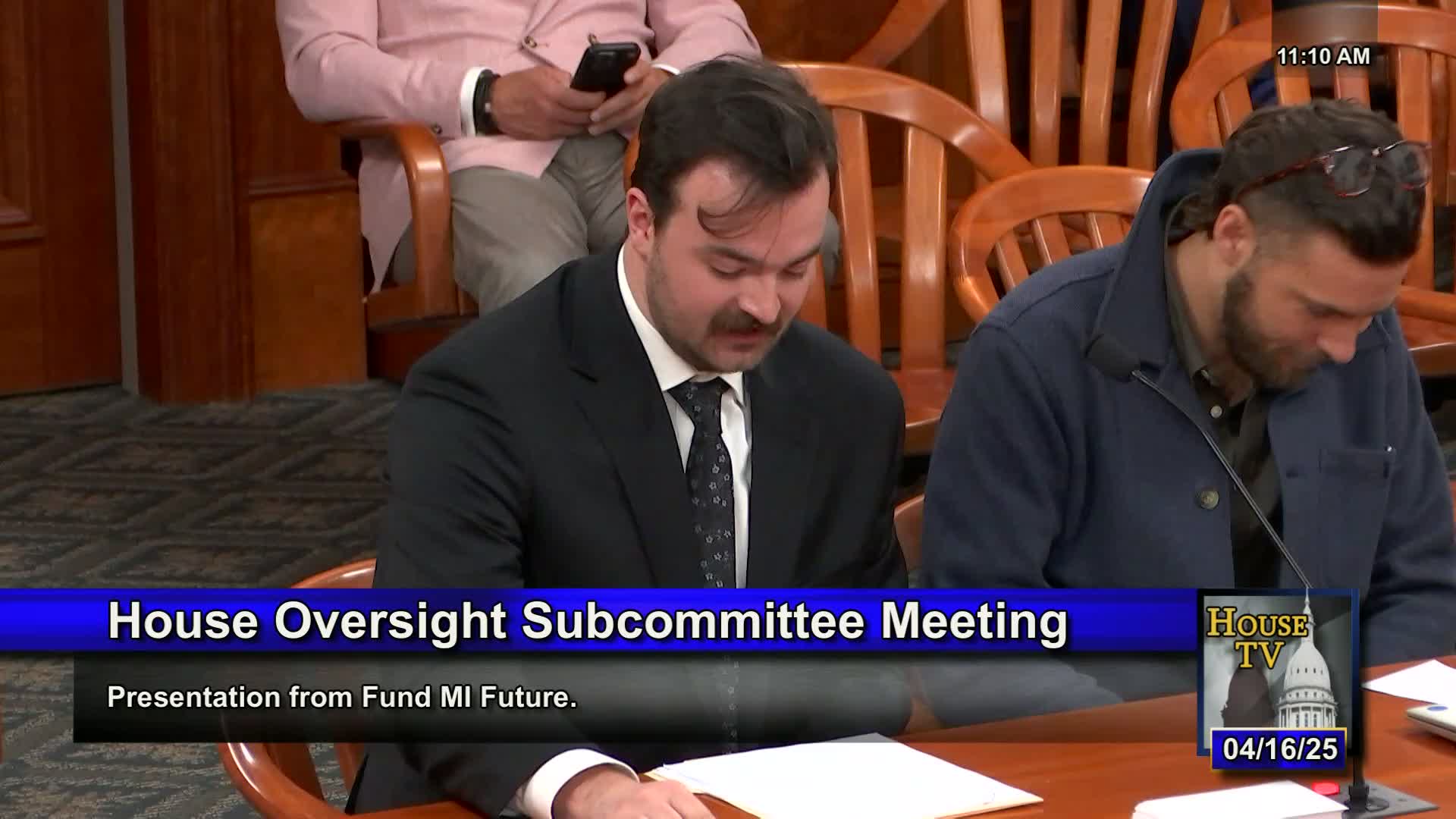
Charlie Kemp, research director at Fund My Future, and Charlie Cavell of the same coalition told the Oversight - Corporate Subsidies and State Investments subcommittee that Michigan's MEGA tax-credit program has been an expensive, ineffective subsidy that has shifted costs from corporations onto the public.
Kemp said the credits "essentially passed the cost of wages onto the Michigan public rather than the companies profiting off of their labor." He told lawmakers that the program has cost Michiganders billions and that, unless addressed, "the credits will continue to cost us $2,000,000,000 through the end of the decade."
Kemp cited historical impacts and audit findings: he said an Auditor General review showed recipients in 2015 created 48% of the standard new jobs they had promised, 39% of promised high-tech jobs, and retained 83% of the jobs they pledged to keep. He also said that the scale of credits has forced budget choices, noting that in 2015 the legislature cut $325,000,000 from the budget after unexpected credits were redeemed and that in 2019 the state collected about $1.3 billion in corporate tax revenue but paid out $511 million in MEGA refunds.
Fund My Future argued the money would be better spent on schools, roads and workforce programs. "We rank 40th in education nationally… With $2,000,000,000 we could create programs that bring more skilled trade jobs to Michigan," Kemp said, urging lawmakers to prioritize public investments over subsidies.
Lawmakers from multiple ideological backgrounds pressed the witnesses on whether public sentiment supports ending subsidies and on alternatives such as a stable, level tax rate and investments in infrastructure; the witnesses said stopping open-ended corporate subsidies and refocusing on education and infrastructure would produce fairer outcomes.
The subcommittee continued the hearing with follow-up questions and other witnesses.