Get Full Government Meeting Transcripts, Videos, & Alerts Forever!
Get email alerts on the Mega Tax Credits topic
No spam. Unsubscribe anytime.
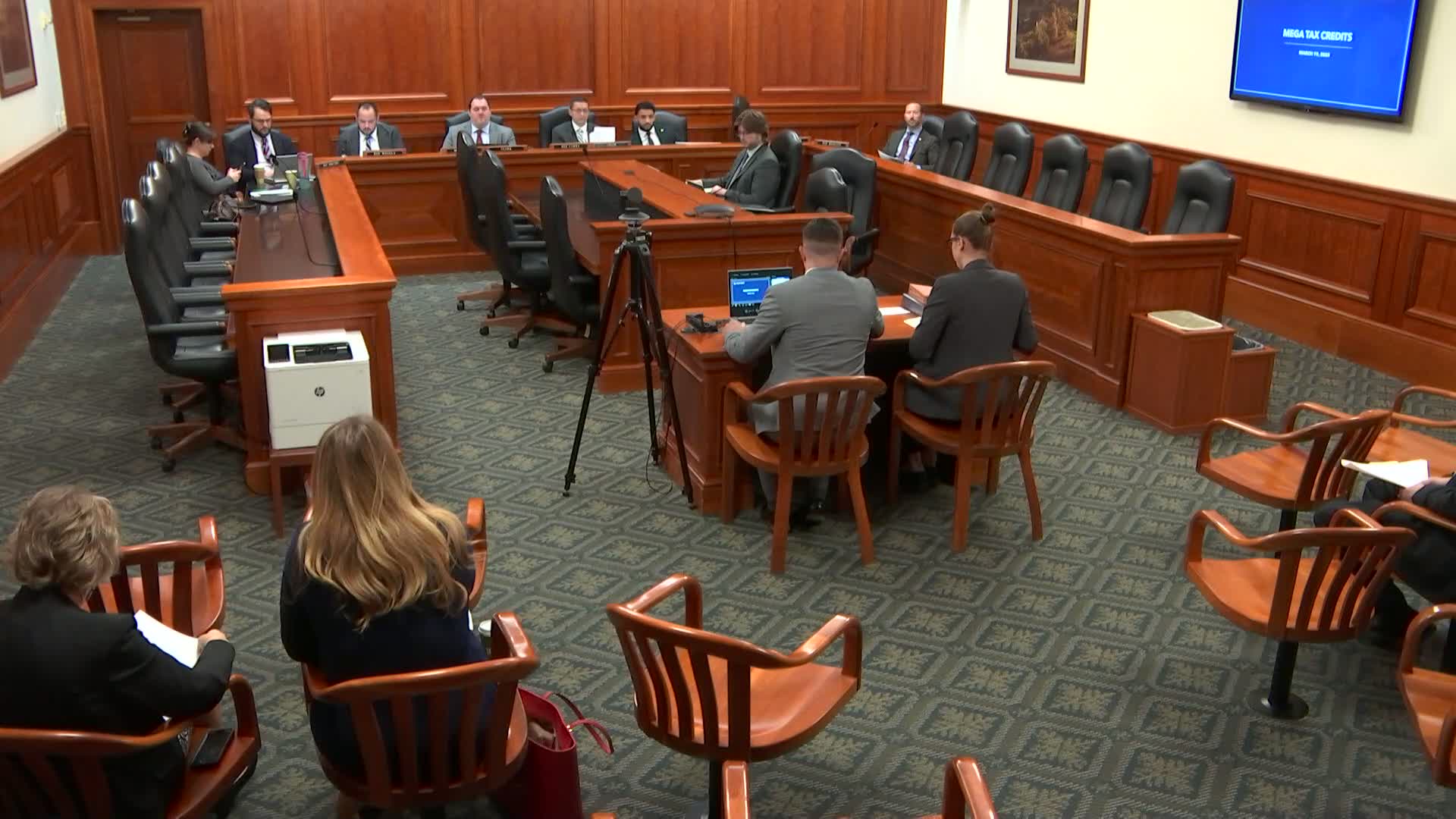
House Oversight Subcommittee Questions MEDC on MEGA Tax Credits' Transparency and Compliance
Summary
At a House Oversight Subcommittee hearing on corporate subsidies and state investments, Michigan Economic Development Corporation officials explained the MEGA tax credit program and answered questions about compliance sampling, outstanding certificated credits and statutory limits on disclosure.
At a House Oversight Subcommittee hearing on corporate subsidies and state investments, Michigan Economic Development Corporation officials explained the state’s MEGA (Michigan Economic Growth Authority) tax credit program, its compliance procedures and estimates of remaining certificated credits, while committee members pressed for greater transparency and detail about program costs and job retention.
The MEGA program was created by the Legislature in 1995 and, MEDC officials said, stopped issuing new agreements in 2011 after the tax code change that replaced the Michigan Business Tax (MBT) with the Corporate Income Tax (CIT). Josh Hunt, with the MEDC, said the program “was started, in 1995 and established by the legislature and signed into law by Governor Engler,” and that credits issued under the program are refundable — meaning they can reduce a company’s MBT liability below zero and generate a refund from the state treasury.
The committee’s questioning focused on three central areas: how the MEDC verifies eligibility for credits, what company-level tax and filing data the state may legally share, and the scale of remaining obligations tied to outstanding certificated credits. Kristen Armstrong, senior vice president for business development programs and execution at the MEDC, described the agency’s compliance work and audit procedures: “The tax credits are subject to a very rigorous audit and verification process,” she said, adding that the compliance team performs a random-sample audit of employee lists and payroll documentation for companies claiming credits.
Why this matters: MEGA credits have been associated with large investments and long-running obligations. MEDC figures presented to the committee show roughly 63,000 new jobs certified and about 184,000 retained jobs certified through the program, and more than $52 billion in actual private capital investment tied to MEGA agreements. Documents cited by MEDC report about $6.3 billion in tax credit certificates issued since the program began. Committee members repeatedly said those totals warrant clearer visibility into how many dollars flow to recipients in a given year and how credits interact with companies’ overall tax liability.
How the credits work and the compliance process: MEGA credits were designed to incent job creation or retention and were structured as refundable credits under the MBT. MEDC witnesses described several credit types created over the program’s life — standard credits, high-technology credits, rural credits and retention credits — and said individual agreements specified job counts, wage floors and investment requirements. Armstrong said the MEDC selects a 15% random sample of employees from the base, new and retained populations for audit and expands that sample if irregularities appear. If a company fails to demonstrate that employees meet the agreement’s requirements for a given year, MEDC does not certify a credit for that year.
Open questions and legal limits on data: Committee members asked whether MEDC can provide Treasury-level tax filings or aggregate annual net tax payments for MEGA recipients. MEDC staff said they only have access to the tax credit certificate amounts and do not receive companies’ full MBT filings; they noted statutory restrictions enacted in amendments after 2008 that limit disclosure. MEDC offered to provide the committee with the specific statutory citations that control what may be shared.
Companies still on MEDC’s active list and recent changes: MEDC listed companies that, on its records, still have active compliance processes or certificated credits, including Dow Inc.; Farmers Group Inc.; Ford Motor Company; General Motors; Gentex Corporation; Graphic Packaging International; Hemlock Semiconductor Operations; Hyundai Kia America Technical Center; LG Energy Solution Michigan; PureFlex Inc.; Stellantis (filed as FCA US LLC); and Exalt Energy LLC. MEDC said Dow agreed to a mutual termination of its remaining certificated credits effective tax year 2025 as part of a separate grant agreement in process.
Scale, caps and examples: MEDC and other witnesses discussed agreement-specific wage floors and caps. Statutory minimums described by witnesses included a baseline requirement that counted jobs pay at least 150% of the federal minimum wage for standard credits, and such as a “high-wage” subcomponent that required 300% of federal minimum wage for some awards. MEDC also noted a cap on the portion of wages eligible for credit at $250,000 per employee. In a company-specific example cited to the committee, the overall cap on General Motors’ MEGA obligations was stated in the record as roughly $3.475 billion over a 20-year term, with the last tax year eligible for a credit listed as 2029.
Arguments for and against incentives: Representatives on the committee pressed MEDC on fairness and fiscal trade-offs. Minority Vice Chair Wigela asked whether the state was effectively funneling taxpayer dollars to highly profitable corporations and whether the state’s incentive strategy is adequately transparent. Mike Johnston, executive vice president for government affairs and workforce development at the Michigan Manufacturers Association, testified in support of incentives, arguing that retaining and attracting large manufacturing investment produces broad multiplier effects and wages that support local businesses: “Retaining existing companies is critical to any growth strategy,” he told the committee.
Committee direction and next steps: Committee members asked MEDC to provide statutory citations governing disclosure and to coordinate with the Department of Treasury about what aggregate tax-payment information Treasury can legally provide. MEDC indicated it would supply citations; committee members signaled further interest in Treasury-level summaries or explanations of legal limits that restrict sharing of company tax filings.
No formal votes or committee actions were taken during this hearing. The record shows extended questioning of MEDC officials and a subsequent separate witness panel from the Michigan Manufacturers Association.