Get Full Government Meeting Transcripts, Videos, & Alerts Forever!
Get email alerts on the Fentanyl Opioids topic
No spam. Unsubscribe anytime.
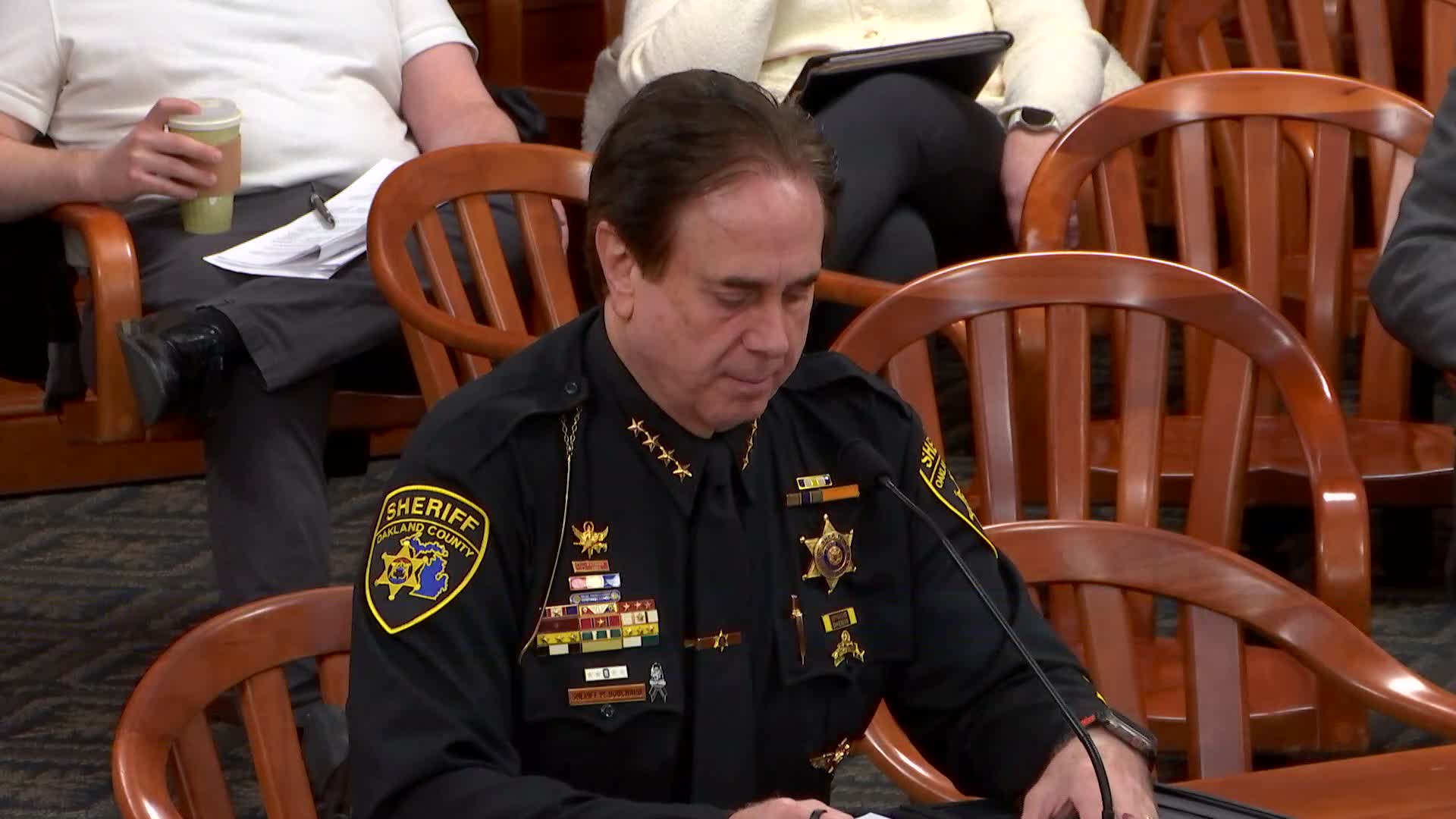
Oakland County sheriff urges state action on fentanyl, Xylazine and pill-press regulation
Summary
Oakland County Sheriff Mike Bouchard told the House Oversight Subcommittee on Homeland Security and Foreign Influence that fentanyl and emerging synthetic adulterants are driving an overdose crisis and urged the Legislature to reclassify xylazine and tighten pill‑press rules.
Oakland County Sheriff Mike Bouchard told the House Oversight Subcommittee on Homeland Security and Foreign Influence on Oct. 12 that fentanyl and new synthetic adulterants are the principal drivers of an unprecedented overdose crisis and that state action is needed to strengthen law enforcement and public-health responses.
Bouchard, introduced as Oakland County sheriff, said, “We’re not gonna arrest our way out of the drug tragedy that’s happening in America,” and urged a combined approach of prevention, treatment, diversion and targeted enforcement. He described fentanyl as the “primary driver” of overdose deaths and said synthetic analogs and veterinary tranquilizer xylazine are appearing in local casework.
Why it matters: Bouchard said nearly 100,000 Americans died of overdoses in 2023 and that local crime labs are seeing new components — including para-fluorofentanyl and xylazine — mixed into street drugs, sometimes even marijuana. He said that adulteration makes ordinary street purchases much more dangerous and that public-health, legislative and law‑enforcement measures must adapt quickly to new chemistries.
Details of local response: Bouchard described multiple county programs: a crisis response unit that follows up with people after overdoses; a co‑responder program pairing deputies and mental‑health professionals; year‑round Operation Medicine Cabinet collection sites for unused prescriptions; a rides‑for‑recovery program to get people directly to treatment beds; and jail‑based medically assisted treatment (MAT) programs with aftercare referrals. He said his office equipped patrol cars with naloxone (Narcan) after lobbying the legislature for authorization, and deployed an FDA‑approved nasal opioid‑reversal spray as well.
On outcomes and data, Bouchard said his agency had “833 deployments of Narcan and [an FDA‑approved nasal spray] since 2015 through February of this year, with 764 of those being Narcan and 70 being the other spray.” He also said those deployments represented lives saved; the transcript contains an inconsistent total when he later referenced 834 lives saved. The committee did not provide an independent verification of those counts during the hearing.
Legislative recommendations: Bouchard urged the Legislature to: - Move to schedule xylazine as a Schedule 3 controlled substance so its importation and distribution would carry criminal penalties at the state level (he referenced House Bill 4913 as a prior attempt); - Reschedule fentanyl under state law to mirror proposed federal scheduling changes (moving it from Schedule 2 to Schedule 1, as he described); - Tighten regulation and penalties for illicit pill‑press use and distribution, citing counterfeit pills laced with fentanyl as a leading cause of death among young people; and - Increase support for reentry programs and multi‑agency drug enforcement teams, which his office says have seen resource declines.
On prevention and schools, Bouchard urged passage of the Fentanyl Fathers and Mothers Act (FFAM), which he said would require age‑appropriate instruction about fentanyl risks, and described in‑school presentations that had “stunned” students.
Cautions and context: Bouchard repeatedly said local efforts alone are insufficient, noting the role of transnational production and supply chains. He emphasized coordination with federal partners, including the DEA, for forensic origin work, and said labs must be nimble because illicit manufacturers alter chemical precursors to evade scheduling.
Ending: Bouchard closed by urging swift legislative action and offering to answer committee questions. The committee’s discussion that followed focused on border pathways, criminal networks, law‑enforcement safety protocols, and treatment funding.