Get Full Government Meeting Transcripts, Videos, & Alerts Forever!
Get email alerts on the Child Welfare topic
No spam. Unsubscribe anytime.
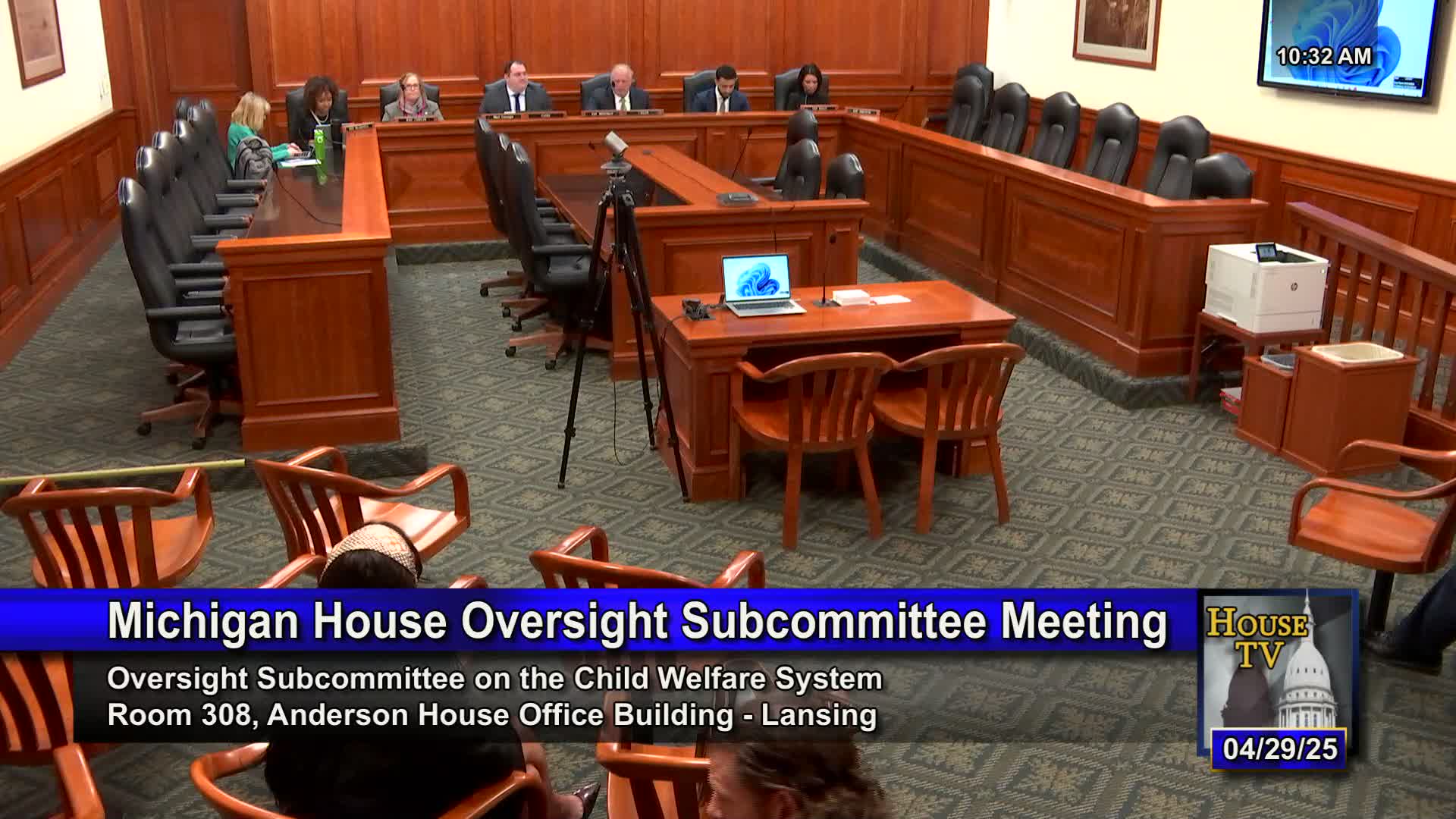
House oversight hearing details child-welfare failures after multiple deaths, audit flags
Summary
A Michigan House oversight subcommittee heard testimony from an attorney, a county sheriff and other witnesses describing multiple child deaths and systemic lapses by Children's Protective Services and MDHHS, citing an Auditor General review that the Office of the Family Advocate excluded and failed to complete dozens of child-death reviews.
LANSING — The House Oversight Subcommittee on Child Welfare System heard graphic testimony and calls for accountability as witnesses described years of missed warning signs, inadequate supervision of private placements and failures by the Michigan Department of Health and Human Services' Children’s Protective Services.
Attorney Jonathan Marco, representing the father of 3-year-old Chase Allen, told the panel that “the system needs to be fixed” after recounting that Allen’s decaying body was discovered in a basement freezer on June 24, 2022. Marco said medical records and CPS referrals showed prior serious injuries — including skull and femur fractures, brain bleeds and blindness diagnoses — that were not acted on in the months before Allen’s death.
The testimony added to accounts from other cases Marco said he represents, including a 9-year-old who drowned after placement with a private contractor, a 16-year-old who died after being restrained multiple times and a 15-year-old who took his own life while in a private facility that Marco described as “worse than a prison.” Marco said some private providers were paid significant taxpayer funds while state oversight was inadequate.
Why it matters: witnesses and committee members said the failures are not isolated. The Office of the Auditor General’s recent review of the Office of the Family Advocate — cited by the committee — found that the office excluded 150 MDHHS child-death notifications from its evaluations and did not complete 135 child-death reviews that met the office’s criteria. Members said gaps in review and response can leave children exposed to preventable harm.
Monroe County Sheriff Troy Goodenough described local cases he said illustrate the statewide problem. He told the subcommittee his office repeatedly found children living in tent and car settings in Bedford Township after central intake had been notified and described one case in which officers brought two children to the sheriff’s office, arranged motel housing through community partners and reported not receiving follow-up from CPS. Goodenough said of that file: “We called AP, Child Protective Services. Nothing.”
Goodenough also described an 82-year-old man, Ronald Montgomery, living in squalid conditions; he said local agencies and the sheriff’s office ultimately secured motel housing, a guardianship petition and placement in a county infirmary pending a planned conservatorship hearing.
Committee members repeatedly pressed witnesses about supervisory and accountability failures. Representative McDonough asked whether the department had been invited; the record shows a staff reply that the department had not been invited to that portion of the hearing and later that there is a plan to bring department officials in to respond. The subcommittee also referenced a prior Auditor General performance audit and a July 2024 follow-up that, members said, described the agency’s work as “unethical” and “dishonest.”
Several witnesses described recurring patterns: doctors or caregivers raising concerns that were closed out quickly, forensic interview procedures not followed, and private placement contractors operating with insufficient state monitoring. Marco said federal court filings in at least one matter raised questions of possible deliberate indifference by state workers.
The panel’s public testimony also included Jim Casha, who described multi-generational harms linked to prenatal alcohol exposure and urged long-term prevention and treatment efforts. Casha said the problems in child welfare go back decades and stressed prevention work focused on prenatal health.
Votes at a glance: The subcommittee approved minutes from an April 22 meeting by unanimous consent after a motion by Representative Regas. Later, Representative McDonough moved to excuse absent members; that motion also prevailed by unanimous consent. Both procedural actions were recorded during the session.
The hearing repeatedly returned to two themes: specific case failures described by witnesses and broader structural weaknesses identified in Auditor General reviews. Lawmakers said they will seek further testimony and records; at least one member indicated plans to invite department officials back to answer questions about the cases and the audit findings.
The committee adjourned after a motion to excuse absent members prevailed by unanimous consent.