Get Full Government Meeting Transcripts, Videos, & Alerts Forever!
Get email alerts on the Life Insurance topic
No spam. Unsubscribe anytime.
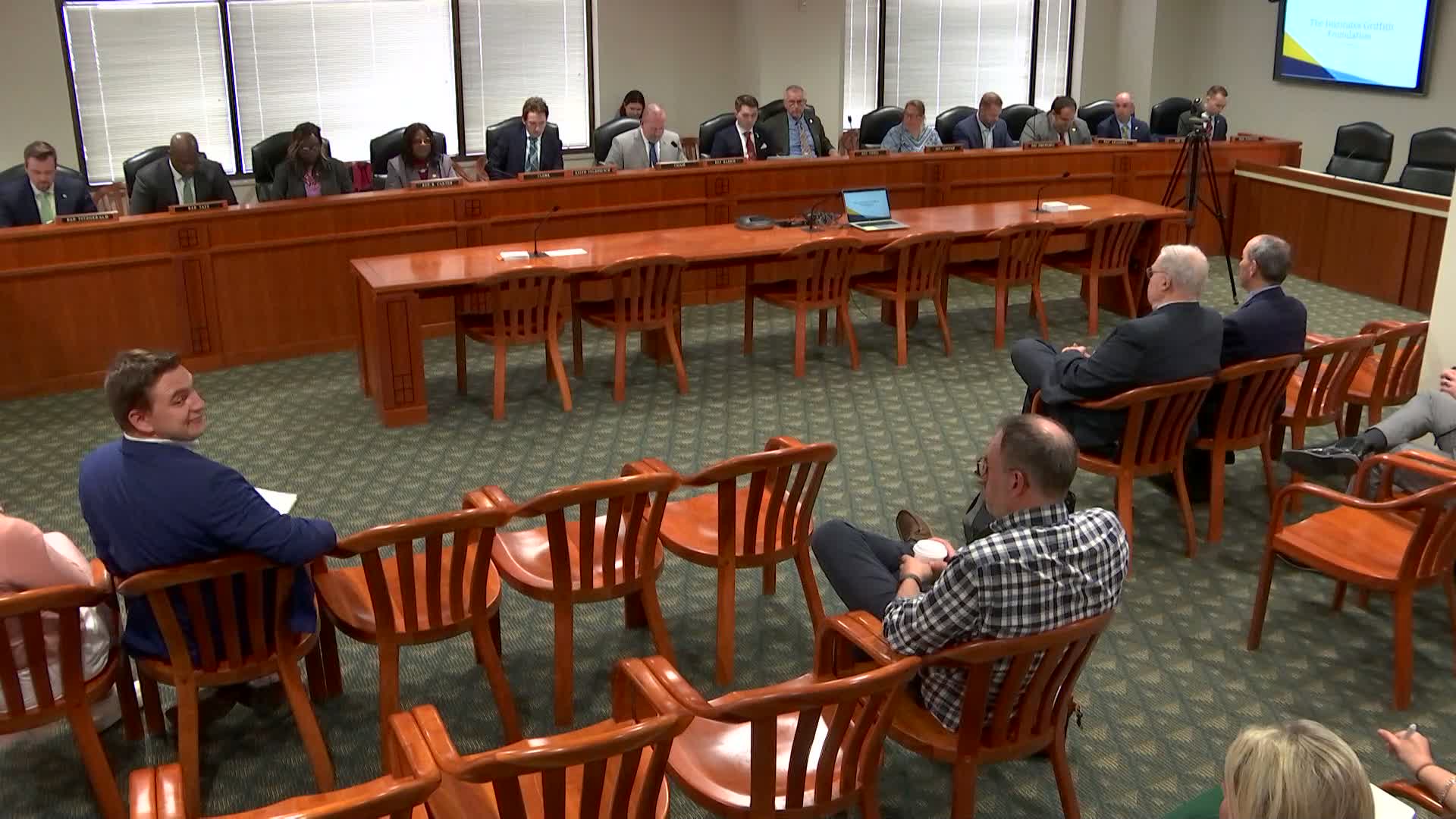
House Insurance Committee hears briefing on life insurance, annuities and regulation
Summary
The House Insurance Committee heard a detailed educational presentation from the Griffith Foundation and Dr. Robert Klein on life insurance types, annuities, solvency and market regulation, followed by committee questions on financial literacy and artificial intelligence in insurance.
The House Insurance Committee heard a briefing on life insurance and annuities from the Griffith Foundation and Dr. Robert Klein, Emeritus Professor of Risk Management and Insurance at Georgia State University, during its meeting. The presentation reviewed major life insurance product types, policy provisions, regulator roles and consumer protections, and the committee followed with questions about financial literacy and artificial intelligence in insurance.
The Griffith Foundation's Executive Director, Frank Paul Tomasello, opened by describing the group as an educational nonprofit and said its materials are provided on a complimentary, nonpartisan basis. “We are here to educate,” Tomasello told the committee.
Dr. Robert Klein described life insurance as a contract “that can do a couple of things,” stressing that “all life insurance policies provide some form of death benefit.” He summarized major product categories — term life, ordinary/whole life, universal life — and explained differences in cash-value accumulation, renewability and long-term risks. He offered a marketplace example, saying a 30-year-old male could purchase $500,000 of term coverage for about $18 a month at one source the presenter cited.
Klein walked the committee through policy features that commonly cause consumer confusion: the suicide clause (typically a one- to two-year limit before benefits are paid), nonforfeiture options on cash-value contracts, and the possibility of taking policy loans against accumulated cash value. He described annuities as “a sort of life insurance in reverse” that can create a steady stream of retirement income but warned of expense loads and trade-offs.
On regulation, Klein separated solvency oversight — the state-based monitoring of insurers’ financial condition — from market regulation, which covers product approval, marketing, underwriting and claims practices. He noted the existence of state guarantee associations and said Michigan’s association covers up to $100,000 in cash value for insolvent life insurers. Klein described the regulatory role as primarily “policing bad actors” and said the National Association of Insurance Commissioners (NAIC) and state regulators have addressed historic consumer issues, such as disclosure and producer suitability rules for complex products like universal life.
Committee members asked about financial literacy and emerging technology. Representative Carter, vice chair of the committee and chair of life insurance for the National Conference of Insurance Legislators (NCOIL), urged stronger financial education for young people: “When we're young, we don't feel we're gonna ever die,” she said, arguing earlier purchase makes coverage more affordable. On artificial intelligence, Carter asked about guardrails; Tomasello and Klein said AI is already attracting attention from regulators and industry, and both said finding “some equilibrium” between innovation and consumer protection will be necessary.
No formal committee action was taken during the presentation; members thanked the presenters and indicated they may request additional resources or follow-up briefings.
The presenters pointed legislators to free resources at GriffithFoundation.org and offered to provide deeper dives on request.