Get Full Government Meeting Transcripts, Videos, & Alerts Forever!
Get email alerts on the Veterans Services Outreach topic
No spam. Unsubscribe anytime.
Veteran tells House Families and Veterans Committee he spent 12 years before finding support; lawmakers vow better outreach
Summary
At a meeting of the House Families and Veterans Committee, Army veteran Bobby Bright described difficulty reintegrating after service and urged better advertising and peer supports; legislators pledged to pursue earlier connections to services such as the Michigan Veterans Affairs Association and American Legion posts.
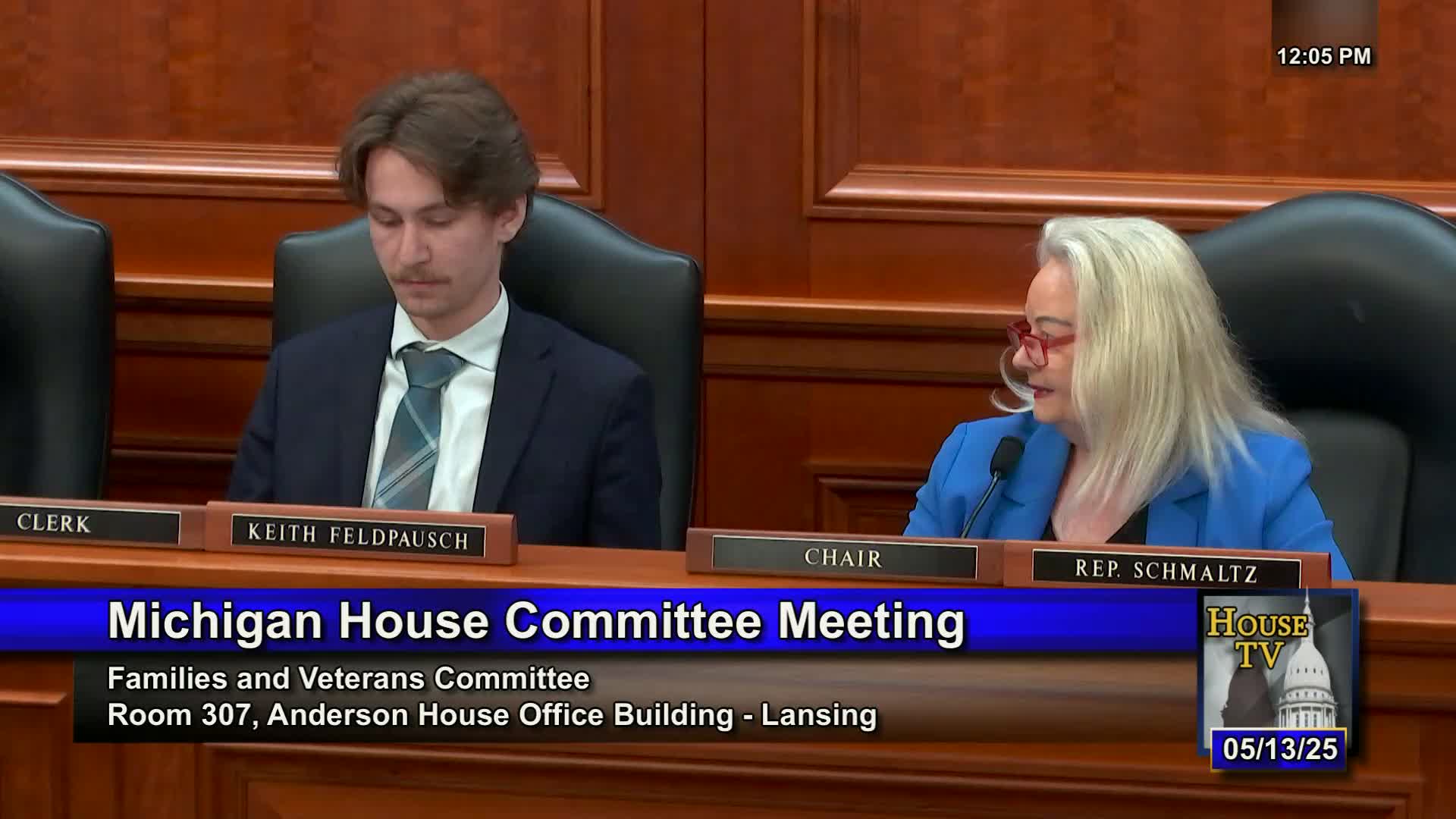
LANSING — At a meeting of the House Families and Veterans Committee, Representative Schmaltz invited Army veteran Bobby Bright to describe his experience leaving the military, and Bright told lawmakers he wandered for about 12 years before finding the American Legion as a support network.
Bright, identified by the committee as a Livingston County veteran of the year, told members that transitioning from military service can be “a huge culture shock” and described long-term emotional effects from combat and peacetime service. “You leave and you're responsible for a million dollars worth of equipment, and you can't get a minimum wage job,” Bright said. “You do have 100% of my attention” when he speaks now about those experiences.
The testimony gave committee members a firsthand look at how peer networks and veterans service organizations (VSOs) help returning service members. Bright praised the American Legion’s local posts, saying a combat-veterans peer group often focuses on everyday conversation rather than re-litigating battlefield events. “That ability to listen is huge,” he said.
The committee discussion centered on two themes: the length of time some veterans spend before connecting to supports and the need for clearer, earlier outreach. Representative Burns asked whether returning service members receive written materials or post-deployment contact; Bright replied that many veterans are effectively “back on the street” and that the gap is largely an advertising and outreach problem. “If they would put money or budget towards advertising…you would see a lot of these 12-year gaps disappear,” Bright said, referring to outreach by the Michigan Veterans Affairs Agency and related groups.
Representative Wolford said connecting veterans to benefits could draw federal dollars back to the state and described outreach as a bipartisan priority; he also asserted that veterans and their families make up “about 30%” of the community, a figure he attributed to his own view during the committee exchange. The committee did not provide a verified statistic during the meeting.
Bright also described battlefield experiences and recounted how he earned a Bronze Star after exposing himself to enemy fire during a convoy attack. He described an incident at an entry control point in Iraq that left a lasting emotional mark: “We lose our humanity. When you come home years later, you recall these events,” he said.
Committee members and Bright discussed existing organizations veterans use to reconnect, naming the Michigan Veterans Affairs Agency (MVAA), American Legion, Veterans of Foreign Wars, Vietnam Veterans of America and the National Council on Aging as partners that can guide veterans to services. Bright singled out Director Love of the MVAA for praise, saying he diverts veterans to the place that can best help them rather than prioritizing attendance figures.
Bright offered local examples: he said the Howell American Legion post grew from about 290 members in 2017 to more than 1,300 and credited peer outreach and family involvement for that growth. Committee members said they would work to make contact numbers and resource information more visible so veterans do not have to seek help on their own.
Procedural items recorded during the meeting included adoption of the May 6 minutes by unanimous consent after Representative Song moved to adopt without objection, and a later motion by Representative Johnson to excuse absent members, also adopted without objection.
Lawmakers closed the session saying they would explore ways to improve early outreach and advertising for veteran services; no new legislation or budget appropriations were proposed or voted on during the hearing.
Bright’s testimony and the committee discussion highlighted gaps in outreach and the role of community-based peer support in helping veterans reintegrate. Committee members asked staff to consider how to increase awareness of existing state and local resources so returning service members encounter help sooner rather than later.