Get Full Government Meeting Transcripts, Videos, & Alerts Forever!
Get email alerts on the Oversight Subpoena Rules topic
No spam. Unsubscribe anytime.
House Oversight panel adopts rules expanding subpoena authority, authorizes chair to subpoena Department of State records
Summary
The Michigan House Oversight Committee voted to adopt a set of additional rules governing subpoenas and depositions and authorized the committee chair to execute a records-only subpoena seeking Department of State training materials on local election administration.
The Michigan House Oversight Committee voted to adopt a set of additional committee rules covering subpoenas and depositions and authorized the committee chair to execute a records-only subpoena for Department of State materials on training of local election officials.
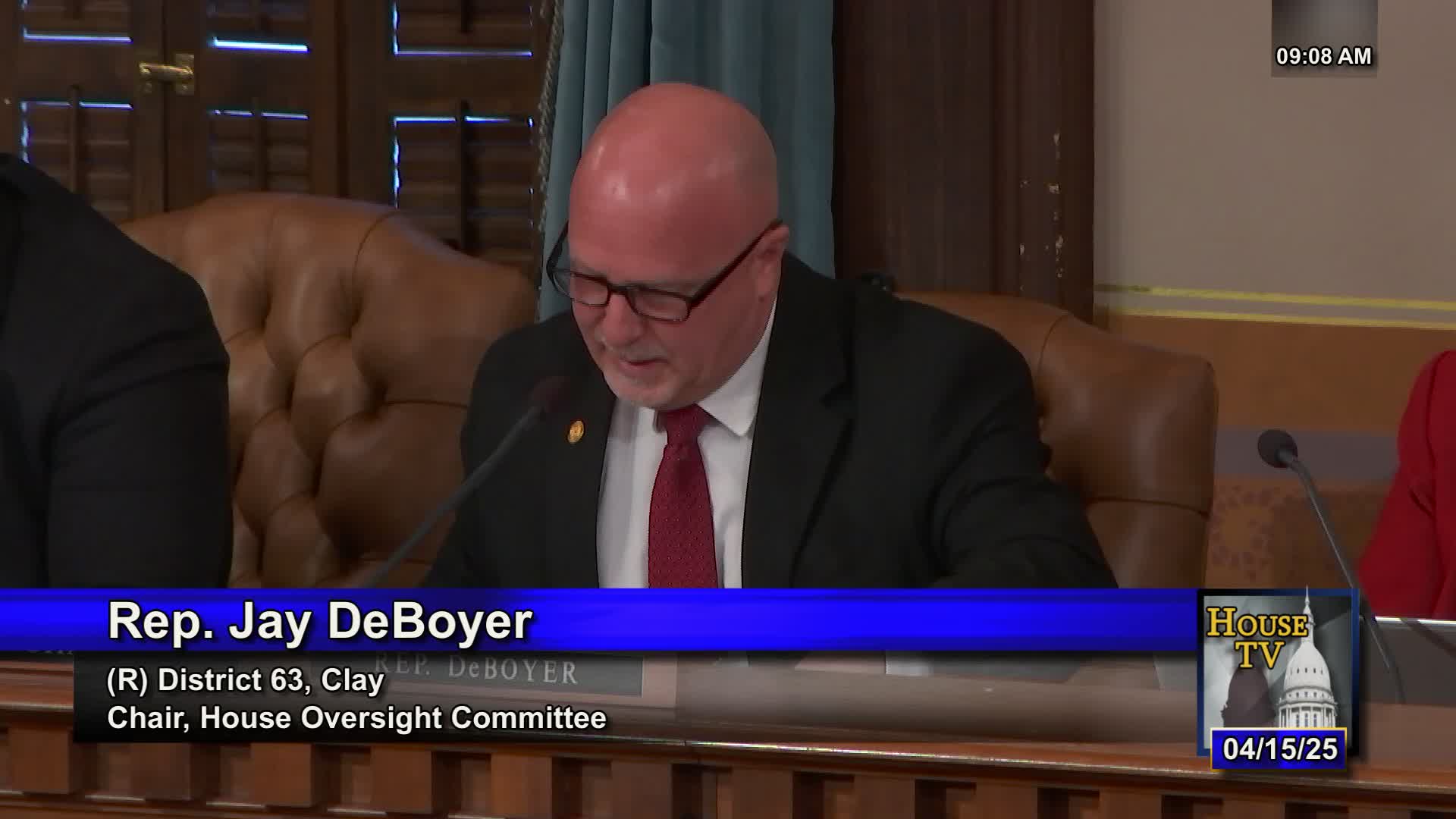
Chair Matt DeBoer, chair of the House Committee on Oversight, moved the authorization and framed it as necessary because, he said, "the Michigan House of Representatives has the right to know how Secretary of State Jocelyn Benson is instructing local election officials to conduct the elections within the state." The committee approved the rules and later approved the chair's authorization to issue a subpoena by roll call votes.
Why it matters: The committee cited repeated unsuccessful requests for the materials and said the Department of State's refusals left the committee no practical alternative. Representative DeBoer said the chair had sent letters on March 12 and April 4 seeking the documents and that deadlines set in those letters were missed. Representative Schmidt, whose earlier attempts to obtain the records were described in committee remarks, had sought the materials for roughly four months, according to the motion's recitation.
Committee members asked for specifics about how the new rules will work in practice. Representative Sarah Polanski asked whether non-deposition subpoenas would require advance notice; the chair replied that the committee would "authorize the issuance" in this meeting and that the completed subpoena would be made available to members once prepared. Several members asked about confidentiality procedures, who may attend depositions, and the scope of subpoena motion authority.
Representative Maureen Miller raised concerns about confidentiality and the deposition process, asking whether depositions would be recorded and who determines privilege; the chair responded that depositions would be transcribed by a certified court reporter and that individuals retain their constitutional rights, including privilege against self-incrimination. Representative Miller also asked whether subcommittees would obtain subpoena power; members noted House Rule 361 (as cited in the discussion) prohibits subcommittees from being granted subpoena power.
Representative Wigela and others objected to portions of the rules that give the chair or subcommittee chair the exclusive ability to move for subpoenas and to authorize who may attend depositions, saying those provisions limit rank-and-file members' ability to participate. The chair replied the rules are amendable and defended limiting attendance at depositions to create a less adversarial environment for fact-finding; he said counsel for both majority and minority would be present for depositions and that any determination on confidentiality would be discussed among the chair and counsel from both sides.
Members also pressed procedural concerns about the practical two-step process the chair described: a committee vote to authorize issuance followed by preparation of the subpoena text. Representative Caroline Conlon and others expressed worry that members could be asked to vote to authorize a subpoena without seeing the final written language. The chair said counsel would have an opportunity to reconcile the authorized scope and the written subpoena and that legal challenges in court remain available to affected parties.
Votes at a glance: - Motion: Adopt additional committee rules governing subpoenas and depositions. Vote tally: 9 yes; 2 no; 5 abstain. (Roll call listed Chair DeBoer and other members; committee recording shows final tally of 9 yeas, 2 nays, 5 passes.) - Motion: Authorize the chair of the House Oversight Committee to execute a records-only subpoena to the Michigan Department of State (seeking documents identified in letters dated March 12 and April 4, 2025, and previously requested by Representative Schmidt). Vote tally: 9 yes; 6 no; 1 abstain. The motion states the subpoena is for records only at this time.
The chair and committee members repeatedly emphasized that individuals served by subpoenas retain constitutional protections, and that subpoenas and depositions may be subject to judicial review if parties challenge them. Representative DeBoer told members that the committee's vote is a key safeguard and that, in his view, the committee — not staff or a single member — is the ultimate check on subpoenas. Members of the minority repeatedly urged changes to allow broader member motions and to broaden who may move or attend depositions.
The authorization names the party to be subpoenaed as the Michigan Department of State and/or its relevant officers, employees, or agents, including Secretary of State Jocelyn Benson and any records custodian. The motion recited prior efforts to obtain the same materials and specified the requested material as the documents requested by the committee chair in letters dated March 12, 2025 and April 4, 2025, which the motion said the Department of State had not provided by set deadlines.
Several members said they would prefer to see the final subpoena language before voting on issuance; the chair said members would be provided the completed subpoena after the committee's authorization vote and that counsel from both parties would have access during preparation. The chair also said depositions would be transcribed by a certified court reporter and that the deposition rules were modeled on federal and prior state oversight practice.
Ending note: The committee's adoption of the rules and the authorization to issue a records-only subpoena set up a likely legal review path: if the Department of State refuses production, the chair and committee counsel indicated subpoenas could be defended or challenged in court. Several members signaled they will press for future changes to the rules to expand motion rights and clarify attendance and confidentiality processes.