Get Full Government Meeting Transcripts, Videos, & Alerts Forever!
Get email alerts on the Anaerobic Digestion topic
No spam. Unsubscribe anytime.
Operator says state action and shifting rules forced Fremont digester to close, leaving manufacturers without disposal option
Summary
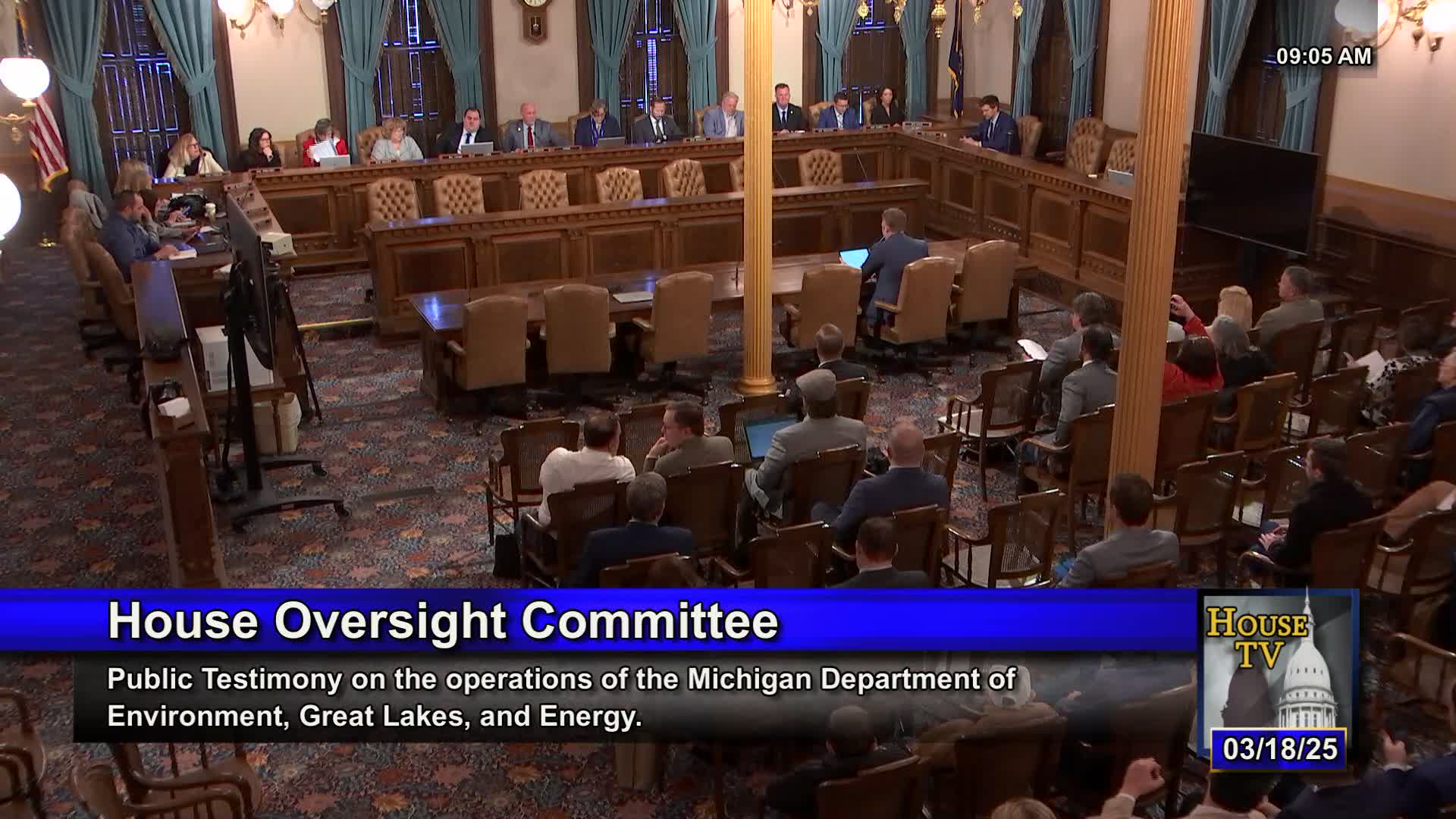
Generate Upcycle told the House Oversight Committee that Michigan regulators reclassified its digestate, imposed new permit terms and repeatedly disrupted operations; witnesses representing farms and digester projects said similar regulatory uncertainty is pushing projects out of Michigan.
Dan Masarello, vice president of operations for Generate Upcycle, told the House Committee on Oversight that his company closed its anaerobic digestion facility in Fremont after years of what he described as punitive treatment by the Michigan Department of Environment, Great Lakes and Energy (EGLE).
"EGLE has at times marginalized our business, made intimidating comments to our employees," Masarello said, describing a pattern of interactions he called "extraordinary" and a departure from the company's experience with regulators in states such as California and New York. He told lawmakers the Fremont site, acquired by Generate earlier this century, had converted food and agricultural waste into renewable electricity, renewable natural gas and organic fertilizer and supported about 20 full‑time jobs before the company announced permanent closure in late 2023.
Why it matters: Masarello said the closure wiped out a roughly $25 million investment, eliminated a local outlet for about 150,000 tons a year of food‑industry organic waste and left nearby food manufacturers with fewer options than landfill or long hauls out of state. Several lawmakers and other testifiers tied the company’s account to a wider pattern of permitting and enforcement actions that they say discourage investment in renewable‑fuel and farm‑based digester projects.
Masarello told the committee EGLE reclassified the Fremont facility’s digestate — a material other states treat as a beneficial reuse or commercial fertilizer — as an "industrial wastewater" and pressed the operation toward a groundwater discharge permitting framework that he said would require near‑drinking‑water quality treatment before land application. That change, he said, would have cut the facility’s permitted land base by 60–80% and required expensive capital investments to comply, in his estimate more than $10 million just to add treatment capacity.
James DeYoung, an agricultural consultant who has worked on nutrient management plans and said he previously worked for the Fremont digester, told the committee: "The Michigan Department of Environment and Great Lakes and Energy has become hostile to farms in Michigan." DeYoung said regulatory decisions are more frequently made without collaborative discussion, inspections are often scheduled with little notice, and some farm operators avoid speaking publicly for fear of retaliation.
Dairy manager Claire Aldering and dairy farmer Paul Windemoller described parallel concerns from livestock producers: they said many farmers feel rules and enforcement have become less predictable and more punitive, discouraging investment and making family operations harder to sustain. "The department makes it incredibly difficult, even for dairies," Aldering said.
What EGLE told lawmakers: Masarello said part of the dispute involved how EGLE and the Michigan Department of Agriculture and Rural Development (MDARD) interpret whether a digester product qualifies for agricultural use authorization or instead falls under groundwater discharge rules. Committee members asked whether EGLE had shown lab results tying the material to groundwater impacts; Masarello said EGLE "did not" present scientific findings that the facility’s applications polluted groundwater, and that the company performs extensive annual testing.
Committee context and next steps: Lawmakers pressed whether state testing after 2023 showed levels outside statutory fertilizer limits; Masarello said he could not recall specifics of every test amid years of data exchanges. Several representatives and witnesses urged clearer rules and more engagement between regulators and industry so farms and digester projects can comply without sudden, business‑ending changes.
Ending: Developers and farmers testifying asked the committee to pursue clearer, science‑based guidance and more predictable permitting so renewable organic waste projects and farm digesters can operate without sudden reclassification or enforcement actions that they say have led investors to take projects to other states.