Get Full Government Meeting Transcripts, Videos, & Alerts Forever!
Get email alerts on the Special Education Workforce Programs topic
No spam. Unsubscribe anytime.
Administrators detail Project SEARCH, paraeducator training and Mitten virtual library; ask for sustained funding
Summary
Michigan Association of Administrators of Special Education and partners briefed the subcommittee on workforce and program initiatives funded with 27J dollars, reporting program outcomes and sustainability plans and citing funding requests for continued support.
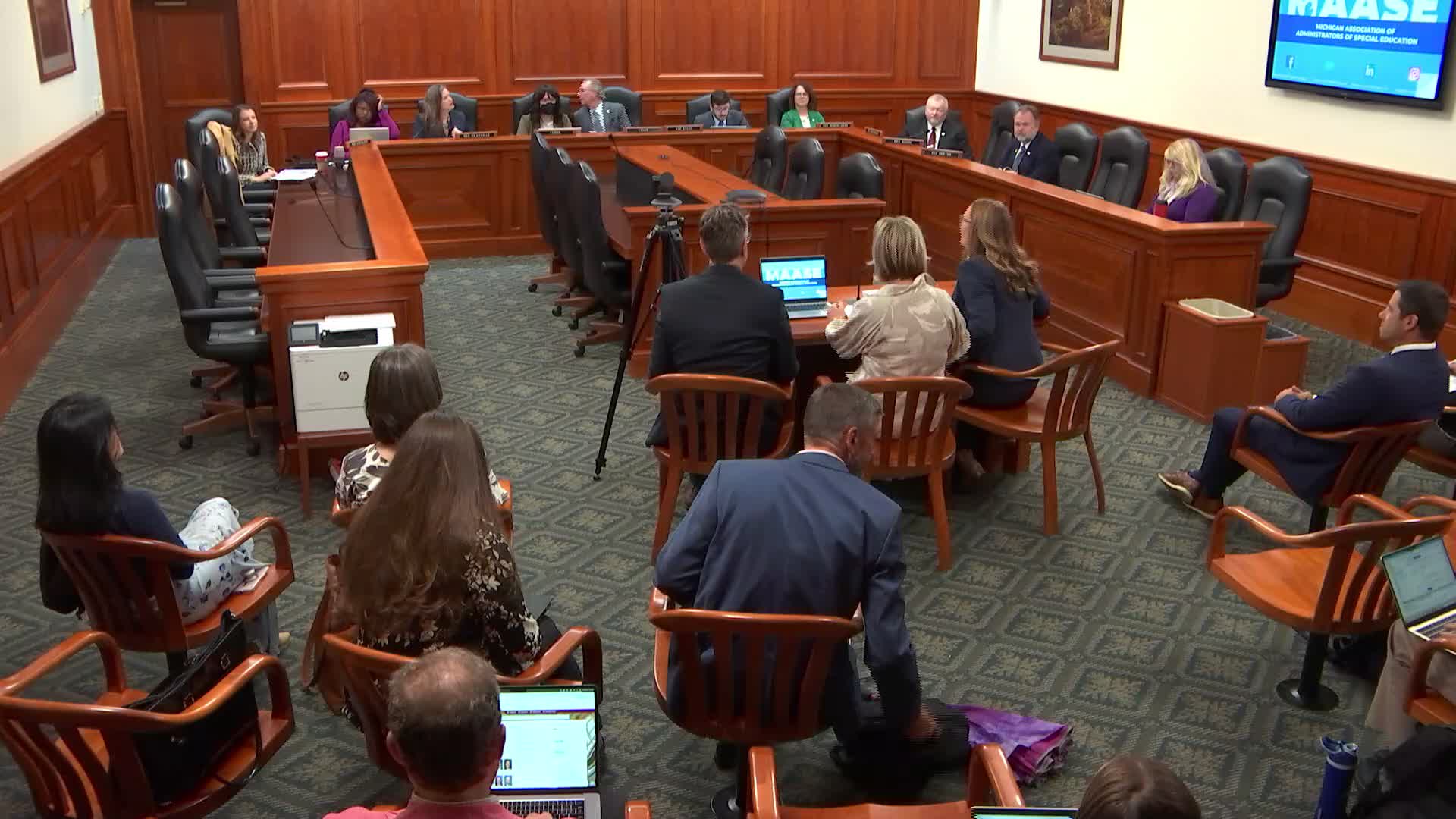
The House Appropriations Subcommittee on School Aid and Department of Education heard updates from the Michigan Association of Administrators of Special Education (MACE) on multiple special-education workforce and program initiatives that have been funded through state categorical allocations.
Abby Seifer, executive director of MACE, introduced a suite of programs funded in recent state budgets (often referenced in the hearing as "27J" funding) that MACE and partner organizations have used to support building leaders, paraeducators, special-education teachers and transitional programs for young adults with disabilities.
Project SEARCH, a one-year school-to-work internship program operating in hospital and business settings, was highlighted by statewide Project SEARCH directors Sarah Winslow and Michael Zipsak. Winslow said Project SEARCH places students in three internships inside partner businesses and reported that about "85% of the interns in Michigan have found employment," with interns averaging about 25 hours per week and earning minimum wage or higher. She said roughly 33% of partner businesses hire interns after the program and that Michigan is among the highest-performing states in the Project SEARCH network. Winslow asked the committee to continue $1,500,000 in funding that has supported Project SEARCH expansion over the past four years.
MACE representatives described workforce and professional learning programs funded under the 27J grant and related budget lines. Cheryl Marie Manson and other presenters described the Paraeducator Boot Camp, which launched earlier in 2025, and said the project has trained or scheduled training for about 1,400 paraeducators and established a statewide trainer network of roughly 385 trainers to expand capacity. Presenters said Michigan has about 16,000 paraeducators statewide and that the project aims both to upskill current paraeducators and to build pipelines using CTE programs and other Grow Your Own strategies.
MACE detailed a Developing Inclusive Leaders program designed to train building principals and other school leaders to better support inclusive instruction. The program is offered in multiple pathways, including a two-year transformation pathway with coaching, an advancing pathway and a foundations pathway of on-demand modules. Presenters said the initiative pulls coaches from partner organizations to provide ongoing support.
Presenters also described a High Leverage Practices (HLP) training effort aimed at giving novice and experienced special-education teachers common, research-based instructional tools. MACE said it is partnering with Central Michigan University and others to align pre-service and in-service instruction and to use HLP training to improve teacher retention.
MACE reported launching an alternate-route program for special-education administrator approval; the association said its first cohort (launched in January) included 29 participants, with 25 receiving a $2,500 scholarship. Presenters said the program costs $12,500 per participant compared with an average of $35,000 for university-based alternatives and that the shorter, virtual model increases access—especially in rural districts.
Christine Gullin, who oversees the Mitten virtual library (a collection of digital modules focused on life skills and independent living), described the library’s content and statewide uptake. Gullin said Mitten's virtual professional learning communities drew about 160 participants meeting monthly and that the project has published peer-reviewed studies on its modules in partnership with Michigan State University. MACE asked for ongoing support and noted a request for $3,000,000 in additional funding to sustain and expand Mitten; presenters also described plans to license content outside Michigan to create revenue for long-term sustainability.
Representatives on the subcommittee asked about program continuity if one-time funds expire. MACE speakers said some elements (for example, paraeducator trainer fees and curriculum seat licenses) could convert to tuition-based or self-sustaining models; other elements—particularly those intended to be free statewide or subsidized for rural districts—would require ongoing categorical support to remain accessible. Seifer and colleagues said they had stretched the original two-year 27J allocation across an extra year and estimated roughly $1.5 million remained available for the next grant year from the original $5,000,000 allocation.
No formal appropriation vote occurred at the hearing. Committee members thanked presenters and indicated interest in seeing follow-up materials and budget details before any funding decisions.