Get Full Government Meeting Transcripts, Videos, & Alerts Forever!
Get email alerts on the Prevailing Wage Implementation topic
No spam. Unsubscribe anytime.
Contractors warn prevailing-wage implementation is driving bid risk; LEO says rulemaking and education underway
Summary
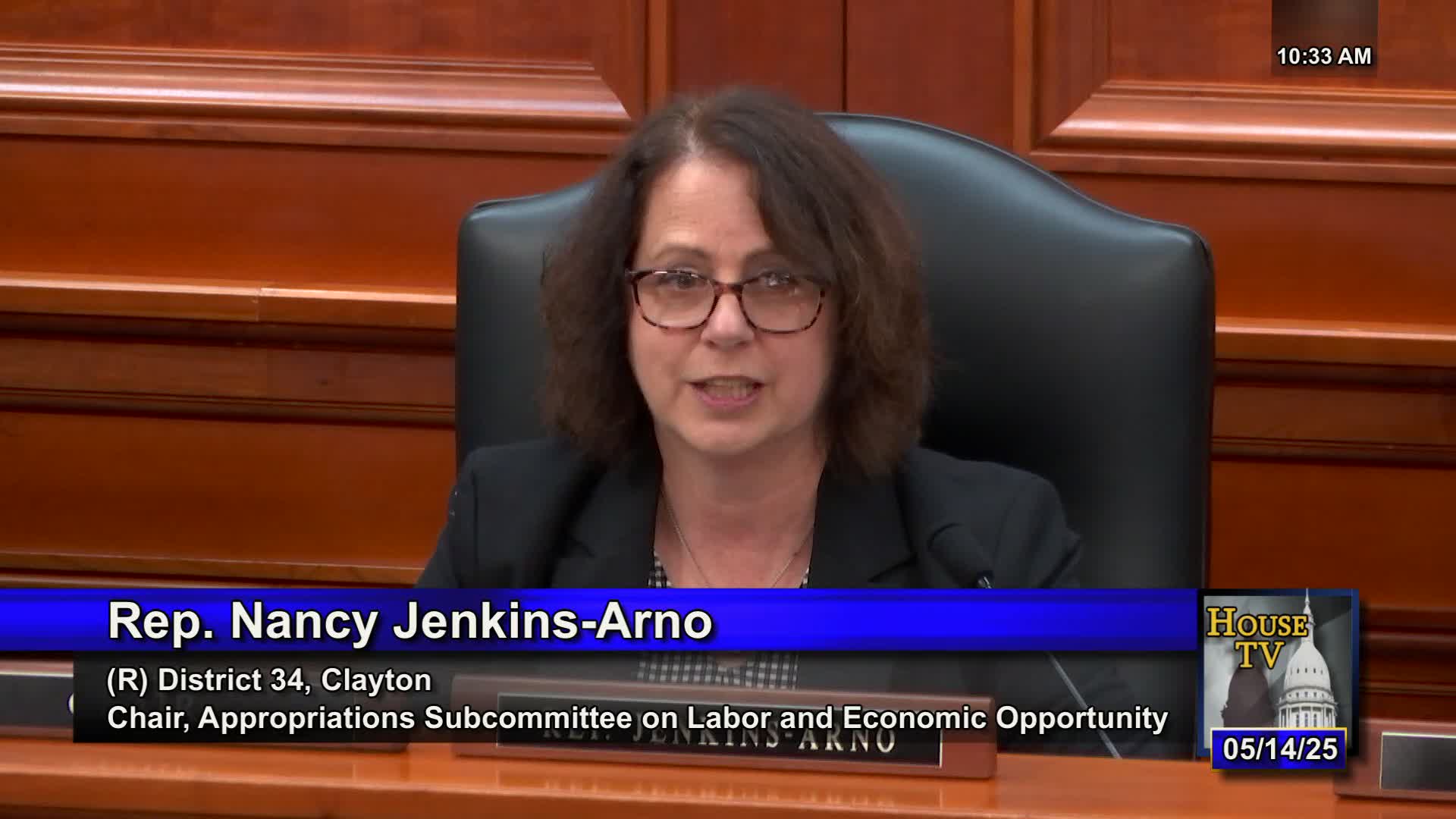
Contractors told the House Appropriations Subcommittee on Labor and Economic Opportunity that uncertainty in Michigan's prevailing-wage implementation, combined with steep penalties and data-privacy risks, is discouraging many firms from bidding on public projects.
LANSING — Contractors told the House Appropriations Subcommittee on Labor and Economic Opportunity that uncertainty in Michigan's prevailing-wage implementation, combined with steep penalties and data-privacy risks, is discouraging many firms from bidding on public projects.
"Prevailing wage is the law," said Shane Hernandez, president of Associated Builders and Contractors of Michigan, testifying to the committee. "But ... our members who are nonunion — who are 80% of Michigan's construction industry — are not comfortable bidding projects that are prevailing wage" because of perceived legal and administrative risk.
The concern centers on several features of the new state law, including an extensive rate schedule, the absence of finalized administrative rules, a preregistration requirement that contractors say collects sensitive employee data, and a statutory enforcement structure that industry witnesses described as heavily penalty-oriented.
Hernandez and Jeff Toyer, an attorney with Foster Swift who represents ABC members, told lawmakers the official rate schedule equates to roughly 14,150 pages of classifications and that the absence of clear administrative rules leaves contractors unclear about issues such as how to calculate fringe-benefit equivalents. "I could file an anonymous complaint on everybody," Hernandez said, warning that anonymous and third-party complaints could lead to costly investigations.
Toyer described multiple sources of potential enforcement under the statute, citing the Commissioner of LEO's authority, county prosecutors, and contracting agents; he highlighted sections of the law that permit civil penalties of up to $5,000 per violation and an additional 10% penalty in some circumstances. "There's a whole pile of [penalties]," Toyer said, and he urged regulators to use rulemaking to narrow enforcement to willful or non-de minimis violations.
Toyer recounted a prior dispute in which an electrical contractor on a $3,900,000 project was found to have underpaid a single employee by $10.56; he used the example to underline his clients' concern that technical or narrow errors can produce disproportionate enforcement exposure.
Labor and Economic Opportunity officials responded that outreach, education and rulemaking are the division's priorities as they implement multiple recent changes to wage-and-hour laws. "Our mission is to educate employers and employees so that they are acting in compliance," said Brennan Smith, deputy director of legislative affairs for LEO. "We believe in ongoing education and not enforcement, as the way to ensure compliance."
Andrew Noginski, administrator of LEO's Wage and Hour Division, said the agency has begun rulemaking and is working to clean up rate data ahead of publishing proposed rules and system changes. Noginski said the prevailing-wage database will reuse an existing state contract used by MDOT to collect certified payrolls and that the division plans to publish draft rules and gather stakeholder input before formal hearings. "We want to bring folks together so we have it right the first time," he said.
Noginski and LEO staff described operational steps intended to reduce the regulatory burden on contractors: targeted FAQs and webinars, a database for certified payroll submissions, outreach to contracting agencies and a goal of shortening case resolution times. "On average, 92% of our claims that were received are solved ... without the need for formal enforcement action," Noginski said, adding that the division currently aims to resolve cases within 90 days and hopes, with staffing increases, to reduce that to 45 days or less.
LEO officials acknowledged specific industry concerns flagged by ABC: potential misuse of employee data contained in certified payrolls (the statute requires retention and submission of payroll records), the impact of anonymous or third-party complaints, and how technical posting or paperwork failures might be treated in enforcement. Noginski said rulemaking and stakeholder engagement would address many of those issues, including possible de minimis exceptions, limits on penalties for good-faith or technical errors, and record-retention practices tied to investigations.
Committee members pressed both sides on the practical effects. Representative Ann Martis asked ABC to describe differences between the state prevailing-wage framework and the federal Davis-Bacon Act; Hernandez and Toyer said Davis-Bacon is more familiar to many contractors because regulations and long-standing guidance make expectations clearer. Representative John Robinson and other members asked LEO to explain how its educational-first approach to enforcement works; Noginski replied that the division uses complaint investigations as opportunities to educate employers and claimants and that formal penalties are not the division's primary goal.
The committee did not take substantive votes on policy changes. It approved the minutes of its May 7 meeting at the start of the session without objection.
Lawmakers and witnesses said they expect the rulemaking process and LEO's system changes to be central to whether contractors regain confidence to bid on public projects. LEO officials told the panel they welcome stakeholder participation in drafting rules and testing the planned database before formal adoption.