
Michigan licensing agency outlines bureaus, rule changes and new licensing needs to House appropriations subcommittee
Get AI-powered insights, summaries, and transcripts
Subscribe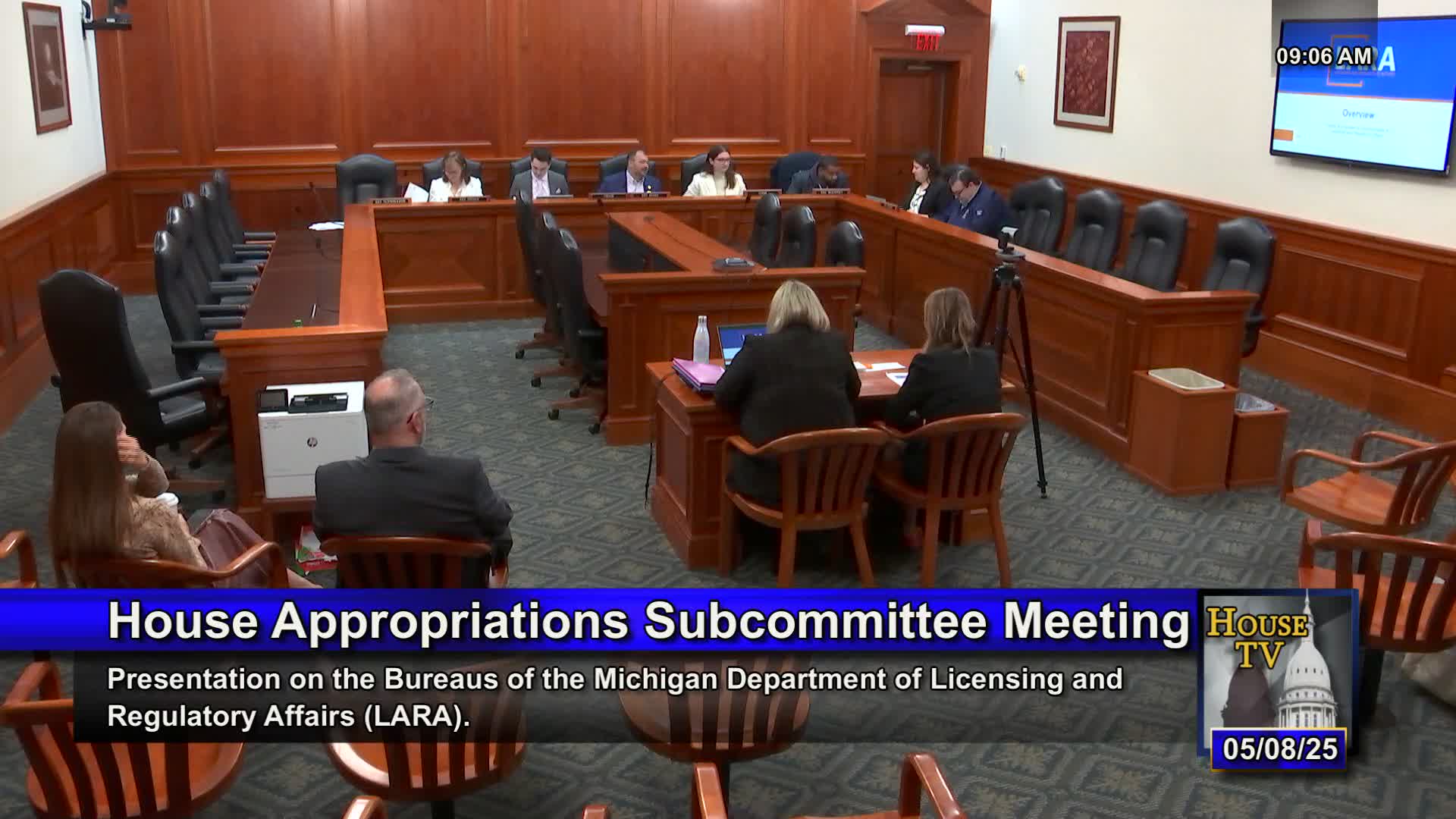
Summary
Paige Fultz, director of the Office of Policy and Legislative Affairs at the Michigan Department of Licensing and Regulatory Affairs (LARA), told the House Appropriations Subcommittee on Licensing and Regulatory Affairs, Insurance and Financial Services that LARA directly serves nearly 2,000,000 individuals and entities and is pursuing statutory and rule changes to reduce regulatory burdens.
Paige Fultz, director of the Office of Policy and Legislative Affairs at the Michigan Department of Licensing and Regulatory Affairs (LARA), told the House Appropriations Subcommittee on Licensing and Regulatory Affairs, Insurance and Financial Services that LARA directly serves nearly 2,000,000 individuals and entities and is pursuing statutory and rule changes to reduce regulatory burdens.
The presentation laid out LARA’s organizational structure and priorities and why they matter to lawmakers responsible for funding and statutory oversight: the department administers professional and facility licensing across multiple bureaus that together affect health facilities, construction codes, professional licensing, commercial licensing and several independent agencies.
Fultz said LARA was established in 1965 (originally as the Department of Commerce), renamed LARA in 2011, and now comprises regulatory bureaus, type 1 (autonomous) agencies and central services. She described four strategic goals: reducing barriers to licensure, improving regulatory compliance through education and consultation, providing timely services, and enhancing the customer experience.
Fultz summarized bureau-level responsibilities and notable figures: the Bureau of Community and Health Systems (BCHS) licenses more than 3,500 adult foster care facilities that serve almost 32,000 residents; BCHS is proposing to streamline six administrative rule sets that currently total about 120 pages (about 206 rules) into a proposed replacement of roughly 39 pages and 73 rules. The Bureau of Survey and Certification (BSC), established in 2022, oversees the federal survey and certification process performed on behalf of the Centers for Medicare & Medicaid Services for more than 20 provider types.
The Bureau of Construction Codes (BCC) enforces construction-related statutes and 23 administrative rule sets and staffs 11 boards and commissions with responsibilities that range from residential building to elevators, boilers and manufactured housing enforcement. Fultz noted BCC’s recent survey work on re-monumentation related to the Michigan–Indiana border and that manufactured housing community complaints remain a frequent legislative inquiry.
Fultz described the Bureau of Fire Services (BFS) responsibilities including code adoption and the issuance of certifications to sell fireworks; LARA has received more than 680 fireworks certification applications so far this year. The Bureau of Professional Licensing (BPL) enforces the Michigan Occupational Code and the Michigan Public Health Code and regulates roughly 792,000 licensees. Fultz told the committee that the sunset of Michigan’s participation in the Interstate Medical Licensure Compact requires BPL to prepare to leave the compact by March 20 of next year; in the presentation LARA referenced that the change would affect 3,255 MDs and 517 DOs in Michigan (transcript phrasing of the date was unclear in one place).
On commercial and corporate filings, the Corporation, Securities and Commercial Licensing (CSCL) bureau administers licensing for 42 industries across 11 statutes and handles corporate formation filings and complaint investigations. Fultz highlighted that the legislature created two new license types last year for the death care industry (deceased removal services and refrigerated transport/removal), and LARA requested $300,000 in state restricted revenue and two full-time equivalents to support licensing and compliance for that new industry. When asked by Rep. Beeson whether the new licenses would be self-sustaining, LARA replied it is the plan that fees would cover those positions.
During questions, committee members pressed for additional detail about board appointment processes, the number and composition of boards overseen by specific bureaus, and which appointments require advice and consent. LARA staff said statutory language typically establishes boards and that the department manages boards’ administrative functions while appointment and term length details are governed by statute and the appointments office. Committee members asked LARA to provide a complete list of boards, their membership counts, and which appointments go through legislative advice and consent.
No formal policy votes were taken on licensing proposals at the meeting. The subcommittee approved the minutes of its April 24, 2025, meeting without objection earlier in the session.
The presentation concluded with LARA offering to work with legislators on the department’s “red tape” recommendations and to provide follow-up lists and data requested by members.
Next steps: LARA provided committee members with the red‑tape report referenced during the presentation and said it would supply detailed lists of boards, the precise text of proposed rule reductions and further information on the new death‑care licensing revenue model upon request.