Get Full Government Meeting Transcripts, Videos, & Alerts Forever!
Get email alerts on the Child Welfare Consent Decree topic
No spam. Unsubscribe anytime.
MDHHS tells appropriations subcommittee it has cut monitored child-welfare requirements and aims to exit 17-year consent decree
Summary
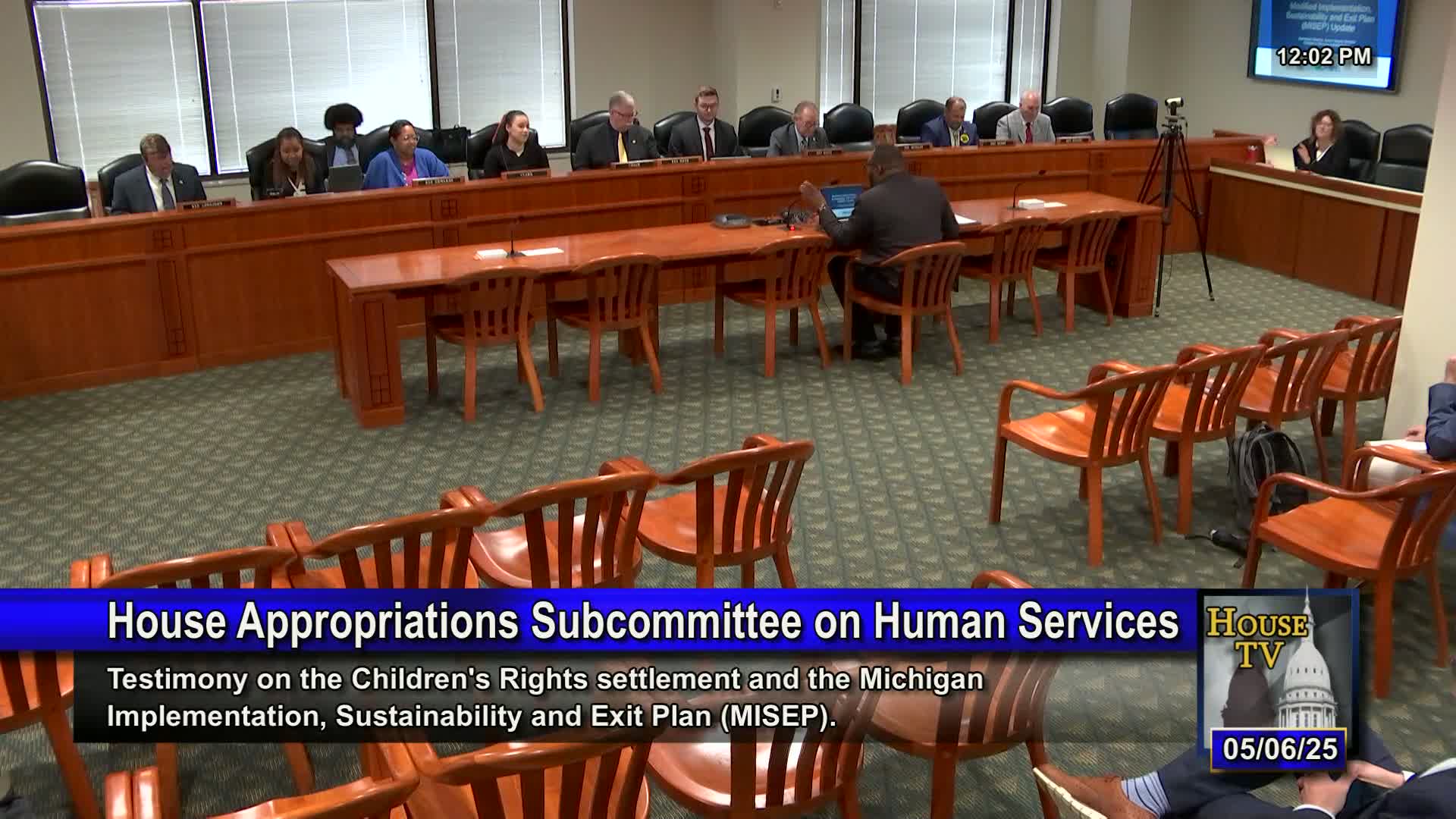
Demetrius Starling, senior deputy director for children's services at the Michigan Department of Health and Human Services, told the House Appropriations Subcommittee on Health and Human Services that structural changes and targeted spending have reduced the number of consent-decree provisions under active monitoring and moved the state closer to exiting a 17-year federal oversight arrangement.
Demetrius Starling, senior deputy director for children's services at the Michigan Department of Health and Human Services, told the House Appropriations Subcommittee on Health and Human Services during a committee meeting that the department has reduced the number of consent-decree provisions under active monitoring and is targeting an exit from federal court oversight within the next one to two years.
Starling said the department renegotiated and streamlined the long-running lawsuit settlement, noting that a stipulated order signed in January 2024 removed 31 provisions and reduced monitored items to 23. "We've been able to achieve more than 20% of the measures in a stipulated agreement in less than one year," Starling said.
The presentation outlined structural changes MDHHS said it has implemented since the original class-action lawsuit was filed in 2006 and the initial settlement in 2008: a division of continuous quality improvement, a statewide centralized intake unit for reports of abuse and neglect, a maltreatment-and-care division, enhanced oversight of congregate care facilities, and new permanency-focused roles such as Permanency Resource Monitors and an executive strike team. Starling said those changes were partly funded through legislative resources and departmental reallocations.
Why it matters: Michigan has been under court supervision related to the children's-rights lawsuit for 17 years. Starling told the committee that improvements in permanency, safety and other federal outcome measures make an eventual exit from oversight possible and would let MDHHS concentrate more resources on direct child-safety services rather than court reporting.
Key metrics and program changes cited by MDHHS included a decline in the foster-care population from more than 19,000 in 2008 to about 9,300 today; a drop in children placed in congregate care from more than 1,200 to roughly 350; and a reduction in reported restraints in congregate care from about 900 per month to roughly 350 per month. Starling said the permanency rate in a six-county pilot rose from 9.9% to 22.3% when comparing January–June 2023 with January–June 2024.
Starling described the department's approach to maltreatment-in-care (MICEP) requirements and remediation: MDHHS set a target victimization rate of less than 9.07 per 100,000 foster-care days, and in 2024 developed a statewide remediation plan that includes improved investigative tools, technical assistance to private child-caring institutions, supports for relative caregivers and expanded training. "We're putting that into action right now," Starling said of the remediation plan.
Committee members pressed for detail on monitoring and spending. Vice Chair Edwards asked whether the five areas that exceeded standards and the 26 areas being monitored referred to the current reporting period or the full 17-year history; Starling said the counts refer to the full history and offered to provide a crosswalk listing which stipulations have been removed. Representative Longjohn asked for a definition of "permanency;" Starling said it means "being in a placement where we don't foresee any disruption," which may include reunification, adoption, kinship care or independent living, and noted the 9.9% figure was the benchmark the department had to exceed for the pilot cohort.
On budget questions, committee members asked how roughly $10 million in last year’s fiscal budget is being used to support exit from oversight. Starling said about $5 million of that was designated for adoption subsidies and had not yet been spent; other funds have been used for kinship supports, expansion of team decision-making with enhanced treatment foster care, regional trainings, discretionary county funds to address urgent needs, supports for independent living and transitional housing, and targeted kinship training and placement-collaboration capacity.
Starling acknowledged continuing gaps and documentation problems: he said improvements in medical screenings and behavioral-health connections have been implemented but that documentation—such as records showing consent and monitoring for psychotropic medications—has not always been complete. "We're getting those kids tapped into therapy...We're just not doing the best job. We haven't done the best job in documentation," he said.
No formal committee action was taken on the department's agreement or exit strategy during the meeting; members requested additional detail and crosswalks for the committee record and noted the department will check in with the court and plaintiffs on July 14, a date Starling said was set for the next status review.
The committee heard the presentation and followed with questions about metrics, documentation, and program spending; members asked MDHHS to provide a more detailed crosswalk of removed and remaining stipulations and to return with additional documentation on how budgeted funds are being spent to support permanency and maltreatment prevention.
More background: Starling told the panel that federal court-appointed monitors Kevin Ryan and Eileen Crummey, representing Public Catalyst, continue verification activities and report to the federal court. He said the average lifespan of child-welfare lawsuits nationally is about 17 years and that 21 jurisdictions are under court oversight nationally. He emphasized the department's goal to "overachieve" benchmarks in some areas and to establish post-exit monitoring that prevents backsliding.
(For readers: the presentation and questions took place during the House appropriations subcommittee session; the committee approved its April 22 minutes by unanimous voice consent earlier in the meeting.)