Get Full Government Meeting Transcripts, Videos, & Alerts Forever!
Get email alerts on the Aquatic Invasive Species topic
No spam. Unsubscribe anytime.
Bonner Soil & Water asks county for $20,000 to support invasive-species checkpoints, streambank repairs and community programs
Summary
Bonner Soil and Water Conservation District presented its annual programs to Bonner County commissioners, described expanded boat-inspection activity for aquatic invasive species, outlined a Pack River streambank stabilization project and requested $20,000 in county support to leverage larger state matches and grants.
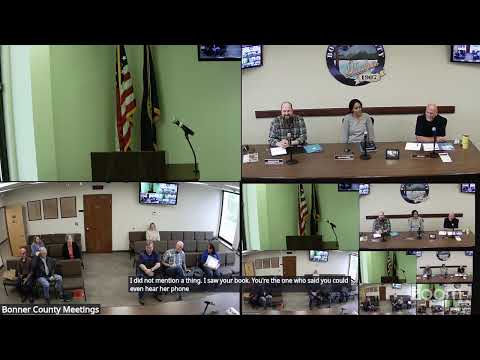
Bonner Soil and Water Conservation District asked Bonner County commissioners on Thursday for $20,000 in fiscal-year 2026 support to help sustain its watercraft inspection program, grant writing and local conservation projects, including a streambank stabilization project on the Upper Pack River.
The request would supplement the district’s guaranteed state allocation of $14,500 and, the district said, unlock a larger state match that helps fund staff, seasonal inspectors and project work. "We are bringing back almost $500,000 in payroll dollars to our community through the grants and projects that we do," said Sarah Garcia, executive director of the conservation district.
Why it matters: the district operates three county boat-inspection stations that the presenter said accounted for about 28% of Idaho’s inspections last year and that are a frontline effort to slow the spread of quagga/zebra mussels and other aquatic invasive species (AIS). Commissioners pressed for details on costs, enforcement and program effectiveness; presenters said funding from the county increases the district’s ability to obtain state matching dollars and federal grants.
Garcia described the district’s work in outreach and stewardship: school programs and events that reach roughly 2,000 students annually, a seedling program that supplies about 190,000 native conifer seedlings to local landowners each year (bundles range from small to several thousand), and a food-incubator project supported by a USDA business-development grant that helps local producers rent commercial kitchen space. "We are very much community program based," Garcia said.
On AIS, Garcia told commissioners the district runs three inspection stations at Albany Falls, Samuels and Clark Fork, employs about 23–26 seasonal workers for those stations and processed roughly $70,000 in sticker sales that help support the program. She said Samuels and Albany Falls were averaging about 300 boats per week early in the season and that boats coming into the county made up a large share of Idaho-bound watercraft in the district’s last-year demographic snapshot. The district reported three local detections that were not viable, and noted more detections in other parts of Idaho.
Commissioners raised enforcement and cost concerns. A county commissioner asked, "Can we really stop it?" and answered during discussion that prevention is not guaranteed; Garcia and other speakers said the stations are intended to reduce risk rather than eliminate it. Garcia also described reliance on an overtime memorandum of understanding for sheriff support at some stations and asked for better coordination and information from the Idaho State Department of Agriculture (ISDA) on outreach materials.
Garcia summarized grant and project work the district manages: a DEQ-funded agricultural best-management (BMP) restoration grant used for streambank hard crossings and willow plantings; a National Association of Conservation Districts (NACD) community agriculture grant for school gardens and food access; and an EPA-derived clean-water grant administered through the state for the Upper Pack River Banks Stabilization Project (a March 2019 grant). The Pack River project was described as roughly $90,000 in total cost, with Bonner County Road & Bridge committing $15,000, a landowner contributing $5,000 in cash plus in-kind materials, and about $54,000 coming from grant dollars; the remainder would be in-kind district oversight and labor. Garcia said the project is on bull trout habitat, requires a "no-rise" permit from the county and must be built in a narrow seasonal work window; the district expected a funding letter in June and is awaiting final permitting.
Board members who attended introduced themselves and reiterated local volunteer capacity. "We're an agency that works with the people that are here, and we don't throw away anybody," said Dale Vanesso, chairman of the district board.
Commissioners asked the district to email metrics showing how many boats bypass inspection stations, state-match scenarios for several county-support levels (for example $18,000–$22,000), and documentation of grant matches and timelines. One commissioner said they would compile comparison figures and return them to the district by the end of the week.
The district noted that the state and federal grant structure, plus AIS sticker revenue (a large share purchased by out-of-state boaters), reduce the per-local-taxpayer burden of the inspection program, but that county support is important to maintain staffing levels needed to pursue grants and manage projects. No formal county vote or appropriation occurred during the presentation; commissioners took the request under advisement and asked for follow-up materials.
The presentation also included descriptions of the district’s education programs (forestry contest, water festival), seedling sales (priced about $1.10 per seedling), and partnerships (Kootenai-Ponderay Sewer District willow nursery, University of Idaho College of Natural Resources scholarships and partners). Garcia offered to provide commissioners with daily inspection tallies, detection locations and other operational links for the inspection stations.
The district asked the county to consider the $20,000 request for FY26 to sustain staffing and to preserve the district’s ability to leverage state matches and federal grants that support local projects and AIS prevention. The commissioners requested additional documentation and a state-match projection before taking a funding decision.