Get Full Government Meeting Transcripts, Videos, & Alerts Forever!
Get email alerts on the Mdard Budget Biosecurity Diagnostics topic
No spam. Unsubscribe anytime.
MDARD asks appropriators for funds to boost biosecurity, diagnostics and freshwater programs
Summary
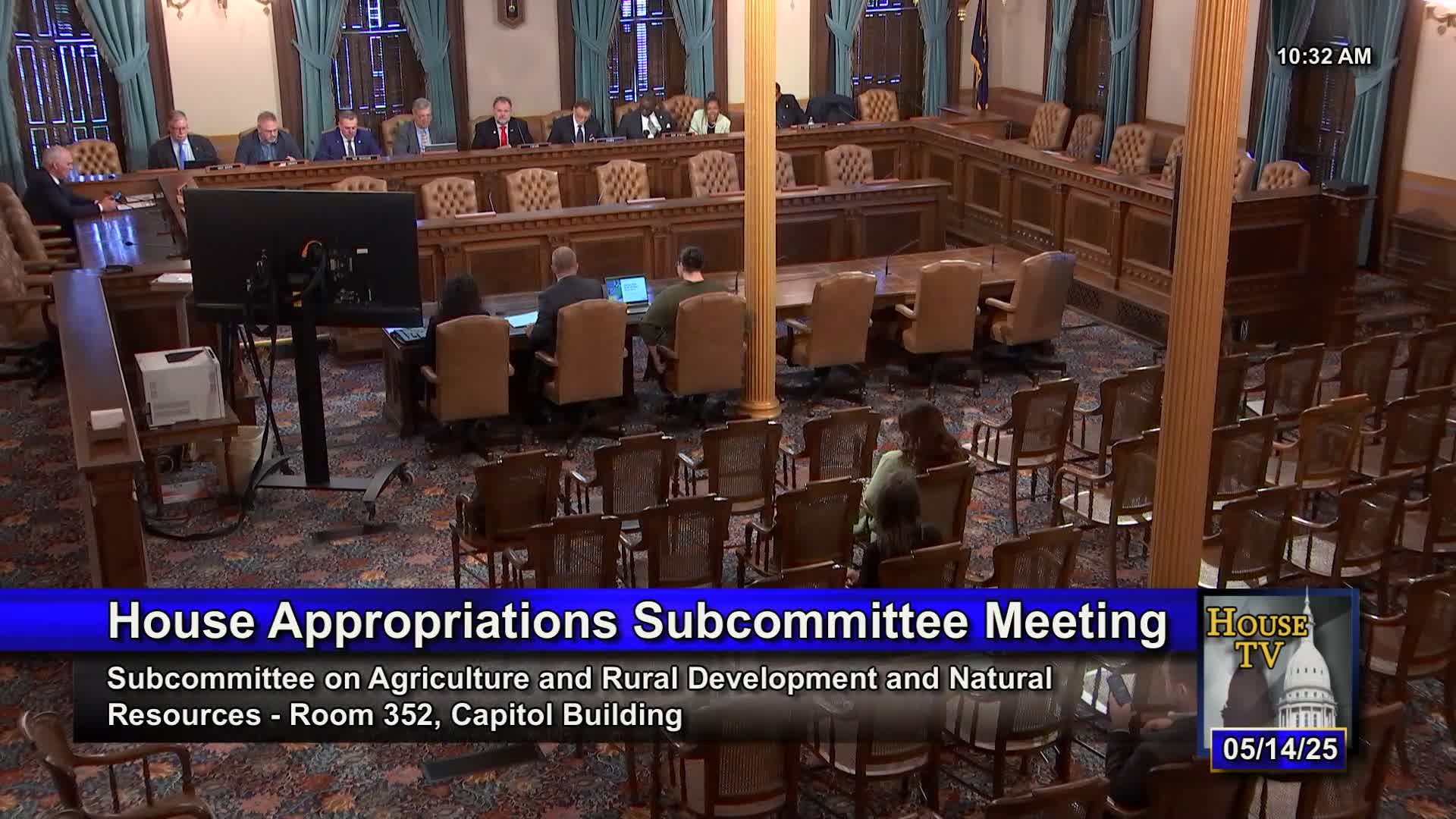
Director Tim Boring of the Michigan Department of Agriculture and Rural Development told the House Appropriations Subcommittee on Agriculture and Rural Development and Natural Resources that the department’s recommended budget would prioritize biosecurity, plant and soil diagnostics, export certification capacity and reauthorization of the Freshwater Protection Fund.
Director Tim Boring of the Michigan Department of Agriculture and Rural Development told the House Appropriations Subcommittee on Agriculture and Rural Development and Natural Resources that the department’s recommended budget would prioritize biosecurity, plant and soil diagnostics, export certification capacity and reauthorization of the Freshwater Protection Fund.
Boring said Michigan’s agricultural profile is changing and warned of falling crop diversity: “We are now listing 200 commodities produced here in Michigan … rather than the 300 we would have used weeks or months ago,” he said, citing U.S. National Agricultural Statistics Service thresholds.
The nut graf: the department framed the budget ask as investments to protect the state’s food supply, support farm-level disease response and keep more testing and technical expertise in Michigan. Those steps are intended to preserve market access for growers and reduce costs for farmers who now ship soil and plant samples out of state for analysis.
Most immediately, Boring tied the request to lessons learned from recent animal-disease responses. He described the department’s work during outbreaks of highly pathogenic avian influenza (HPAI) and a separate dairy response last year as drivers for expanded biosecurity investment. MDARD is seeking both one-time and ongoing funds to expand testing capacity for plant, soil and pest diagnostics and to increase services that certify exports are pest-free, he said.
The budget narrative also asks to raise the administrative cap on grants from the state’s rural development fund, which Boring said is supported by mining severance revenues from the Upper Peninsula. “Adjusting this cap … is gonna have direct benefit and results for the people of Michigan,” he said, describing fund uses such as infrastructure and business development in rural communities.
Boring described the Freshwater Protection Fund — financed in part by assessments on fertilizer and pesticides that he said have historically been about $1 per ton — as a program that comes up for reauthorization periodically and helps fund conservation-district technical assistance and “Clean Sweep” pesticide recycling. He told legislators stakeholders including farm groups and environmental organizations have engaged around how to balance costs and benefits before any reauthorization.
The director also promoted in-state soil-health testing and specialized interpretation tailored to Michigan cropping systems, saying current practices require farmers to ship samples to other states for analysis. “If you’re a farmer, you’re shipping that soil sample to Missouri or North Dakota or New York for testing,” he said; keeping testing in Michigan, Boring said, would allow recommendations specific to Michigan crops and help farmers reduce fertilizer costs.
Boring highlighted complementary investments in regenerative agriculture and workforce development, including a partnership to use the VFW national home demonstration farm in Eaton Rapids — a roughly 600-acre site, he said — to link veterans and other workers to climate-smart agriculture and training. He said MDARD is coordinating with Michigan State University’s Center for Regenerative Agriculture to avoid duplicative programs.
Committee members pressed Boring on several related items during Q&A: Representative Green asked about fee increases related to MDARD’s meat program and whether the department would reprioritize to avoid burdening producers; Boring described stakeholder conversations around the Freshwater Protection Fund and said past changes had shifted more costs onto pesticide manufacturers rather than directly onto farmers. Representative McKinney asked about state involvement in food labeling and lab-grown meat; Boring said Michigan already performs significant federal food inspection work and that conversations about labeling and trust in labels are ongoing with federal partners.
Boring noted MDARD’s small share of the state budget (about 0.18%) while outlining the department’s four bureaus and a wide array of consumer-protection, food-safety and environmental work ranging from dairy and produce inspection to laboratory services.
Discussion vs. decision: the presentation was an informational budget briefing and generated no formal committee votes or directives beyond a general invitation from MDARD to meet with legislators and hold small roundtables. Legislative liaison Mikaela Heffernan was identified by Boring as the subcommittee contact for follow-up and district outreach.
The department did not present final figures for all requests during the hearing; Boring said some proposals include combinations of one-time and ongoing funding and that stakeholder engagement on the Freshwater Protection Fund will continue.
The subcommittee did not take action on the budget during the session; members thanked MDARD for the presentation and indicated they would follow up as the budget process continues.