Get Full Government Meeting Transcripts, Videos, & Alerts Forever!
Get email alerts on the Public Notice Policy topic
No spam. Unsubscribe anytime.
LPA backs tighter public‑notice rules for rezonings and major land use hearings
Summary
The Local Planning Agency recommended changing town rules so applicants — not staff — must provide mailed and posted notice ahead of public hearings for rezonings, large developments and similar requests; the change standardizes notice content, requires photographic proof and aims to improve transparency.
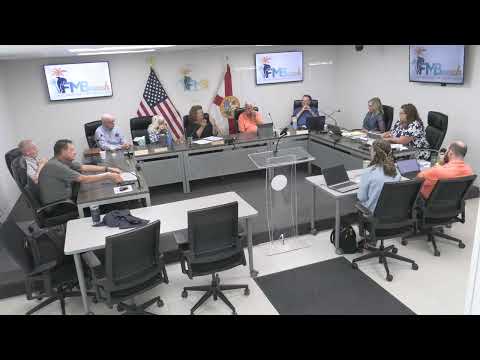
The Fort Myers Beach Local Planning Agency on May 13 recommended that the Town Council adopt an ordinance requiring applicants to provide mailed and posted public notices for rezonings, development agreements and CPDs, with photographic proof supplied to the town before the hearing.
Under the proposed amendment staff presented to the LPA, applicants (or their agents) would be responsible for mailed notice and on‑site posted notice. For rezonings, commercial projects and multifamily developments the draft requires mailing to property owners within a 500‑foot radius and submission of proof of mailing seven calendar days before the hearing; the rule would also require the applicant to post professionally lettered signs on any property frontage that abuts public right‑of‑way and to provide photographs of the posted signs. For single‑ and two‑family variances the draft reduces the required mailing scope to abutting property owners and property owners across a right‑of‑way and the same seven‑day proof requirement.
Nut graf: Town staff and LPA members said placing the burden for noticing on applicants (rather than staff) reduces staff workload, standardizes notice materials and makes proof of outreach part of the official record. The change does not replace state statutory notice requirements; it adds a town‑level step designed to give neighboring property owners clearer, earlier and more consistent information about land‑use hearings.
Key points from LPA discussion
Community Development Director Judith Frankel said the ordinance refines the town’s existing practice and scales notice requirements to the application type so that single‑family homeowners seeking a small variance are not subject to the heavier notice burdens appropriate for large commercial projects. "We would ask the applicant to provide proof — maps, mailing lists and photos of the mailed postcards with paid postage — seven days before the meeting," she said.
LPA members asked staff to provide a sample poster and a template for mailed notices and to allow a brief transition period before the ordinance takes effect so applicants can adapt. Staff suggested a July 1 or August 1 effective date and said existing applications already scheduled for hearings would not be retroactively subject to the new rules.
Vote and next steps
The LPA voted to forward the ordinance to Town Council as consistent with the comprehensive plan and recommended adoption. If the council adopts the ordinance the town will publish templates and guidance for applicants on the town website, and staff said it will continue to work with applicants to minimize process delays while preserving due‑process safeguards.
Ending: LPA members emphasized the balance between transparency and practicality and asked staff to draft clear sign and postcard templates and to include limited, defined exceptions for emergency declarations or other extraordinary circumstances.