Get Full Government Meeting Transcripts, Videos, & Alerts Forever!
Get email alerts on the Multifamily Tax Exemption topic
No spam. Unsubscribe anytime.
Council holds first reading of multifamily tax exemption ordinance; debate centers on tax shift and affordable-unit requirements
Summary
Council received a staff presentation and public comment on a proposed Multifamily Property Tax Exemption (MFTE) ordinance that would create a 12‑year exemption for qualifying projects that set aside at least 20% of units as affordable; the ordinance establishes a framework only and does not grant any exemptions tonight.
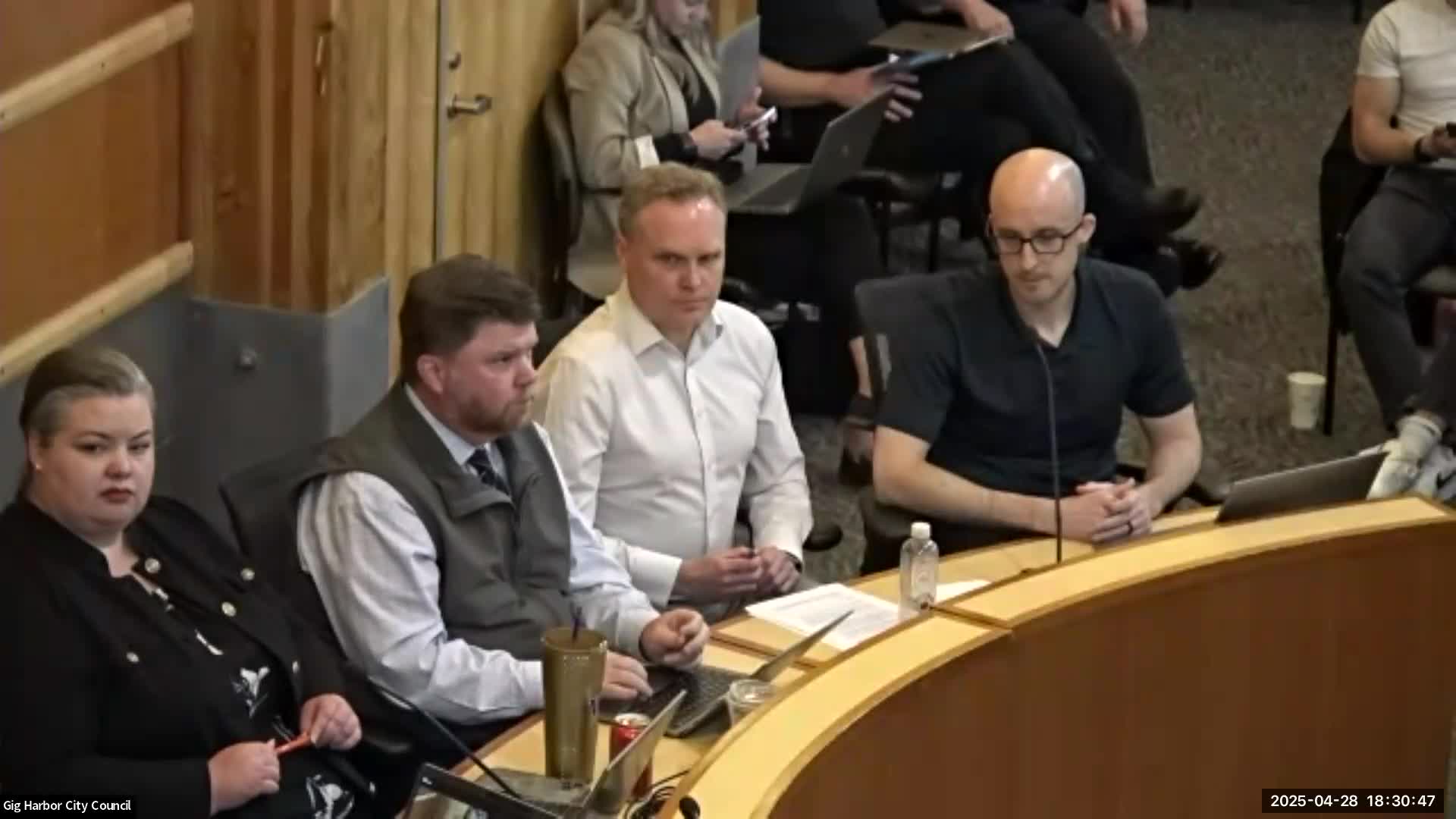
The Gig Harbor City Council heard a first reading on April 28 of an ordinance to establish a Multifamily Property Tax Exemption (MFTE) program. Staff from Community Development and the Housing, Health & Human Services office presented the draft ordinance as a framework that would allow future property owners to apply for a tax exemption; council did not approve any specific exemption or project during the meeting.
Housing, Health & Human Services Manager Shay Smiley and Community Development Director Eric Baker said the draft program would allow a 12‑year exemption on the residential improvement value for qualifying projects provided at least 20% of units are set aside as affordable to households at specified income levels. Staff emphasized that adoption of the ordinance itself would not grant exemptions; any developer seeking an exemption must submit a complete application and would require subsequent council approval. Staff also said any future application would be accompanied by a transparent financial analysis of the tax‑shift implications for the community.
The MFTE discussion drew extended council debate and public comment. Council members asked why the draft proposed a 12‑year exemption rather than the 8‑year or 20‑year options allowed under state statute; staff said 12 years is the common regional approach when a 20% affordable set‑aside is required and that 20‑year programs carry additional eligibility conditions. Council member Wook also quoted an RCW provision and asked about minimum density and how the ordinance would interact with zoning and targeted residential areas; staff said residential target areas would be adopted by council by resolution and explained the geography would be set later.
A central point of contention was the fiscal mechanism. Staff explained that the exemption is implemented as a tax‑shift: the developer would not pay property tax on the residential improvement value for the exemption period, and the resulting difference is distributed across the jurisdiction via the levy rate; staff said participating taxing districts (schools, fire, etc.) continue to receive revenues, but the levy rate adjusts to cover the exemption. Several council members expressed concern about that distribution, with Council member Storset saying the potential shift onto other residents could be unpopular and Council member Wouk urging caution.
Public commenters included a representative from Radiant (a local property owner/developer) who said multifamily developers the speaker had consulted generally supported the approach but cautioned that programs with too‑burdensome conditions may not be used. Several council members asked staff for clearer, simpler language in the ordinance and for financial impact modeling if candidate target areas are proposed. Staff said the draft would return after revisions and that council direction at the study session had been to move forward with a program framework.
Why this matters: The MFTE is a policy tool that can make certain multifamily projects financially feasible and increase the supply of units affordable to lower‑ and moderate‑income households. Council members and members of the public differed on whether the potential tax shift to other property owners is acceptable and how aggressive the program should be.
Next steps: Staff will revise the draft ordinance to respond to council comments, provide clearer language and modeling of tax impacts for any proposed residential target areas, and return to council for further consideration.