Get Full Government Meeting Transcripts, Videos, & Alerts Forever!
Get email alerts on the Accessory Dwelling Units topic
No spam. Unsubscribe anytime.
Council adopts ADU ordinance (Ordinance 15-41) to implement state law loosening rules for accessory dwelling units
Summary
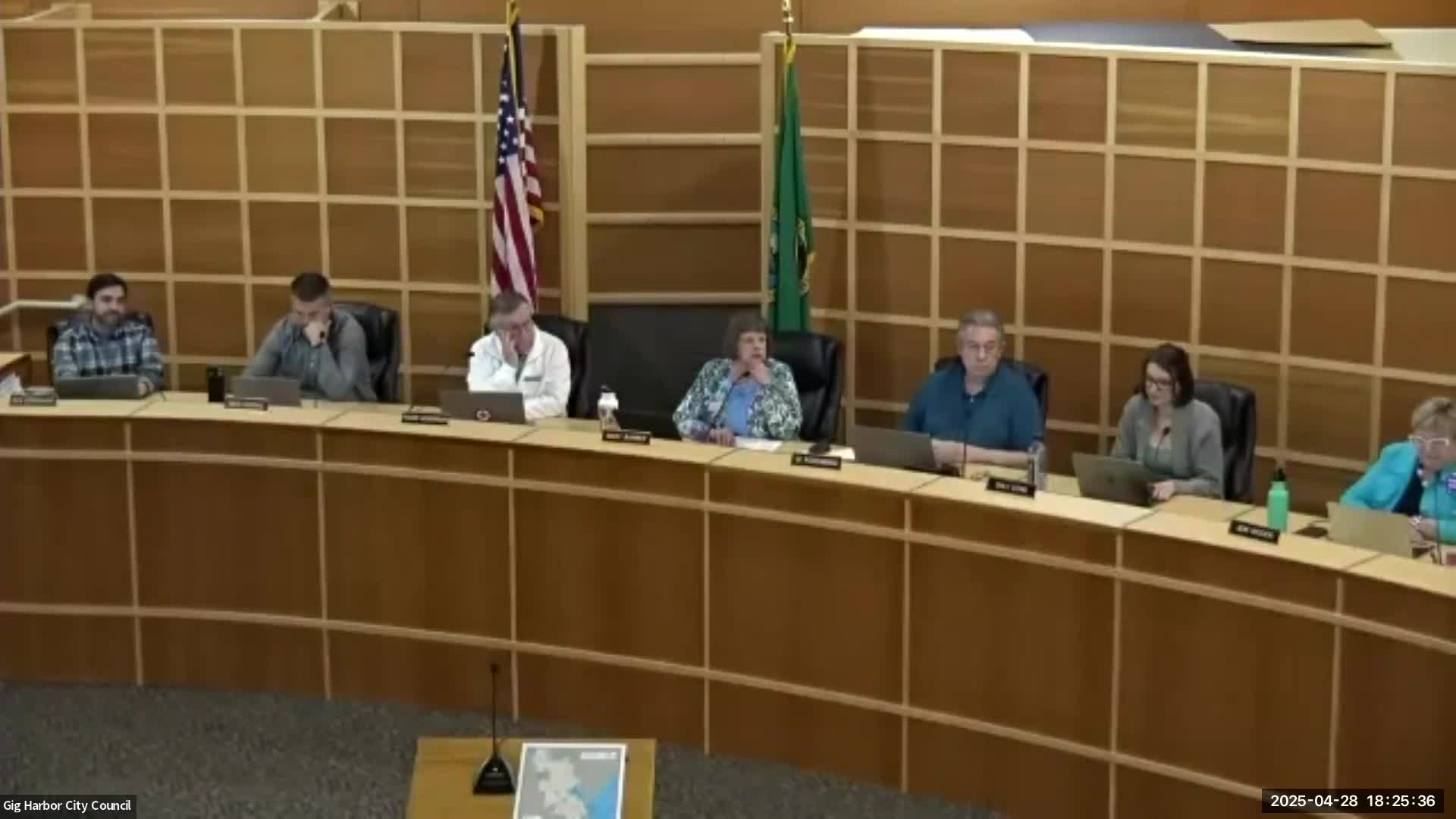
After a public hearing and discussion, the City Council approved Ordinance 15‑41 (7–0), amending Gig Harbor’s municipal code to permit accessory dwelling units consistent with state House Bill 1337 and to add a new chapter with definitions, parking rules and a pathway for ADU permitting.
The Gig Harbor City Council voted unanimously, 7–0, on April 28 to adopt Ordinance 15‑41 (as recorded in the meeting transcript) revising the municipal code to permit accessory dwelling units (ADUs) in more residential zones and to add a new code chapter to implement state requirements.
Senior Planner Jeremy Hammer and Community Development Director Eric Baker presented the ordinance as a code amendment to bring Gig Harbor into compliance with House Bill 1337 (referred to in the staff presentation as House Bill 13‑37). Staff said the ordinance adds or updates definitions, removes the city’s existing “accessory apartment” conditional‑use framework, amends the land‑use matrix to allow ADUs where residential uses are permitted, revises parking requirements, and creates a new Chapter 17.69 for ADU standards.
The proposal followed Planning Commission study sessions, a public hearing and two council study sessions. Public comment at the hearing included residents who described the potential benefits and the permitting costs of ADUs; one speaker said permit costs he faced while adding an accessory unit were high. Staff told the council that some fee changes (for example, impact fee adjustments) will be handled in the fee schedule rather than in the zoning code.
Council discussion touched on several details. Council members asked whether ADUs count toward the city’s housing targets (staff said yes for long‑term rental units and explained the city’s reporting approach for short‑term rentals), asked for clarity on whether square‑footage caps should exclude garages, and flagged potential constraints from lot coverage and hard‑surface limits related to stormwater control. Staff said those implementation details and fee‑schedule updates would return to the council; they also noted the city will be required to track ADU construction and use for the 2029 five‑year assessment.
After the public hearing and deliberations, Council member Wouk moved to approve Ordinance 15‑41; Council member Rodenberg seconded. The motion passed 7‑0.
Why this matters: The ordinance implements a state law intended to reduce barriers to ADU construction and broaden housing choices. Council members and members of the public described ADUs as one piece of a broader housing strategy; questions remain about permit costs, lot‑coverage impacts and short‑term rental treatment.
Next steps: Staff will update the fee schedule and return with clarifications (for example, gross floor‑area calculations and any exclusions for garages), begin annual ADU tracking and report on ADU uptake as part of the city’s housing monitoring.