Get Full Government Meeting Transcripts, Videos, & Alerts Forever!
Get email alerts on the Health Als Funding topic
No spam. Unsubscribe anytime.
ALS advocates urge Senate to keep $1 million-per-year statewide support in HB 96
Summary
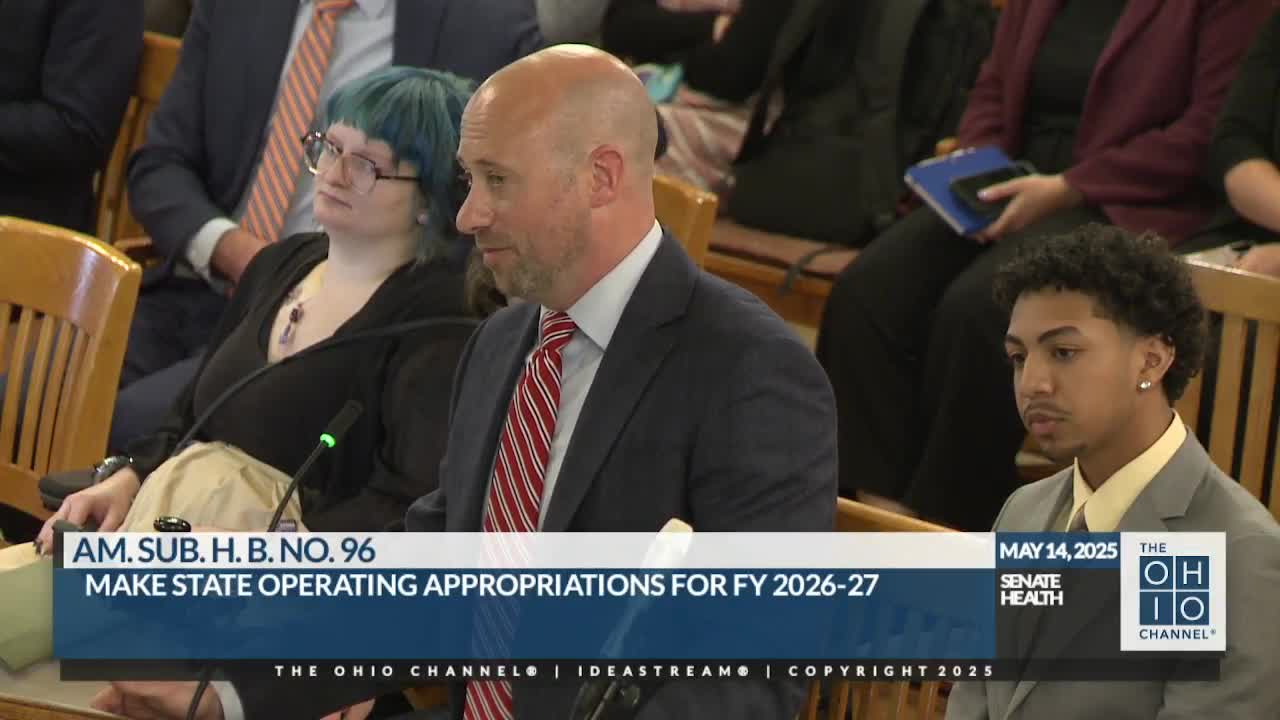
Advocates representing people with amyotrophic lateral sclerosis (ALS) told the Senate Health Committee that $1 million per year included in the executive and House budgets is needed to continue equipment loans, case management and other supports for Ohioans with ALS.
Marlene Seymour, representing ALS United Ohio, told the Senate Health Committee that the group seeks the council's support to continue a $1,000,000-per-year line in the biannual budget for ALS care services included in the executive and House budgets.
Seymour said the nonprofit provides case management, support groups, equipment loans and emergency grants for Ohioans with ALS and their caregivers and asked that the Senate keep the funding included in House Bill 96 (line item 440,485). She read from a one-page state funding outcomes report describing how the organization used the prior appropriation to deliver services.
Why it matters: ALS is a progressive, terminal neurodegenerative disease with no cure; patients typically survive two to five years after diagnosis, advocates said. The requested state funds are intended to help pay for equipment, in‑home supports and services that families otherwise cannot afford.
Advocates gave specific program details and usage counts. “Last year, we served 587 people with ALS and their caregivers and family members,” Seymour said, noting that ALS United Ohio’s patient caseload rose nearly 20 percent in five years. Lindsay Jack of the ALS Association said the association used prior state funding to provide durable medical equipment, multidisciplinary clinical care and assistive devices, and reported serving 444 Ohioans, including 60 military veterans, in the last fiscal cycle.
Families described gaps that state funding helped fill. John Collins, an Ohio resident with ALS, and his wife, Cynthia Collins, said insurance denials often leave families to cover equipment costs. “If Medicare won’t pay for it, private insurance won’t pay for it either,” Cynthia Collins told the committee, adding that ALS Association grants and equipment loans have been essential for their household.
Advocates asked senators to preserve the $1,000,000 annual appropriation already in the executive and House versions of HB 96 and pointed committee members to the bill language and the line item reference on the House side. No formal committee action was taken during the testimony period.
Ending: Witnesses said the funding would allow nonprofits to meet rising demand for services and urged the Senate to maintain the appropriation as negotiations continue on the biennial budget.