Get Full Government Meeting Transcripts, Videos, & Alerts Forever!
Get email alerts on the Child Welfare topic
No spam. Unsubscribe anytime.
County officials and providers urge Senate to address child placement crisis, oppose one-size-fits-all foster rate card
Summary
County commissioners and child welfare providers told the Senate Health Committee that Ohio is in a placement crisis for children with complex behavioral needs and urged maintained funding plus careful policy development rather than a rapid statewide rate card change.
County commissioners and child welfare providers told the Senate Health Committee that Ohio is in a placement crisis for children with complex behavioral needs and urged maintained funding plus careful policy development rather than a rapid statewide rate card change.
Jack Everson, a Ross County commissioner testifying for the County Commissioners Association of Ohio, described statewide increases in placement costs and said counties pay nearly three-quarters of placement costs. "Placement costs have increased all across the settings and now have outpaced inflation," Everson said, citing rises in foster home, group home and residential treatment costs.
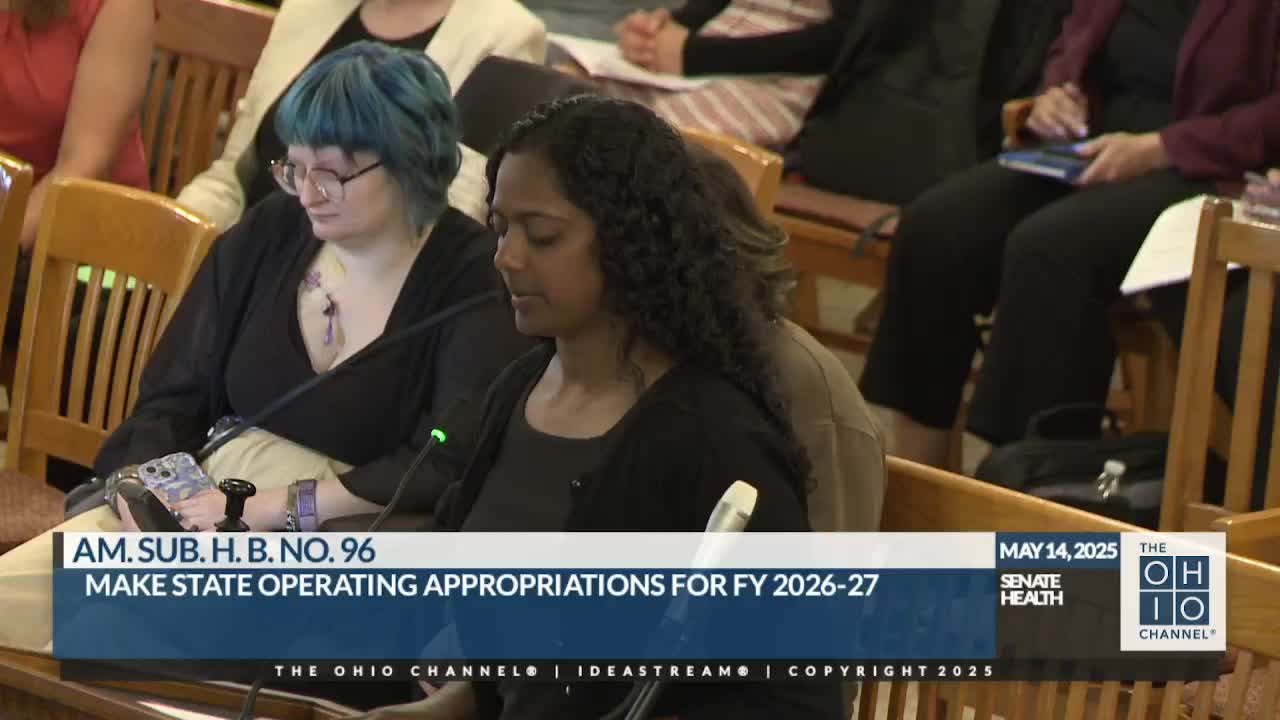
Christina Massey, executive vice president for programs at Buckeye Ranch, urged the committee not to adopt statutory language in HB 96 that would let the Department of Children and Youth standardize foster-care and residential placement rates. She said a single rate "does not account for all these various needs" such as staffing shortages, liability insurance and higher costs tied to youth with severe behavioral-health needs. Buckeye Ranch asked the committee to replace the statutory language with a legislator‑led study committee (amendment SC0716) to review cost reports and recommend data‑driven solutions.
Angela Sasse, executive director of the Public Children Services Association of Ohio (PCSAO), and Jeremy Ratcliffe, a local director, told senators House Bill 96 includes dedicated one‑time funding to establish regional short-term crisis stabilization centers ("Child Wellness Campuses") that the placement crisis working group prioritized. "We ask that the Senate maintain this proposed investment so that children will not have to sleep at their county agency, but instead in a safe setting that can deescalate and stabilize their behaviors," Sasse said.
Ratcliffe and local directors described the practical consequence of scarce placements: counties sometimes have no option but to house children overnight in agency offices. Ratcliffe said proposed policy changes to provide “consistency and transparency to placement rates” are necessary but warned against unintended destabilization of local providers without a careful study.
Senators heard local cost examples: Ross County reported placement costs rising from $2.395 million in 2015 to $6.343 million in 2024 for its region, and witnesses told the committee counties are absorbing large unbudgeted placement expenses.
No final vote was taken in committee. Witnesses asked the Senate to preserve proposed one‑time investments for crisis stabilization centers and to pursue a study-based approach to rate standardization rather than immediate statutory rate-setting.