Get Full Government Meeting Transcripts, Videos, & Alerts Forever!
Get email alerts on the Health Als topic
No spam. Unsubscribe anytime.
ALS advocates urge Senate to continue $1 million-a-year care funding in HB 96
Summary
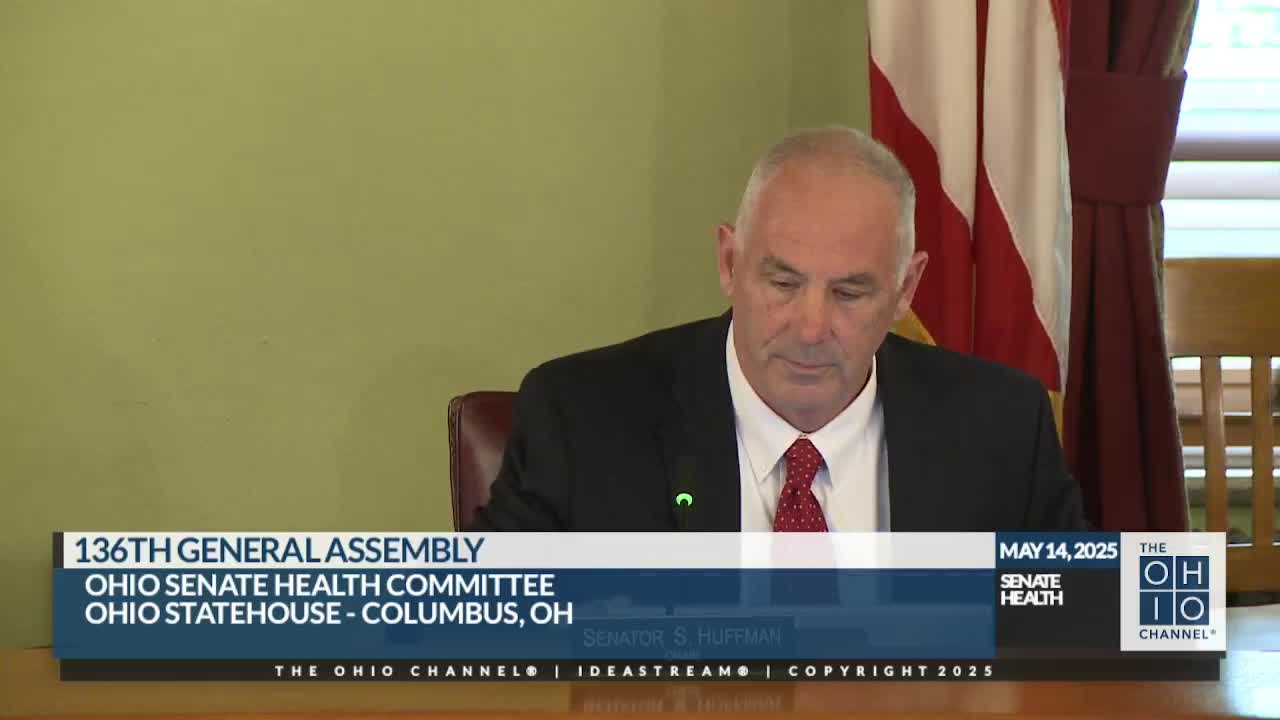
Representatives of ALS United Ohio and the ALS Association told the Senate Health Committee the executive and House budgets include $1 million per fiscal year to support home-based services, equipment loans and case management for people living with ALS and asked the Senate to preserve that funding in HB 96.
Marlene Seymour, representing ALS United Ohio, and Lindsay Jack of the ALS Association urged members of the Ohio Senate Health Committee to preserve $1,000,000 per fiscal year in the biannual budget for services to people with amyotrophic lateral sclerosis, or ALS.
The funding request is included in the executive budget and the House version of HB 96, and proponents told the committee that the dollars support case management, equipment loans, grants, support groups and home visits that many families depend on.
“I'm testifying today representing people with ALS in Ohio,” Marlene Seymour said. She told the committee her organization compiled a state funding outcomes report showing what the groups invested after the previous appropriation. “Our testimony today is in support of $1,000,000 for each year of the biannual budget, which is already included in the executive budget and the house budget.”
Lindsay Jack, speaking for the ALS Association, said the financial burden on families can be staggering and that state support enables organizations to supply durable medical equipment, augmentative communication devices, multidisciplinary care and home modifications. “This funding of 1,000,000 per fiscal year is critical to the well-being of ALS patients, caregivers, and their families,” she told the committee.
Care recipients and family members gave examples of services covered by the groups' grants and loans: ventilators, motorized wheelchairs, voice amplifiers, assistive-computing devices, bathroom adaptations and assistance applying for disability benefits. John and Cynthia Collins described using ALS Association grants and services to obtain equipment and caregiver training after John's diagnosis.
Advocates said caseloads are growing: ALS United Ohio reported serving 587 people last year and told the committee their statewide patient population rose nearly 20 percent over five years. Witnesses cited the House bill language placing the funding in line item 440,485 of HB 96.
No formal vote occurred during the testimony. Witnesses asked the Senate to retain the $1 million per fiscal year line item in its version of HB 96 so providers can continue loan programs, multidisciplinary care supports and direct grants to families.
If the funding is removed, advocates said, nonprofit providers face increased financial strain to replace state support used for equipment, home modifications and case management.