Get Full Government Meeting Transcripts, Videos, & Alerts Forever!
Get email alerts on the Health Als topic
No spam. Unsubscribe anytime.
ALS advocates urge Senate to keep $1 million-a-year appropriation in HB 96
Summary
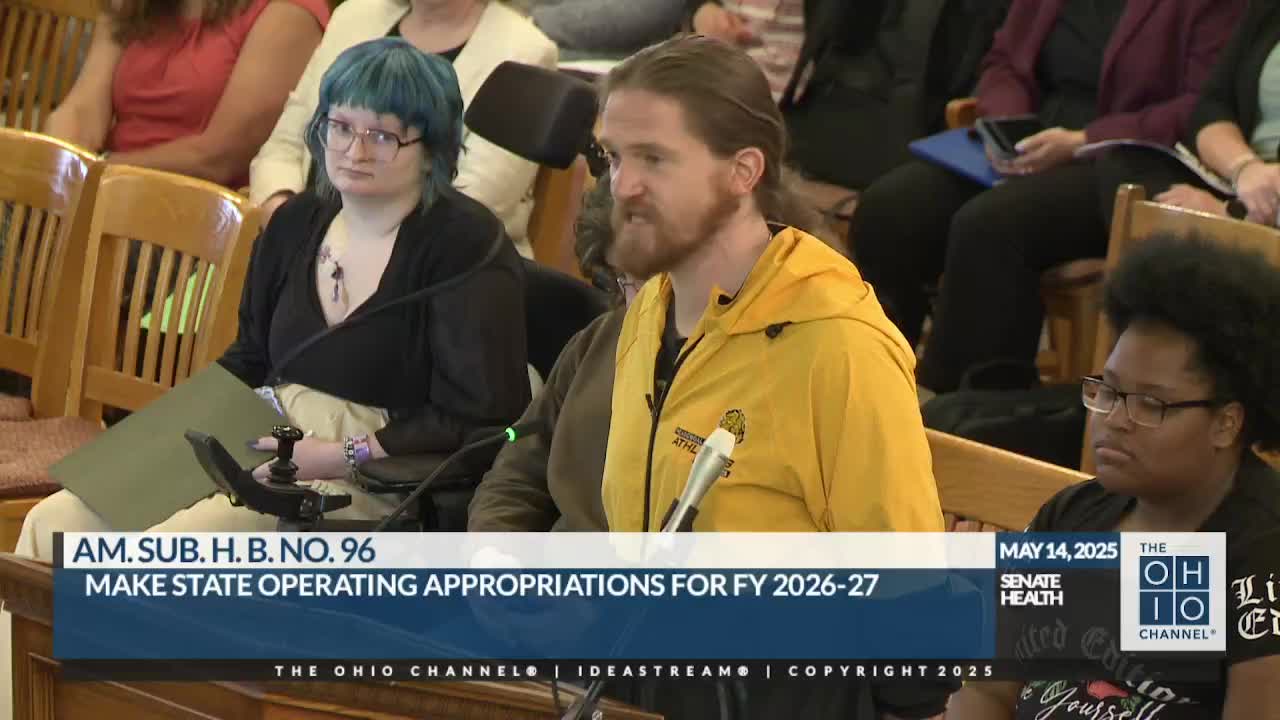
Multiple ALS organizations and people living with ALS told the Senate Health Committee the governor's and House budgets include $1,000,000 per year for ALS care services (line item 440,485 in HB 96) and asked senators to maintain that funding to continue case management, equipment loans and other supports for Ohioans with ALS.
Marlene Seymour, speaking for ALS United Ohio, told the Ohio Senate Health Committee she was asking lawmakers to “support continuing $1,000,000 per year” in the biennial budget to fund services for people with amyotrophic lateral sclerosis (ALS).
"I'm testifying today representing people with ALS in Ohio," Seymour said, and she referenced a state funding outcomes report attached to her testimony showing what the groups invested after the last appropriation.
The request is for a line item already included in the executive budget and the House budget; Seymour cited House Bill 96, line item 440,485. She described ALS as “a progressive terminal neurodegenerative disease” that “gradually robs people of the ability to speak, eat, walk and eventually to breathe,” and said the typical life span from diagnosis is “2 to 5 years.”
Lindsay Jack, testifying for the ALS Association, echoed the request and described services the national organization provides with state support. “This funding of $1,000,000 per fiscal year is critical to the well-being of ALS patients, caregivers, and their families,” Jack said. She told the committee the ALS Association used prior state funding to serve 444 Ohioans living with ALS, including 60 military veterans.
People living with ALS and caregivers described the practical effects of those services. John Collins, identified in testimony as a person with ALS, said the disease is “not only physically debilitated, but financially overwhelming.” His wife, Cynthia Collins, told senators the ALS Association connected the family to equipment and supports they could not otherwise afford: “We were forced to use our savings to pay for the equipment and care that John needs.”
Witnesses described the kinds of support the nonprofits provide: case management by nurses and social workers, support groups, equipment loans (mobility devices, voice amplifiers, ventilators), home visits, caregiver education and small grants. Seymour said ALS United Ohio served 587 people last year and that the organizations’ patient counts have risen roughly 20 percent over five years.
No committee vote or formal action took place during the hearing; the testimony was a request that senators preserve the line-item funding as the budget moves through the Senate.
If the Senate keeps the appropriation, groups told the committee the funding would continue to support equipment loans and grants, home-visit services, and caregiver supports that families said substitute for items insurers denied.