Get Full Government Meeting Transcripts, Videos, & Alerts Forever!
Get email alerts on the School Choice Dpia topic
No spam. Unsubscribe anytime.
Committee debate on DPIA, e‑school funding and vouchers highlights split between choice advocates and critics
Summary
Witnesses traded sharply different views on whether Disadvantaged Pupil Impact Aid (DPIA) should be expanded to private and e‑school students, and whether voucher or ESA provisions deserve separate legislative consideration.
The Senate Education Committee heard contrasting testimony on two related topics: (1) whether Disadvantaged Pupil Impact Aid (DPIA) should be extended to serve students in public e‑schools and nonpublic schools, and (2) whether voucher and education savings account (ESA) provisions that transfer public dollars to private schools should be debated as standalone measures rather than embedded in the budget.
Paul Palumba, speaking as a citizen and former educator, criticized the practice of embedding private voucher programs in large budget bills. "It’s a maneuver to avoid transparency and public accountability," he said, urging separate votes and broader public debate. He said vouchers divert public resources away from the 90% of Ohio children who attend public schools.
Why it matters: The House budget added language that would make virtual community schools eligible for DPIA at half the brick‑and‑mortar rate, and the package included expansions of voucher‑style assistance. Advocates for virtual and nonprofit schools told the committee that current law excludes some at‑risk groups from DPIA and asked the Senate to make funding equitable.
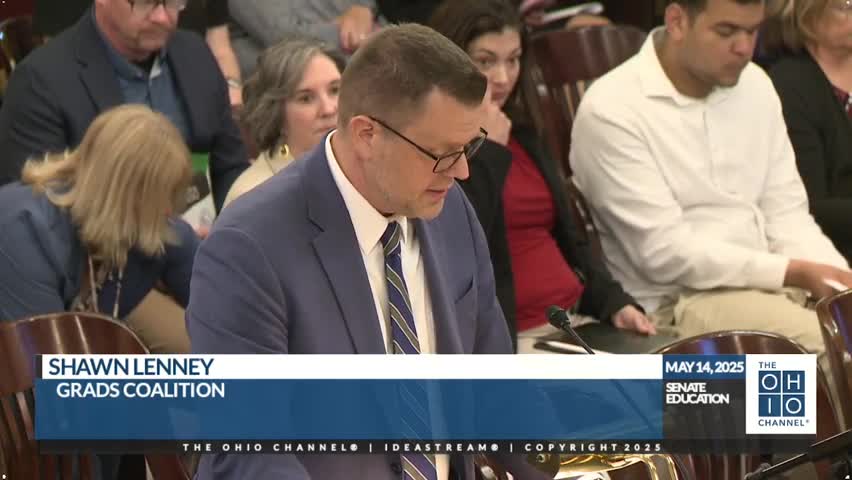
What committee heard: Sean Lenny, superintendent of the Greater Ohio Virtual School and representative of the Grads Coalition, said dropout‑prevention and recovery e‑schools serve economically disadvantaged, trauma‑impacted students and asked the committee to fund e‑school students at the full DPIA rate of $422 per pupil rather than $211. Frank O’Lynn, superintendent for the Diocese of Cleveland, and representatives of nonpublic school groups asked the committee to extend DPIA to nonpublic students eligible under current criteria.
Discussion vs. decisions: Committee members asked whether these policy changes should be in the budget or considered separately. Several speakers urged open debate and separate roll calls for voucher and ESA items; no vote occurred in the hearing.
Ending: The committee received competing requests: some witnesses pressed for parity in DPIA funding for e‑school and nonpublic students; others pushed back, calling for standalone legislation and wider public scrutiny before redirecting public dollars.