Get Full Government Meeting Transcripts, Videos, & Alerts Forever!
Get email alerts on the Early Childhood And Safety topic
No spam. Unsubscribe anytime.
United Way, Camp Invention and nonprofits press Senate for literacy, summer STEM, CPR and meal funding
Summary
United Way representatives, the National Inventors Hall of Fame and other nonprofits asked the Senate to fund third‑grade reading initiatives, Camp Invention expansion, school‑meal startup funds and CPR training line items in the budget, arguing state support furthers early literacy, summer learning and student safety.
A cluster of nonprofits and advocacy groups testified to the Senate Education Committee seeking continued or expanded state investments in early‑childhood literacy, summer STEM programs, school meals and school‑based CPR training.
Leaders of the United Way collaborative — Lisa Cortis (United Way of Central Ohio), Carrie Pedraza (United Way of Clark, Champaign and Madison Counties) and others — asked the committee to restore or continue the collaborative's $2.0 million per fiscal year appropriation in the Department of Education and Workforce project support line to expand evidence‑based third‑grade reading interventions and related family‑stability programs. Cortis cited program outcomes in multiple Franklin County districts: several participating districts improved third‑grade reading proficiency on state assessments after prior investment.
Sofia Johnson, government relations representative for the National Inventors Hall of Fame, asked the legislature to preserve a $250,000 yearly appropriation for Camp Invention (a state grant used to expand week‑long STEM camp seats for low‑income students) after the discontinuation of federal ARPA support.
Dustin Holefinger of the American Heart Association thanked lawmakers for prior CPR training funding and asked for amendment SC136 to appropriate $606,800 per year to allow the Department of Education and Workforce to continue distributing CPR kits and training so that tens of thousands of students can receive CPR instruction; the witness said Ohio trains about 100,000 students per year with existing funding and noted bystander CPR rates in Ohio are lower than the national average.
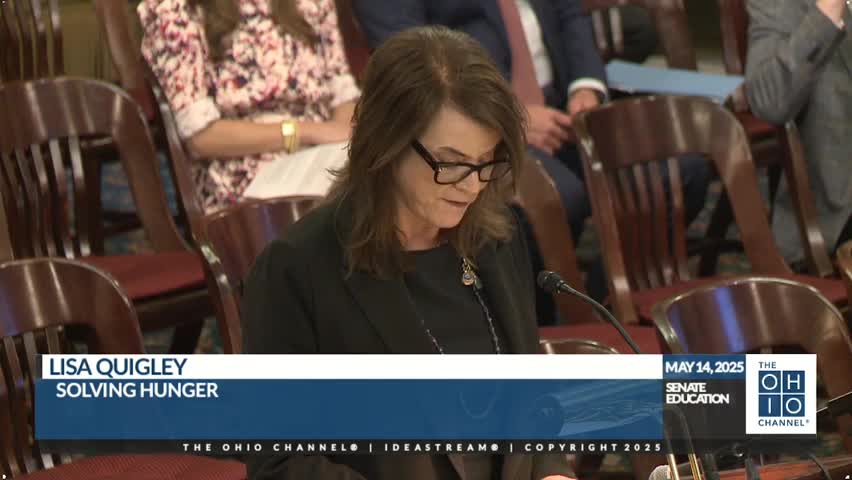
Lisa Quigley (Solving Hunger / Tusk Philanthropies) urged lawmakers to adopt the governor's language encouraging the Community Eligibility Provision (CEP) for high‑poverty schools and to fund startup costs that keep more schools from enrolling; she cited an example that $33 million in state startup funding could serve 92,000 more low‑income students and draw an additional $47 million in federal reimbursements.
Committee members asked for program audits and return‑on‑investment details; witnesses offered evaluation summaries and said third‑grade reading and summer STEM investments demonstrate measurable gains and improved attendance and college aspirations.