Get Full Government Meeting Transcripts, Videos, & Alerts Forever!
Get email alerts on the Health Als topic
No spam. Unsubscribe anytime.
Advocates urge Senate to keep $1 million‑a‑year ALS funding in HB96
Summary
Multiple ALS organizations and families asked the Senate Health Committee to retain a $1,000,000 per‑year line in House Bill 96 for care services, citing rising need, equipment and service shortfalls, and veterans' disease prevalence.
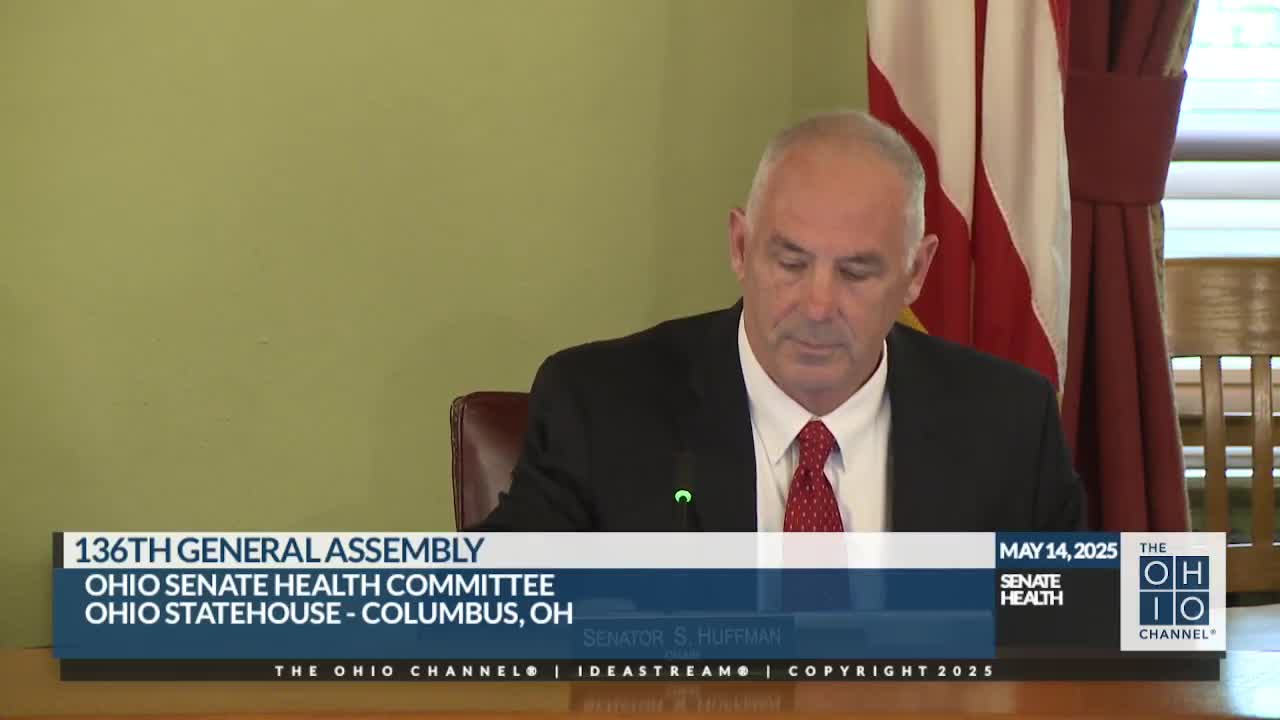
Marlene Seymour, representing ALS United Ohio, told the Ohio Senate Health Committee that the group is asking lawmakers to preserve a $1,000,000‑per‑year appropriation included in the executive and House versions of House Bill 96 for ALS care services.
The funding request, which Seymour identified as line item 440,485 in House Bill 96, covers care coordination, equipment loans, caregiver support and emergency grants that the nonprofit says it currently provides to people living with amyotrophic lateral sclerosis (ALS). “Our testimony today is in support of $1,000,000 for each year of the biannual budget,” Seymour said, adding that the organization served 587 people in Ohio last year and that its caseload has risen about 20% in five years.
Lindsay Jack, representing the ALS Association, also urged the committee to keep the appropriation. Jack told senators the association provided services to 444 Ohioans with ALS last year, including 60 military veterans, and listed durable medical equipment, augmentative communication devices and home modifications among services supported by the requested state funds. “This funding of $1,000,000 per fiscal year is critical to the well‑being of ALS patients, caregivers, and their families,” Jack said.
Two people living with ALS and a caregiver described how nonprofit grants and equipment loans filled gaps left by insurers. Cynthia Collins, who identified herself as John Collins’ wife, said the grants and loans allowed the family to afford a motorized wheelchair, voice‑amplifier and other items her husband needs. “If Medicare won’t pay for it, private insurance won’t pay for it either,” she said.
Speakers emphasized that ALS is progressive and typically terminal within two to five years after diagnosis and noted a higher incidence among veterans; testimony referenced the Department of Defense’s designation of ALS as service‑related. Witnesses provided a state funding outcomes report and asked senators to keep the line item language already added in the House.
If the Senate alters the budget language, witnesses asked for the chamber to restore funding or maintain the House’s included line. No committee vote was recorded during the hearing.
Why it matters: ALS advocates said the modest line item supports direct patient services that families rely on when insurers deny equipment or care, and that caseloads in Ohio are growing.