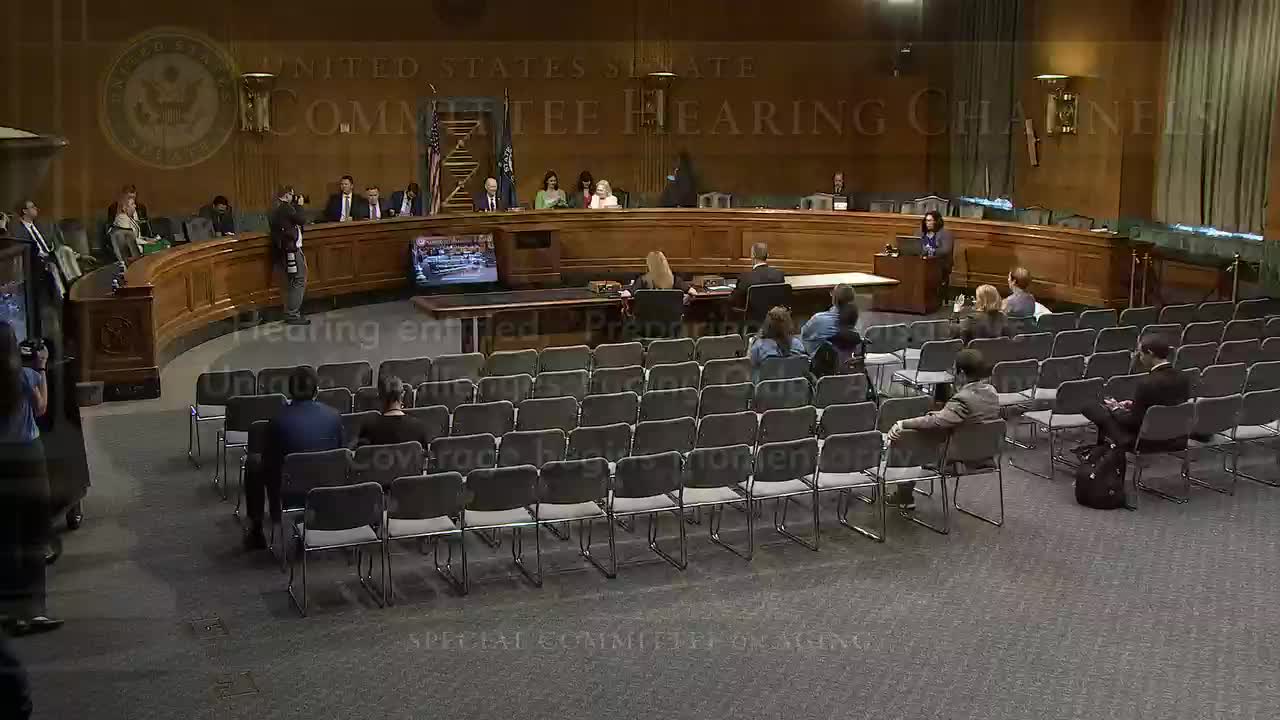
Senate Aging Committee hearing urges inclusive disaster preparedness for older Americans
Get AI-powered insights, summaries, and transcripts
SubscribeSummary
Lawmakers and witnesses at a Senate Special Committee on Aging hearing called for inclusive planning, stronger federal support and local partnerships to protect older adults and people with disabilities during disasters, citing rescues, shelter needs and barriers to recovery.
The U.S. Senate Special Committee on Aging convened a hearing on disaster preparedness for older Americans, where senators and witnesses urged inclusive planning, stronger federal support and local partnerships to reduce disproportionate harms to seniors and people with disabilities.
The hearing centered on why older adults face added risk in disasters and what jurisdictions and federal partners can do to close gaps in evacuation, sheltering, communication and recovery. “If you aren't prepared, nothing else matters,” Sen. Rick Scott, chair of the Special Committee on Aging, said in opening remarks, adding, “preparedness saves lives.”
Witnesses and lawmakers described a range of practical steps and persistent problems. Chris Nocco, sheriff of Pasco County, Florida, recounted recent hurricane responses in his Gulf Coast county — which he said has roughly 750,000 residents with about 22% aged 65 or older — and said his office and partners rescued more than 100 people from rapidly rising storm surge during a recent event. “We were able to rescue more than 100 people from rapidly rising storm surge,” Nocco said, arguing that local first responders, the National Guard and Coast Guard were essential to those operations.
Jennifer Pippa, vice president of disaster programs for the American Red Cross, described survivors’ long recovery journeys and the organization’s role in immediate and ongoing assistance. Pippa recounted meeting an older woman after Hurricane Ian and said, “The disaster never lets her forget that she was now a victim of it,” to illustrate how disasters can strip seniors of daily routines and independence. She said the Red Cross pairs survivors with caseworkers and medical professionals to help reestablish medications, medical devices and other supports during recovery.
Vance Taylor, chief of the Office of Access and Functional Needs at the California Governor’s Office of Emergency Services, called for inclusive planning “with the community,” recommending access and functional needs (AFN) advisory committees that bring older adults, disability advocates and service providers into preparedness planning. Taylor said inclusive planning produces accessible alerts, programmatic sheltering and evacuation resources, and “literally saves lives.” He warned that many jurisdictions lack resources and urged sustained federal support from agencies such as FEMA, the Administration for Community Living and ASPR.
Sen. Kirsten Gillibrand, the committee’s ranking member, described legislative work to fund state strategic plans for aging. “My bill would create a new nationwide grant program under the Older Americans Act to incentivize and support states' efforts to create their own strategic plans for aging, which would include disaster preparedness,” Gillibrand said. She cited a 2024 report noting that a minority of states have adopted strategic plans for aging and argued federal grants would help states build capacity.
Speakers emphasized several recurring, actionable themes:
- Inclusive planning and community partnerships: Taylor and several senators endorsed AFN advisory committees and close coordination with community-based organizations such as Centers for Independent Living and area agencies on aging so plans reflect lived experience and reach people who are not digitally connected.
- Accessible communications and alerts: Witnesses described failures when alerts and communications did not reach people who are deaf, have limited English proficiency, or lack internet access. Taylor said accessible formats and multiple languages can be a matter of life and death.
- Shelter and medical continuity: The Red Cross highlighted needs such as accessible shelter space, medical refills and replacement of assistive devices. Pippa said Red Cross volunteers and caseworkers help older adults reconnect with medical providers and secure emergency refills.
- Local response capacity and federal support: Sheriff Nocco stressed the primacy of local government and the practical value of federal partners (National Guard, FEMA funding), but also cited reimbursement and administrative hurdles. “The more it frees up the local law enforcement to protect the senior citizens … that would allow us to be more proactive,” he said.
- Fraud and unlicensed contractors after disasters: Senators and the sheriff discussed scams targeting seniors in recovery; Nocco said his office conducts unlicensed-contractor stings and urged public education and law enforcement resources to deter post-disaster fraud.
Committee members also raised concrete program and training items: restoring or expanding inclusive emergency management courses, funding strategies to help low-income older adults build “go bags” over time, and Red Cross pilot programs such as targeted in-home interventions and free smoke-alarm installs in affected communities.
The hearing included specific statistics and local anecdotes used to illustrate broader points: Sen. Scott said nearly 60% of the deaths from Hurricane Ian in Florida were seniors; Nocco described coastal neighborhoods west of U.S. 19 and riverine flooding after a separate storm that produced rescues in Wesley Chapel; Pippa noted that about 40% of Red Cross volunteers are 60 or older. Committee members repeatedly linked these examples to the need for federal grants, state master plans and better communication strategies.
No formal votes or committee actions were taken at the hearing. The chair left the hearing record open for additional questions and statements. “If any senators have additional questions for the witnesses or statements to be added, the hearing record will be open until next Wednesday at 5 p.m.,” Sen. Scott said.
The witnesses and senators agreed on the central aim: reduce avoidable harm to older adults and people with disabilities by embedding accessibility and inclusive practices into preparedness, response and recovery — and by ensuring jurisdictions have the funding and partnerships needed to do that work.