Get Full Government Meeting Transcripts, Videos, & Alerts Forever!
Get email alerts on the Housing Planning topic
No spam. Unsubscribe anytime.
Wilsonville planning commission recommends adoption of Housing Our Future reports to city council
Summary
The Wilsonville Planning Commission voted unanimously May 14 to recommend that city council adopt the Housing Needs and Capacity Analysis and the Housing Production Strategy, and related comprehensive-plan text amendments, with a directed edit to acknowledgements in two attachments.
Wilsonville Planning Commission on May 14 voted unanimously to recommend that the City Council adopt the Housing Needs and Capacity Analysis (HNCA), the Housing Production Strategy (HPS) and related comprehensive-plan text amendments, endorsing staff’s recommendation and asking for corrections to acknowledgements in two attachments.
The recommendation, put forward by Commissioner Ron Heberlein and seconded by Commissioner Sam Skoll, was recorded as a motion to approve “resolution LP25-0001 recommending the city council adoption of the housing needs capacity analysis, housing production strategy, and related comprehensive plan text amendments, including updates to the acknowledgments in attachment 1 and 2 to update the planning commission chair and add any additional former commissioners that were not included.” The motion carried unanimously.
Why it matters: The HNCA and HPS are the city’s statewide-required, forward-looking housing planning documents. Staff told the commission the HNCA estimates how much residential growth Wilsonville must plan for over the next 20 years and the HPS lists actions the city will take over the coming six-year implementation period to support housing production and fair housing outcomes.
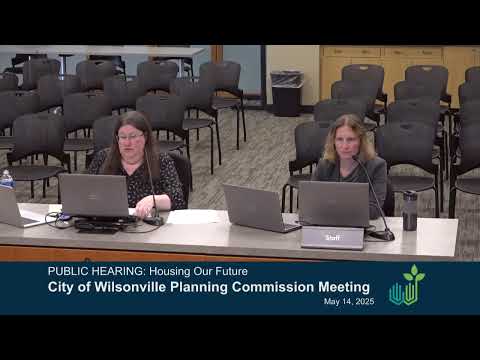
City planning director Miranda Bachel opened the public hearing and described the package as “a really important milestone for the city.” Senior planner Kim Reybold and consultant Beth Goodman (Echo Northwest) presented the technical reports, which staff included as attachments to the staff report and proposed adopting the HNCA as a subelement of the comprehensive plan and the HPS as a standalone strategy.
Key findings and context
- Buildable land and capacity: Staff reported about 269 acres of buildable land in the city, most concentrated in the Frog Pond area. Using Metro’s forecast, the HNCA estimates about 2,815 new housing units are expected over the next 20 years; staff said the city’s existing land base has capacity for roughly 3,600 new units, leaving a modest surplus of capacity primarily for single-unit and “missing middle” housing types.
- Housing mix and redevelopment dependencies: Staff emphasized that much of multifamily capacity is tied to redevelopment in the town center; the city will reassess capacity at the next housing analysis cycle if town-center redevelopment does not occur.
- Affordability and cost burden: Presenters described affordability pressures countywide and locally. The staff presentation noted roughly 55% of renter households are cost-burdened (spending 30%+ of income on housing) and about 29% are severely cost-burdened (50%+), while owner households have lower cost-burden rates.
- Income bands and production needs: The HPS focuses actions on producing housing affordable to households below 80% of area median family income (MFI). Staff told commissioners that housing affordable below 60% of MFI typically requires subsidy or income-restricted development because the private market rarely builds to that level without support.
Staff recommendations, monitoring and schedule
Staff recommended the commission forward resolution LP25-0001 recommending council adoption of the HNCA, HPS and the code/text amendments that would list the HNCA as a comprehensive-plan subelement and make limited edits to the residential development chapter. Staff explained the HPS is designed to be implemented over a six-year period and that monitoring indicators are listed in Exhibit 18 of the HPS and can be incorporated into the city’s annual housing monitoring program.
Commissioner questions and edits requested
Commissioners pressed staff on monitoring and implementation: Commissioner (Yana) Semenova asked whether the city will set specific production targets; staff replied the city is not held to state targets but could treat the HNCA’s household projections as local targets and incorporate monitoring indicators into annual reports. Commissioner Heberlein requested corrections to the acknowledgements in attachments 1 and 2 (to reflect the current planning commission chair and include former commissioners who participated); staff agreed to correct the attachments before forwarding the package to council.
Action and next steps
The commission moved, seconded and voted to recommend adoption, with the explicit instruction to staff to update the acknowledgements in attachments 1 and 2. The motion passed unanimously. The planning commission’s action is a recommendation to city council; council retains final authority to adopt the HNCA, HPS and related comprehensive-plan amendments.
Provenance: The staff presentation and public-hearing discussion for the Housing Our Future project began with staff introduction and presentation (Miranda Bachel, Kim Reybold, Beth Goodman) at the start of the public hearing and concluded when the commission closed the hearing and voted to forward resolution LP25-0001. Key excerpts of the public record include staff remarks introducing the HNCA and HPS and Commissioner Heberlein’s motion to forward the resolution.