Get Full Government Meeting Transcripts, Videos, & Alerts Forever!
Get email alerts on the H2ohio Wetlands topic
No spam. Unsubscribe anytime.
Scientists, farmers and conservation groups urge Senate to restore H2Ohio funding to prevent rollback of wetland, nutrient work
Summary
Presenters at the Ohio Senate Agriculture & Natural Resources Committee hearing urged restoration of H2Ohio funding, saying wetlands, farmer cost‑share and monitoring supported by the program are producing measurable water‑quality improvements and require continued multi‑year investment.
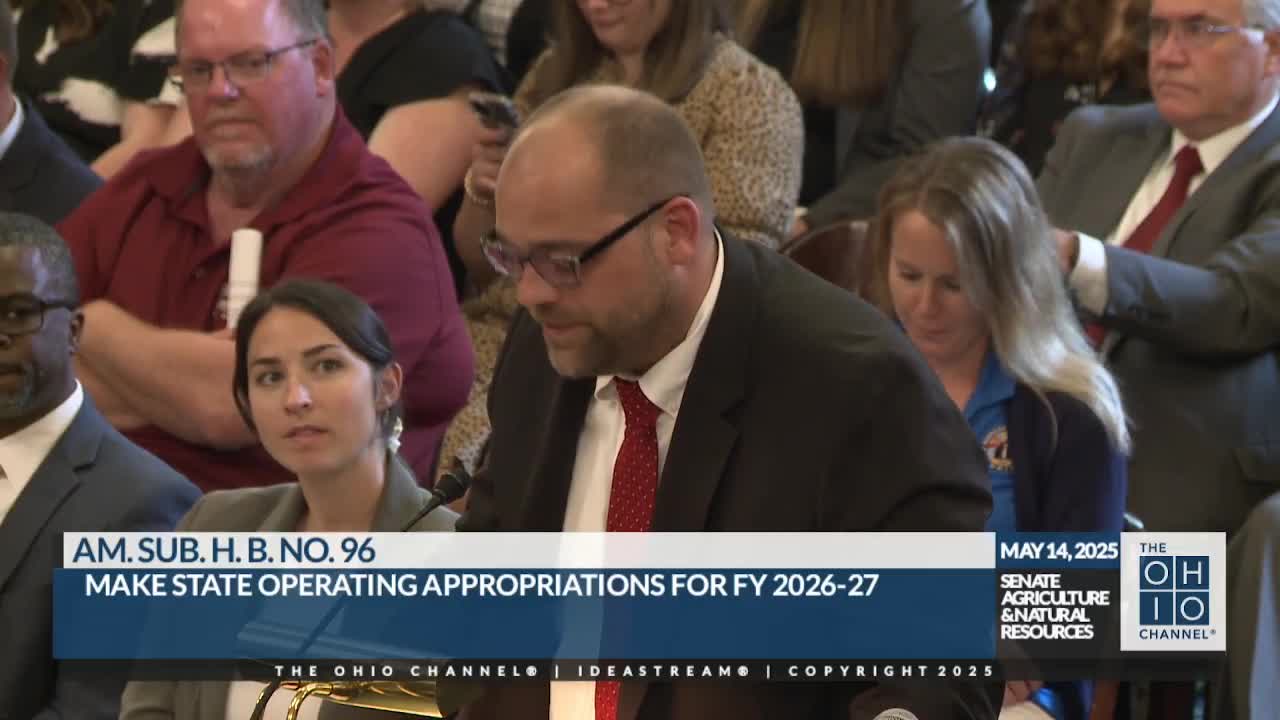
Speakers at a May hearing of the Ohio Senate Agriculture and Natural Resources Committee urged senators to restore full funding for H2Ohio, the multi‑agency state program that funds wetlands, farmer conservation practices and water infrastructure to reduce nutrient runoff and harmful algal blooms.
"Water quality can be improved and real benefits can be realized," said Dr. Steven Jackman, professor of water quality at Wright State Lake Campus, who testified about Grand Lake St. Marys and harmful algal blooms. He and other witnesses told the committee that recent state investments enabled wetland creation and other conservation work that are beginning to lower nutrient concentrations.
The request centered on restoring the governor's original $270 million H2Ohio appropriation after a House amendment cut the program by roughly $120 million. Witnesses from state agencies, universities, soil‑and‑water districts, Ducks Unlimited, the Nature Conservancy and farm groups described projects now underway and warned that abrupt funding reductions would stall momentum.
"H2Ohio is improving water quality in Ohio, but the work is not done. The momentum must continue," said Theresa Dirkson, Mercer County Agricultural & Natural Resources director, who described multi‑year wetland and ditch projects and the multi‑agency permitting and construction timeline needed for wetlands to perform.
Researchers who monitor restored wetlands asked the committee for continued multi‑year support to complete evaluation. "A bare minimum of three years is usually required to assess nutrient removal because of year‑to‑year variability and the time new wetlands need to mature," said Dr. Lauren Kinsman Costello of Kent State, lead of the H2Ohio wetland monitoring program. She told legislators some projects are still young and that dry weather in recent years has delayed definitive findings.
Farm groups and county officials told the committee that H2Ohio helps farmers adopt conservation practices that may have delayed payback and that the program has leveraged federal funding. "If Ohio cuts H2Ohio, we will lose the technical and financial support that encourages participation and leverages federal conservation programs," said Jeff Dooling with the Ohio Agricultural Conservation Initiative.
Conservation groups framed H2Ohio as an investment with economic returns. Jim Samuel of the Ohio Water Partnership and Evan Erickson of Ducks Unlimited described how wetlands and watershed projects protect drinking water, reduce flooding and support recreation economies. They and others asked the Senate to preserve the program's authority to use funds for land acquisition and conservation easements, which the House version restricts.
Multiple witnesses requested that the Senate restore the proposed H2Ohio funding and avoid shifting dollars away from the Western Lake Erie Basin, where witnesses said targeted projects have shown early water‑quality gains.
Ending: Committees will consider the budget through the Senate process; witnesses asked legislators to preserve H2Ohio at the levels proposed by the governor so wetlands, farmer cost share and monitoring can continue without interruption.