
Board weighs flexible instruction days vs. traditional snow days as PDE application due June 1
Get AI-powered insights, summaries, and transcripts
Sign Up Free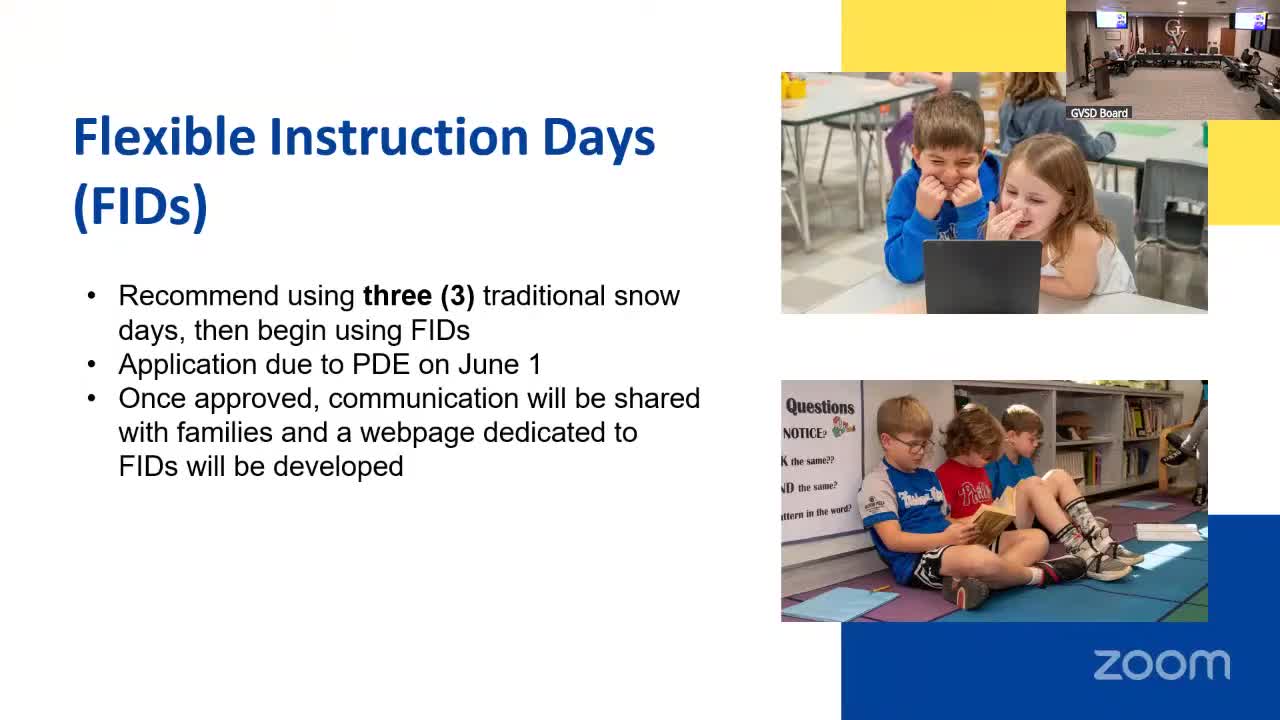
Summary
The district administration recommended using three traditional snow days before converting to Flexible Instruction Days (FIDs) and asked for the board’s informal sense ahead of a Pennsylvania Department of Education application due June 1; board members raised concerns about instructional quality, equity and family childcare burdens.
The superintendent presented a draft plan for Flexible Instruction Days (FIDs) and recommended the district use three traditional snow days before converting to FIDs. The administration said the district will submit an application to the Pennsylvania Department of Education by June 1 and requested an informal board consensus on the approach; no formal vote was taken.
The superintendent explained the rationale for using traditional days first: "They're not a replacement for a full day of instruction with a Great Valley... between a day in Great Valley Schools, a 7 hour day and a FID day, I want those in-person days." The board discussed trade-offs including AP testing schedules, the ability of special-program staff to deliver services remotely, and family childcare burdens when adults must work outside the home.
Board members asked about program specifics and flexibility. The administration said the PDE application allows the district to deliver virtual instruction if approved but that the district would retain the option to stop using FIDs if the model proves unworkable; any change would primarily be a communications and operational issue, not a PDE approval issue. The superintendent noted the application would allow up to five FID days (the maximum permitted) but recommended a more conservative plan to avoid extending the school year unduly; administration estimated three FIDs would shift the school-year end to approximately June 17, while five could push it to about June 22 on the current calendar.
Board members emphasized communication and equity: they asked for a robust family-communication plan (FAQs, special-population outreach, and information on how absences are recorded) and for metrics the district would use to evaluate FIDs’ effectiveness. The superintendent committed to a full rollout plan and regular updates to the board if the application is pursued.
The board gave informal approval to submit the PDE application to preserve the option, with the understanding the district would continue to develop communication protocols, service plans for students who receive specialized services, and an internal evaluation framework before large-scale use of FIDs.