Get Full Government Meeting Transcripts, Videos, & Alerts Forever!
Get email alerts on the Land Use Middle Housing topic
No spam. Unsubscribe anytime.
Council reviews middle-housing code update: ADU size, unit-lot subdivisions, parking and hookup-waiver policy debated
Summary
Council and planning staff continued work on a middle-housing code update April 22. Discussion focused on accessory dwelling unit (ADU) size limits, allowing up to two ADUs per lot, unit-lot subdivision mechanics, lot coverage protections, parking, and potential fee-waiver procedures for qualifying affordable housing projects.
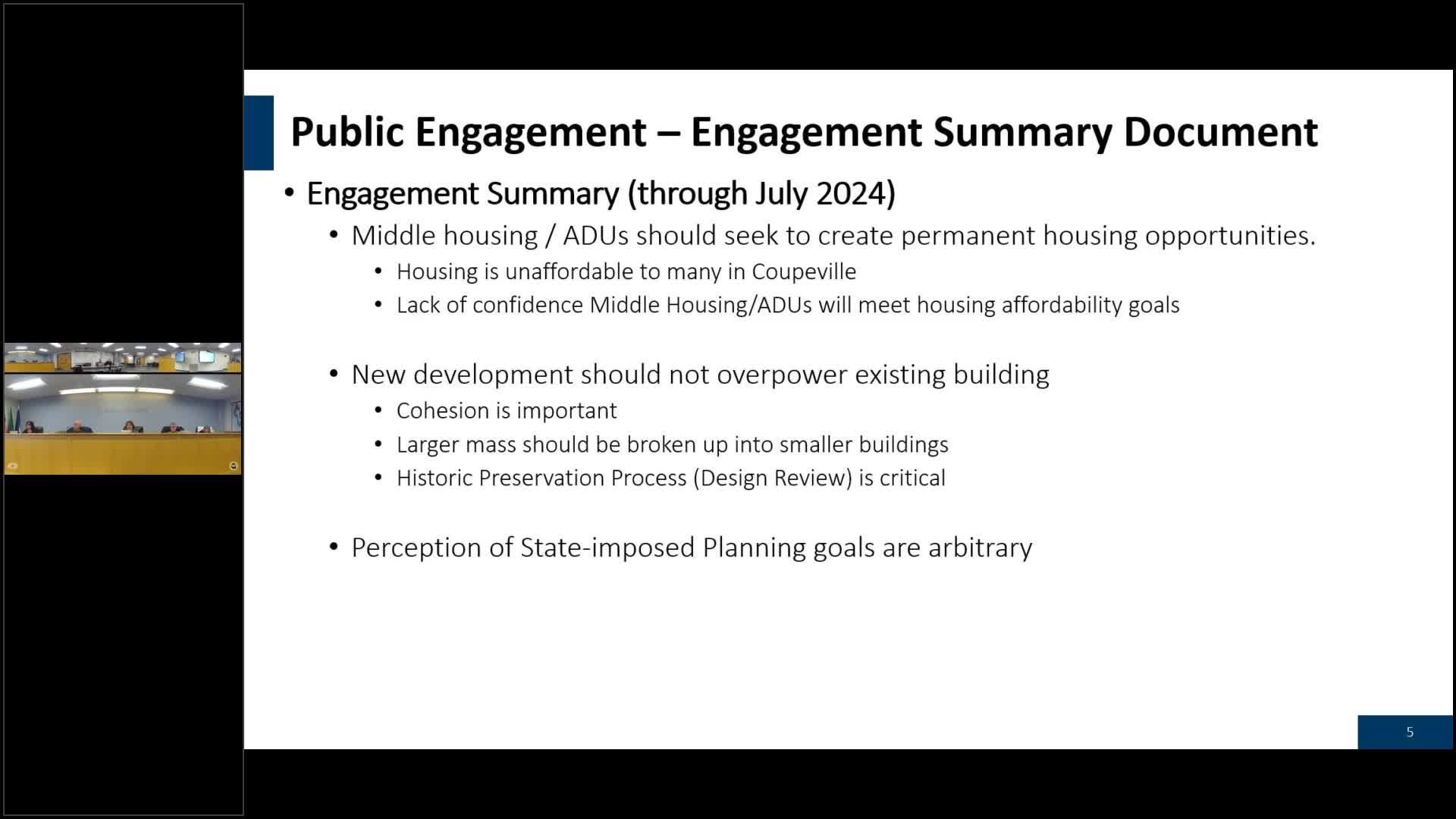
Coupeville — Community Planning Director Joshua Inglebrack presented the town’s draft middle‑housing code on April 22 and discussed required changes under state law, public-feedback themes, and implementation mechanics. Council asked detailed questions about accessory dwelling units (ADUs), unit-lot subdivisions, parking, lot‑coverage protections and how the town would handle hookup-fee waivers tied to affordable-housing projects.
Joshua said the town’s draft aligns with state requirements that the town must allow up to two ADUs per residential lot and that local regulations must not cap ADU maximums below 1,000 square feet. "What we are mandated to do is we cannot restrict the size below 1,000 square feet," Joshua said, describing an adjustment the town made in response to legal counsel. He explained the draft had originally tied ADU size to a percentage of the primary dwelling footprint, but attorney review recommended a clear maximum of 1,000 square feet to avoid inconsistency with state statute.
Council extensively questioned unit-lot subdivisions — a process that lets individual dwelling units on a parent parcel be sold separately as individual land parcels while leaving parent-level development standards (setbacks, lot coverage) in place. Joshua explained unit-lot subdivision changes the ownership mechanics but not the overall density allowed at the parent-parcel level; the parent parcel must still meet lot-coverage and other development standards. He summarized the trade-offs: unit-lot subdivisions facilitate separate ownership of ADUs and principal dwellings, but utilities, access easements and recorded maintenance agreements become necessary to manage shared infrastructure and parking.
Several councilmembers pressed for clearer protections tied to lot coverage and parking so that future sales or multiple owners would not erode neighborhood characteristics. Joshua confirmed the code keeps lot-coverage limits at the parent-parcel level (for example, 35% in medium-density zones), so the total built footprint on a parent parcel remains constrained even if ownership is split across unit lots; however, the town must update utility code to allow separate meters and connections where needed.
The council also discussed the policy mechanics for waiving or deferring hookup fees for qualifying affordable-housing developments. Staff proposed the council consider an administrative policy to handle waivers for nonprofit developers (e.g., Habitat) or projects with deed-restricted affordability, and noted the state has reimbursement programs that the town may use when available. Council requested staff return with specific waiver criteria and an implementation ordinance or administrative form.
Joshua said the planning commission held a public hearing on April 1 and recommended the draft be forwarded to the council for final action. The Department of Commerce 60‑day review is in progress; staff aims to return for formal council action following required notice periods, with a public hearing tentatively scheduled for May 27 if major changes are proposed.
Ending
Staff will refine code language to remove ambiguous phrasing (for example, the phrase "at least" in the ADU size line), prepare a drafted administrative policy for hookup-fee waivers tied to permanent affordability, update utility and metering code language as needed, and return to council for a follow-up hearing in May if substantive edits are proposed.