Get Full Government Meeting Transcripts, Videos, & Alerts Forever!
Get email alerts on the Utilities topic
No spam. Unsubscribe anytime.
Planning commission reviews utilities element: telecom gaps, recycling, utility corridors and stormwater options
Summary
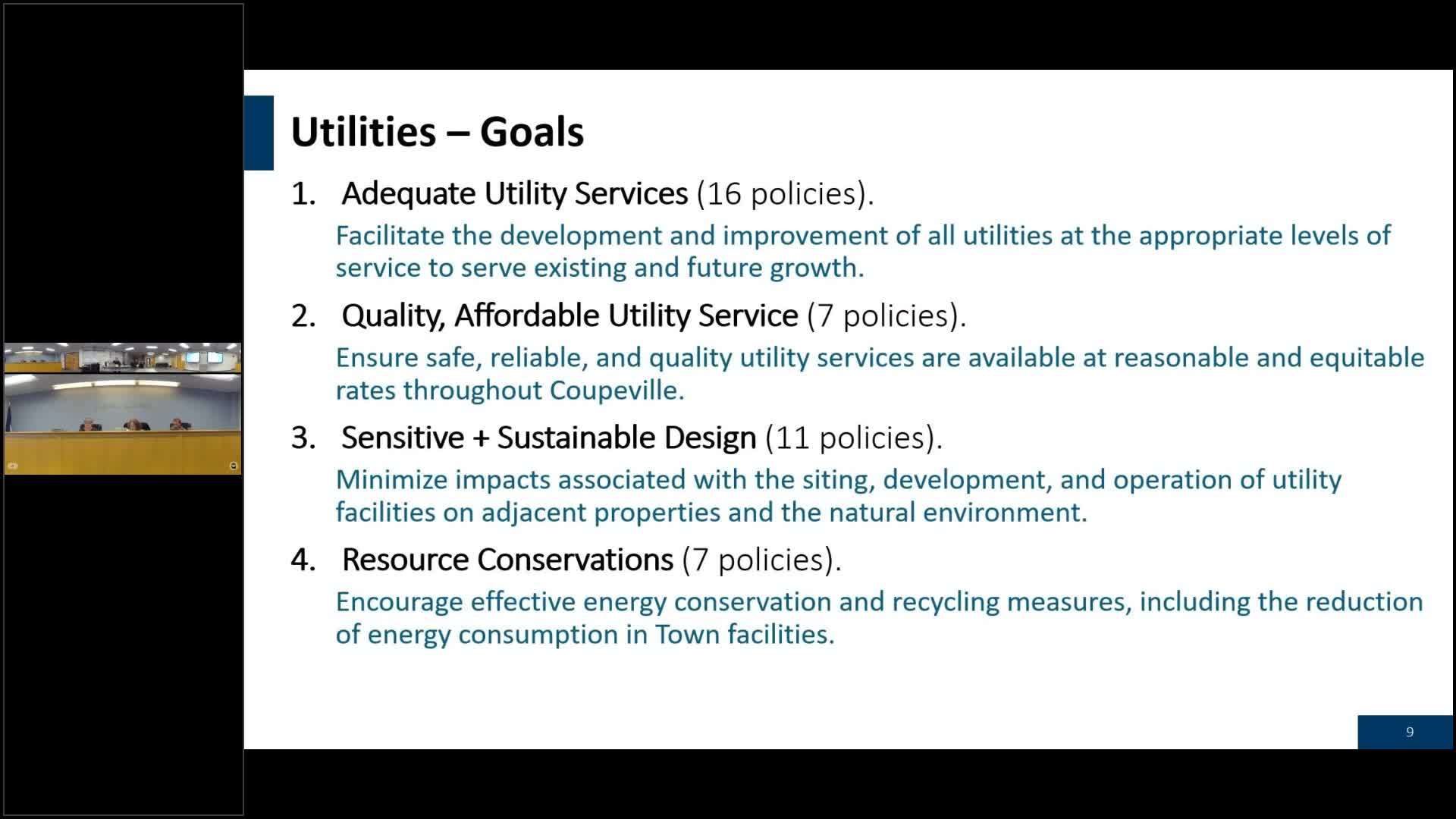
Coupeville planning staff presented the utilities element of the comprehensive plan on May 6 and commissioners raised several service‑level concerns ranging from telecommunications coverage to solid waste and stormwater management.
Coupeville planning staff presented the utilities element of the comprehensive plan on May 6 and commissioners raised several service‑level concerns ranging from telecommunications coverage to solid waste and stormwater management.
Why it matters: utilities — including water, sanitary sewer, power, telecommunications and solid waste — underpin public health, economic activity and coastal resilience for residents and visitors.
On telecommunications, commissioners said local Internet and cellular service remains an important driver for businesses and tourism and asked whether the town can facilitate improved towers or other investments. Staff acknowledged that telecommunications are often managed by private providers but recommended noting the service level as an objective in the plan.
The plan also includes a short policy on “insured exposure to human‑made electromagnetic fields,” which prompted staff to summarize technical findings: state and federal regulations govern non‑ionizing radio frequency exposure, and available public‑health sources do not show a causal link between typical cell/Wi‑Fi exposures and cancer. Staff said inclusion is reasonable to address public concern but that regulation and safety largely fall under state and federal agencies.
Solid waste and recycling drew discussion about composting and “zero waste” festival goals. Commissioners urged investigating town‑led compost or green‑bin programs and stronger education and enforcement for event organizers. Staff noted plastic markets and recycling economics have shifted and recommended scoping feasibility and education programs.
On stormwater, commissioners suggested exploring neighborhood or regional retention/detention ponds (managed either by neighborhoods or town) to reduce individual lot burdens and reduce truck hauling to off‑island disposal. Staff noted examples elsewhere and asked to investigate locations such as low areas near the boat launch that might double as amenity space without substantially reducing parking.
Staff said the utilities element also recommends making use of cleared utility corridors (powerline right‑of‑way) for trails and recreation where safe and appropriate.
Ending: staff will incorporate feedback into the draft utilities element, research feasibility of town‑led composting, follow up on telecom coordination options with providers, and consult Public Works on potential regional stormwater sites.