Get Full Government Meeting Transcripts, Videos, & Alerts Forever!
Get email alerts on the Capital Facilities topic
No spam. Unsubscribe anytime.
Coupeville planners flag $16.6 million shortfall in six‑year capital facilities plan
Summary
Planning staff told the Coupeville Planning Commission that the town’s 2023 comprehensive plan anticipates about $21 million in capital projects through 2028 but only about $4.4 million in identified revenue, leaving roughly $16.6 million unfunded and requiring grant pursuit, financing or reprioritization.
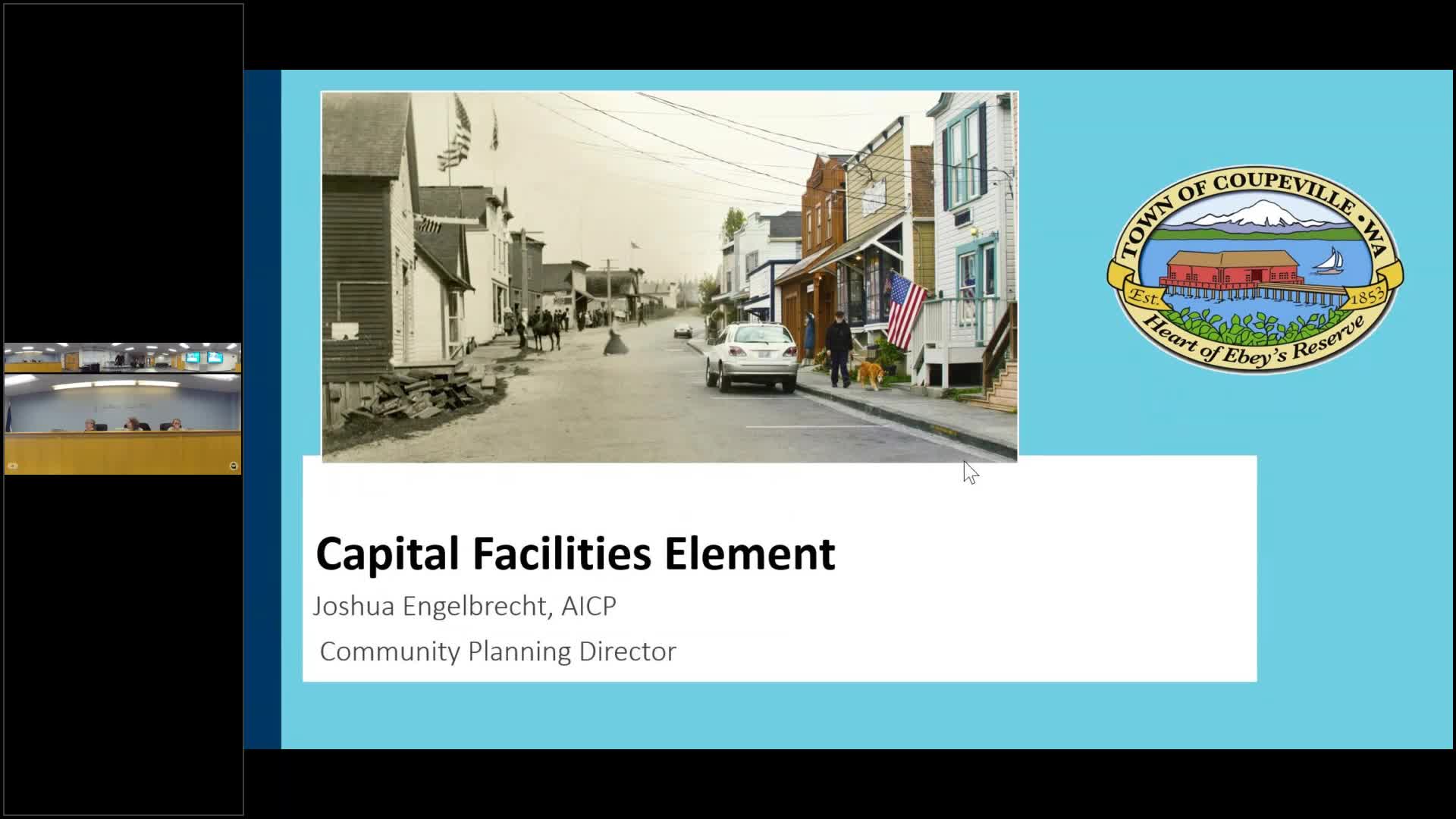
Coupeville planning staff told the Planning Commission on May 6 that the town’s capital facilities appendix projects roughly $21 million in capital facility work from 2023 through 2028 while identifying about $4.4 million in revenue, leaving an estimated $16.6 million funding gap.
Why it matters: the capital facilities element sets the town’s priorities for parks, water, sewer, stormwater, municipal buildings and partner agencies such as the school district and fire response. The shortfall, staff said, affects timing and prioritization of maintenance and expansion projects the town will have to pursue or defer.
Staff framed the element as a high‑level planning tool rather than a project‑by‑project budget. “Over the next 6 years, from 2023 to 2028, … we’re sort of expecting and planning about $21,000,000 worth of capital facility projects,” the staff member said. The same presentation noted a revenue stream of “about $4,400,000” and estimated grant revenue of roughly $2,100,000, leaving a large portion of needs dependent on future grants, bonds, local improvement districts or state/federal appropriations.
Commissioners and other participants pressed staff on how those gaps would be closed and who pursues outside financing. The staff member said the public works team currently handles grant searches and applications and that the town recently added a public works clerk whose responsibilities may include grant pursuit as capacity allows.
Commissioners suggested adding prioritization criteria that account for a facility’s ability to generate revenue directly or indirectly (for example, parking or parks that support tourism) and called for a periodic review of town land and facility inventories to evaluate underused properties as potential revenue or redevelopment sources. Staff agreed to consider language changes that would prompt more frequent evaluation of underused parcels.
The appendix will be updated to reflect 2025–2031 planning horizons and to incorporate projects completed since the 2023 plan. Staff said they will follow up with department partners to confirm which projects have moved forward since adoption and to refine cost and funding assumptions.
Ending note: commissioners directed staff to continue refining the capital facilities appendix, to check current grant assumptions with public works, and to bring a consolidated draft of updated comprehensive plan elements to the commission later this summer.