Get Full Government Meeting Transcripts, Videos, & Alerts Forever!
Get email alerts on the Wastewater Infrastructure topic
No spam. Unsubscribe anytime.
Brainerd utilities staff favor new submersible wet‑well for main lift station after public hearing
Summary
At a March 25 public hearing, engineering consultant Widseth presented four options to replace or rehabilitate Brainerd's aging main lift station. BPU staff eliminated two options and selected a new submersible-style wet‑well (Alternative 3) to advance in the facility plan for PFA funding and placement on the MPCA Intended Use Plan (IUP).
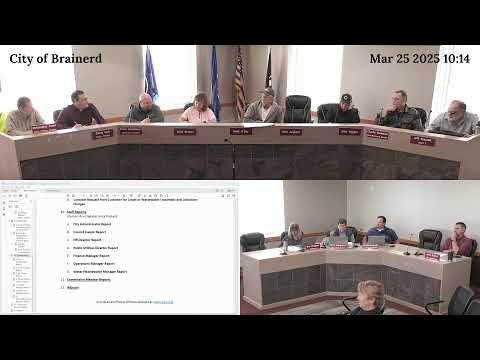
On March 25 the Brainerd City Public Utilities Commission (BPU) held a public hearing on a proposed rehabilitation or replacement of the city’s main lift station. Bill Westerberg, an engineer with Widseth, presented four alternatives and the analysis used to decide a preferred approach; BPU staff informed the commission they had eliminated two alternatives and selected Alternative 3, a new submersible‑style wet‑well station south of the existing pretreatment building, as the preferred option to advance in the facility plan and to pursue Public Facilities Authority (PFA) funding and placement on the Minnesota Pollution Control Agency (MPCA) Intended Use Plan (IUP).
Westerberg said the team “bas[ed] the design on acquiring PFA funding and creating a facility plan,” and described the project need as driven by aging infrastructure, floodplain exposure and declining pump performance. The existing main lift station was built about 40 years ago; the pretreatment structure dates back roughly 50 years. The presentation noted several immediate equipment shortcomings and recommended replacement or rehabilitation to avoid sewage backups in low areas near the Mississippi River.
The consultant described four alternatives: (1) new dry‑pit lift station, (2) rehabilitate existing dry‑pit facility, (3) new submersible wet‑well station (the staff‑selected option) and (4) convert the existing station to a submersible wet‑well. Widseth’s engineering cost estimates with contingencies put total project costs at roughly $16.3 million for Alternative 1, $6.52 million for Alternative 2, $6.61 million for Alternative 3 and $7.26 million for Alternative 4. The report noted that options that reuse the existing building likely require a temporary bypass system during work, which can add cost and operational complexity.
Westerberg said the site is in the Mississippi River floodplain and called out environmental review items that must be resolved before moving forward, including consultation with the U.S. Fish and Wildlife Service, the Minnesota Department of Natural Resources and the State Historic Preservation Office (SHPO). He said SHPO review is expected in May and listed species and resources of concern that the environmental review must address. The presentation also noted a 20‑inch force main that crosses the Mississippi River and a wet well depth of roughly 26 to 30 feet.
On schedule and next steps, Widseth and BPU staff said they submitted a draft facility plan to the MPCA as part of the project priority list (PPL) and plan to incorporate hearing comments and outstanding environmental review outcomes before a June 6 facility‑plan submission deadline. Staff said placement on the MPCA Intended Use Plan is required to obtain priority PFA funding; depending on state bonding and the MPCA schedule, funding could be available as early as this fall but is more likely in early 2026, staff said.
The commission conducted the public hearing and then closed it; no formal commission vote to adopt a specific construction contract or to obligate funding was recorded during the meeting. Staff will incorporate input from the public hearing and pending environmental reviews into the facility plan and pursue PFA/IUP process steps.
Westerberg summarized the rationale for the recommended alternative as balancing lifecycle cost, constructability given groundwater conditions and avoiding the expense and complexity of a long‑term bypass. "It's really time for some of this stuff to happen," he said.
The commission held the hearing, invited public comment, received no in‑room public testimony at the hearing, and closed the hearing before moving on to other agenda items.
Next steps: staff will incorporate the hearing record and outstanding environmental review findings, update the facility plan, and resubmit the application to the MPCA/PFA for IUP consideration by the PFA.