Get Full Government Meeting Transcripts, Videos, & Alerts Forever!
Get email alerts on the Homeless Services topic
No spam. Unsubscribe anytime.
Planning commission recommends one-year trial allowing Bridges of Hope to extend summer operations
Summary
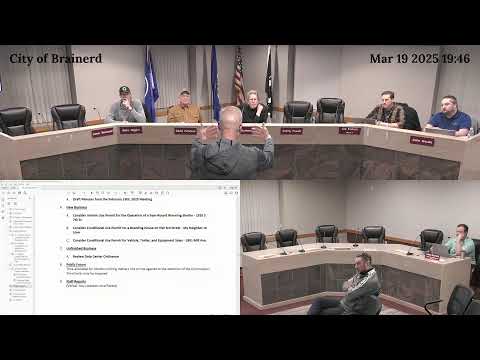
The Brainerd Planning Commission on March 19 voted to recommend that the City Council approve a one-year trial allowing Bridges of Hope (Bridge on Seventh) to operate beyond its current seasonal schedule, forwarding the matter to the council for final action on April 7.
The Brainerd Planning Commission on March 19 recommended that the City Council approve a one-year pilot allowing the Bridges of Hope emergency shelter at 1926 South Seventh to operate outside its current September–April schedule.
Staff had recommended approval of the interim use permit (IUP) only under the existing seasonal conditions — operation September 1 through April 30 — with the IUP to expire June 30, 2028, and with annual reports to council. Community Development staff also noted police data that showed an increase in incidents at or within one block of the shelter and recommended the city retain the ability to suspend or revoke the permit upon a police chief recommendation.
Janice Shogren, representing Bridges of Hope, told the commission the shelter opened in December 2021 and has helped 508 different individuals through more than 12,000 nights of shelter. She disputed characterizing all police interactions as crimes and said that after adjusting for calls that would have occurred independently of the shelter, the facility averages about 1.6 police interactions per month. "If the bridge does not remain open for the summer, interactions between law enforcement and the unhoused population will likely increase," Shogren said.
Rachel Zita, adult services supervisor for Crow Wing County, described county-level casework and resource constraints and urged the commission to consider the shelter’s role in connecting people to services during warmer months when other options are limited.
Commission discussion cited the city’s camping bans and the effect of concentrating services at a single, supervised location. After deliberation a motion to recommend a one-year trial of expanded operations passed on a roll-call vote with three votes in favor and two opposed. The commission’s action is advisory; the final decision rests with the Brainerd City Council, which is scheduled to consider the permit at its April 7 meeting.
The record to the commission included the staff summary of required IUP conditions: facility occupancy limits tied to the fire marshal, staffing during operating hours, a 24-hour contact provided to Brainerd Police and Crow Wing County Community Services, prohibition on outdoor storage of resident possessions (except bicycle racks), and compliance with building, fire and health codes. Staff also recommended the facility provide an annual report to council prior to September 1 and noted that the police chief could request council review if disorderly use is documented.
Supporters at the hearing — shelter staff, volunteers, county behavioral-health staff and several people who had used the shelter — described the shelter as a bridge to services, stable housing or treatment, and urged the commission to allow a pilot to avoid displacing people into unregulated outdoor encampments. Opponents and some commissioners raised concerns about out-of-area users and the documented police calls near the site.
Next steps: the Planning Commission record and recommendation will go to the Brainerd City Council for final action at its April 7 meeting. The commission’s recommendation, the staff conditions, and the police data submitted with the application will be part of the council’s packet.
(Ending) The commission framed its recommendation as a trial with an explicit path for the police chief and council to act if neighborhood impacts increase; the council will make the final determination in April.