Get Full Government Meeting Transcripts, Videos, & Alerts Forever!
Get email alerts on the Homelessness Shelter topic
No spam. Unsubscribe anytime.
Residents, volunteers urge Brainerd council to restore year‑round permission for Bridge on Seventh shelter
Summary
Dozens of residents, volunteers and former board members of Bridges of Hope urged the Brainerd City Council on April 21 to reverse a recent decision limiting the Bridge on Seventh shelter’s permit and to allow year‑round operation, saying the shelter is a short‑term landing spot that connects people to housing and services.
Dozens of residents and volunteers urged the Brainerd City Council on April 21 to reverse a recent decision that denied summer operations and shortened the shelter’s permit to one year for Bridge on Seventh, a low‑barrier seasonal shelter operated by Bridges of Hope.
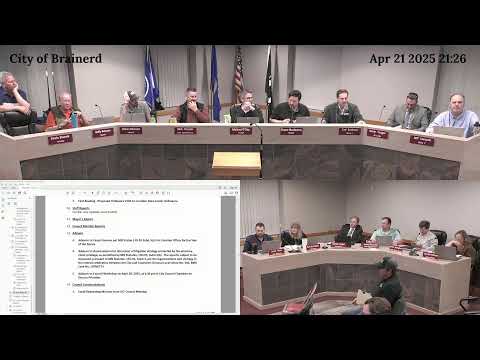
At the city’s public forum, speakers — including former board members and current volunteers — framed the shelter as a local response to homelessness that helps people transition quickly into stable housing and argued the city’s April 7 action conflicted with a recently passed camping ordinance. "Those five words changed everything," said Sarah Nelson Katzenberger, a former Bridges of Hope board member, recounting the group’s decision to start the shelter. "It has saved lives, and it's restored hope."
Why it matters: speakers said the council’s decision to limit the shelter leaves local law enforcement without the services the city’s camping ordinance contemplates. Several speakers cited data collected by Bridges of Hope to argue the program reduces strain on emergency services: "Seventy percent of all shelter guests have stayed 14 nights or fewer since the shelter opened," Amanda Quisberg told the council, and Christie Ramler said, "Out of the 70 individuals who stayed at the shelter this year, 50 have already transitioned into stable housing." Johanna Schoegren, representing Bridges of Hope, said only four people from St. Cloud had stayed at the shelter, countering claims that the program draws people from outside the region.
Speakers urged a path forward without asking the city for operating funds. "We’re not asking for money; we are only asking for permission to operate as we have been," Matt Carlegard, representing Bridges of Hope, told the council, noting that the group is funded by private donations and county support. Multiple speakers asked the council to meet with Bridges of Hope and to explain the standards by which the shelter’s permit will be judged in the future.
Public‑safety context: Sarah Marshall, a Bridges of Hope board member and pastor, addressed concerns about police calls connected to the shelter. She said Brainerd Police receive roughly 18,000 calls a year and described the shelter’s share as a small fraction: "In the context of 18,000 calls in a year, the shelter-related total of about 19 calls is a small fraction," she said, adding that many of those calls were medical emergencies or referrals that resulted in people receiving help. Several speakers argued that when the shelter is closed, calls and visible homelessness rise elsewhere in the city.
Council response and next steps: Council members listened during the public forum and said they would continue to monitor the issue and stay in contact with staff and stakeholders. No new permit decisions or votes on the shelter occurred at the April 21 meeting; the council’s earlier vote on April 7 to deny summer operations and shorten the permit to one year remained in place. Bridges of Hope representatives said they would provide additional data and asked the council to reopen discussions.
Community voices: Other residents described hands‑on volunteer experience at the shelter. Eric Holst, who said he volunteered and once slept outside to raise awareness, said, "We are not asking for help. We're asking for permission." Marie Francis, who lives two blocks from the shelter, said she has not seen disturbances and described the shelter as an "emergency stop place" for police.
What council members said: Council members did not take a motion on the shelter at this meeting. Several council members said they would consider the data and engage with Bridges of Hope and staff before any future action.
Ending: Bridges of Hope volunteers and supporters asked the council to reconvene with the organization and to set measurable, public standards for future permit reviews; the council closed the public forum and said it would continue discussions with staff and community partners.