Get Full Government Meeting Transcripts, Videos, & Alerts Forever!
Get email alerts on the Hazardous Structures topic
No spam. Unsubscribe anytime.
Albert Lea council orders abatement of four hazardous structures after engineers cite public-safety risks
Summary
The Albert Lea City Council on Monday voted to declare four properties hazardous and to begin abatement proceedings — by repair or removal — after building officials documented severe structural deterioration that staff said poses a public-safety risk.
ALBERT LEA, Minn. — The Albert Lea City Council on Monday voted to declare four properties hazardous and to begin abatement proceedings — by repair or removal — after building officials and engineers documented severe structural deterioration that staff said poses a public-safety risk.
The council approved orders for 338 Broadway Avenue South (the former Broadway Theatre), 809 Clark Street West, 915 Autumn Street and 819 Garfield Avenue. Councilors said they expect staff to obtain detailed demolition and asbestos-removal estimates and to return to the council for contract award and financing decisions when costs exceed the city’s internal thresholds.
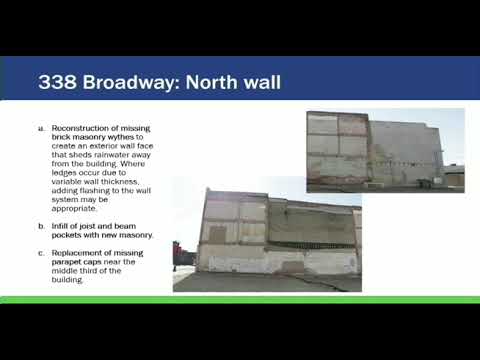
City Manager (name not specified) and Wayne Sorensen, Albert Lea building official, told the council the Broadway Theatre has a large bulge and deflection in a south masonry wall, fractured foundation stone, moisture damage beneath stucco, and an aging truss system that engineers say must be fully investigated before any repair plan could be guaranteed. Sorensen said a 2023 contractor estimate for masonry and related exterior work was about $726,000; he added that exposing the interior structure could reveal additional costs and that a realistic total for repair could add roughly $200,000–$300,000 depending on conditions. "It's just a matter of when it's gonna fall, not if," Sorensen said of the masonry failure risk on the Broadway building.
City Attorney (name not specified) told the council he had initially tried to support saving the theater but concluded the building now represents a serious safety threat: "I legitimately believe that this is an actual threat of somebody, an Albert Lea resident dying as a result of the failure of the building," he said. He said the abatement process remains flexible and allows owners to pursue renovation if they come forward with feasible plans and funding.
The city manager reported approximately $308,000 in a TIF fund dedicated to the 300 block redevelopment that could be used for eligible blight-removal costs on the Broadway property; the council did not commit that money but heard it may be an available funding source. Sorensen said the city will obtain asbestos sampling and formal demolition estimates and return to the council; under city and state procurement rules, projects above certain dollar thresholds require competitive procurement and a separate council approval when costs are finalized.
At the 809 Clark Street West hearing staff described longstanding foundation and sill-beam rot. Sorensen said the structure was first placarded in 2017 and re-placarded in March 2024 after remediation attempts stalled. The property is vacant; owner contact has been intermittent and a bank is involved in at least one case discussed. Sorensen said the city typically pays for abatement demolition and places the assessment on the property when owners do not perform the work themselves.
At 915 Autumn Street staff reported collapsed or crumbling concrete-block foundation walls and widespread rot; exterior inspection and limited interior access informed the recommendation for removal. The building was placarded in May 2023 and a bank has declined to take action; staff said the house is unlikely to be economically rehabilitated given foundation costs.
At 819 Garfield Avenue staff described a recent fire to an accessory building and a heavily damaged residence with compromised concrete-block foundation walls and an improvised interior shoring pattern. Staff said one contractor and one investor are actively evaluating a market-based rehabilitation that would include a new wood foundation; because of that potential private interest, staff recommended language allowing repair or removal so private plans could proceed if feasible. Robert Hoffman, a local developer and downtown property owner, spoke during public comment and said he supports removal for several of the properties, including the Broadway building: "This one's a stinker to see lost, but I think it's just the time," Hoffman said.
Councilors asked for clarifications on process and cost. Sorensen gave a ballpark demolition range for the Broadway building of about $250,000–$300,000 but emphasized asbestos-removal sampling could materially change the price. For smaller single-family demolitions staff described a wide range of recent bids, including examples given in the meeting (a Plainview job at about $57,500 and another at $7,500) and said consolidated bidding of multiple properties typically produced better prices.
Council actions: the council voted unanimously to approve abatement orders for all four properties. After the motions passed, councilors said staff should proceed with asbestos testing, obtain formal demolition bids under competitive procedures required for large projects, and return to the council with final cost and financing recommendations.
The council’s next steps on each property will vary by owner cooperation and any state historic-preservation review. For the Broadway Theatre, Sorensen and councilors noted the State Historic Preservation Office (SHPO) was reviewing whether the structure remains a contributing building in the historic district; if SHPO finds it contributing the city likely will need to complete an Environmental Assessment Worksheet (EAW) before demolition, a process staff said could add time and expense.