Get Full Government Meeting Transcripts, Videos, & Alerts Forever!
Get email alerts on the Aquatic Invasive Species topic
No spam. Unsubscribe anytime.
Shell Rock Watershed seeks council OK to treat curly‑leaf pondweed on Fountain Lake
Summary
The Shell Rock River Watershed District requested city permission to allow a contractor to apply the herbicide Aquathol to about 60 acres of Fountain Lake to control invasive curly‑leaf pondweed; council raised outreach and permitting questions and raised no objection to staff signing required permit documents.
The Shell Rock River Watershed District asked the Albert Lea City Council on April 14 for the city's cooperation in treating roughly 60 acres of Fountain Lake for invasive curly‑leaf pondweed.
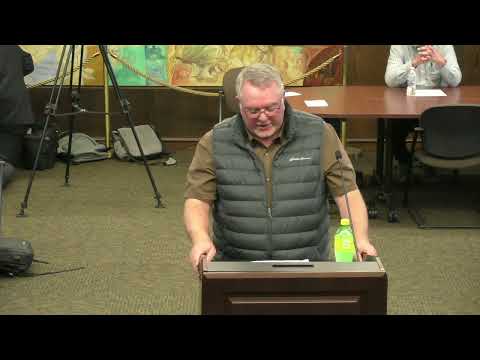
The district's representative, Andy, told the council the district is proposing a single spring application of the herbicide Aquathol, a salt‑based, leaf‑contact herbicide widely used in Minnesota. "We're roughly gonna be treating roughly 60 acres of the lake," Andy said, and said the treatment works best when water temperatures are between 50 and 60 degrees. He said the operator Solitude, Ltd. will apply for the Minnesota Department of Natural Resources permit on the district's behalf and asked the council to allow a city staff member to sign an "intent to treat" notification if the DNR requires local sign‑offs.
Councilors pressed staff on public‑notice steps and environmental effects. Councilor Baker asked whether the chemical dissipates and whether it bioaccumulates; Andy replied, "it's a salt based, it does not bioaccumulate" and said the main human risk is to those handling the concentrated product. Councilor Christiansen asked about impacts on wildlife and pets; Andy said the watershed will do outreach, publish statements in the paper, and likely use radio when treatment dates are known. Andy added that treated areas would be posted with a closed sign and people should stay out for 24 hours.
Andy described why early spring application is necessary: curly‑leaf sprouts earlier than native plants and dies off in mid‑ to late July, releasing phosphorus that contributes to late‑summer algae blooms. "We want to treat this before our native vegetation gets to a certain height," he said, explaining the goal is to suppress curly‑leaf so native plants such as coontail can reestablish and compete. He said the district expects treatment to be repeated annually for several years — "probably for the next, I'm hoping, 5 to 7 years, and then we'd be done" — to bring the invasive under control.
He also described permitting and property issues: about 75–80% of the area proposed for treatment is city‑owned; some shoreline parcels are privately owned and may need landowner sign‑offs depending on DNR requirements. The watershed said it had increased contractor Solitude's insurance requirement from $1,000,000 to $1,500,000 and will list the city as an additional insured on the certificate of insurance.
Mayor Murray asked for objections to granting staff authority to sign permit documents when needed; no councilors objected. The mayor said, "Any concerns from the council? No concerns. Sounds like we're okay." Andy said the district will keep the city updated and offered to return to a future meeting to answer more questions.
Why it matters: Fountain Lake's improved water clarity since dredging has allowed aquatic vegetation to flourish, but curly‑leaf pondweed can form dense mats, increase phosphorus on die‑off and spread rapidly. The watershed's plan aims to minimize summer algae blooms and promote native aquatic plants while the DNR permit and property‑owner approvals are secured.
What happens next: Solitude, Ltd. will proceed with the DNR permit application. If the DNR or the permit process requires private landowner signatures, the watershed said it will work directly with those homeowners. The council's lack of objection allows a city staff member to sign permit documentation when the application is ready.