Get Full Government Meeting Transcripts, Videos, & Alerts Forever!
Get email alerts on the Design Review topic
No spam. Unsubscribe anytime.
Council reviews revised design-review code to comply with state law and consolidate standards
Summary
Staff presented a revised design-review code to implement HB 1293, consolidate scattered design standards, and replace a two-step public hearing process with a hybrid administrative/public model; the Planning Board recommended adoption and staff scheduled a public hearing and additional revisions.
Planning staff presented a revised design-review code on May 6 intended to implement HB 1293 (2023) and to streamline Edmonds’ design-review processes.
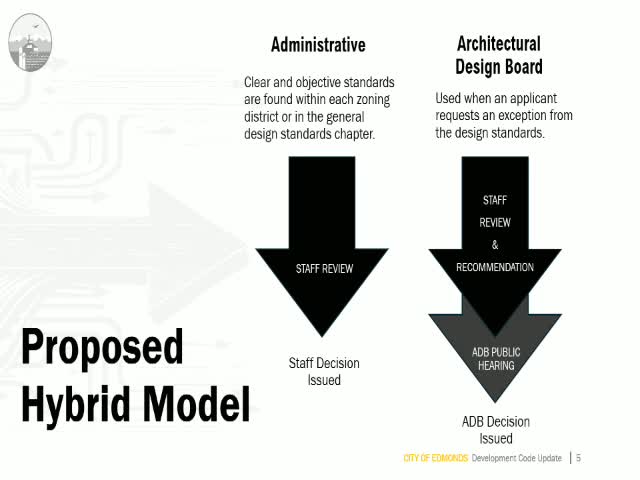
Mike Clugston and Senior Planner Grama Shipley said the draft consolidates design standards now scattered across multiple chapters into one primary chapter (ECDC 20.10) and moves district-specific rules into their zoning districts. The proposal removes the city’s two-step district-based review and replaces it with a hybrid model intended to reduce duplicative review and to make clear which projects can be approved administratively and which must go to the Architectural Design Board (ADB) for a single public hearing.
Staff said the changes aim to make more of the code clear and objective, reduce redundancy, and provide general design standards where a zoning district currently has none (for example, many RM and small commercial zones). Planning Board vice‑chair John Milke and the Planning Board recommended adoption, subject to refinements.
Planners noted remaining work: the general-design standards in the draft should be reviewed to ensure each requirement is necessary and objective; some design standards for neighborhood centers/hubs and middle housing will be addressed in later phases (phase 3); and recent and pending state legislation could affect local material/cladding regulations, which staff will monitor.
Council members asked questions about transparency requirements (windows and ground-floor activation), parking and garage placement, and whether the design-review model would continue to allow ADB public hearings for departures from standards. Staff said departures would still trigger an ADB hearing but emphasized ADB cannot override clear and objective standards. The sequence staff outlined: Planning Board recommendation (this meeting), public hearing May 13, revision/review May 27 and adoption ordinance targeted for June 3, with a phase‑3 follow-up for code refinements.
No ordinance was adopted on May 6; staff scheduled the public hearing and asked council for feedback on the redline draft before final adoption.