Get Full Government Meeting Transcripts, Videos, & Alerts Forever!
Get email alerts on the Homelessness Religious Hosting topic
No spam. Unsubscribe anytime.
Burien council receives state-law briefing on religious hosting of people experiencing homelessness; motion to fast-track local ordinance fails
Summary
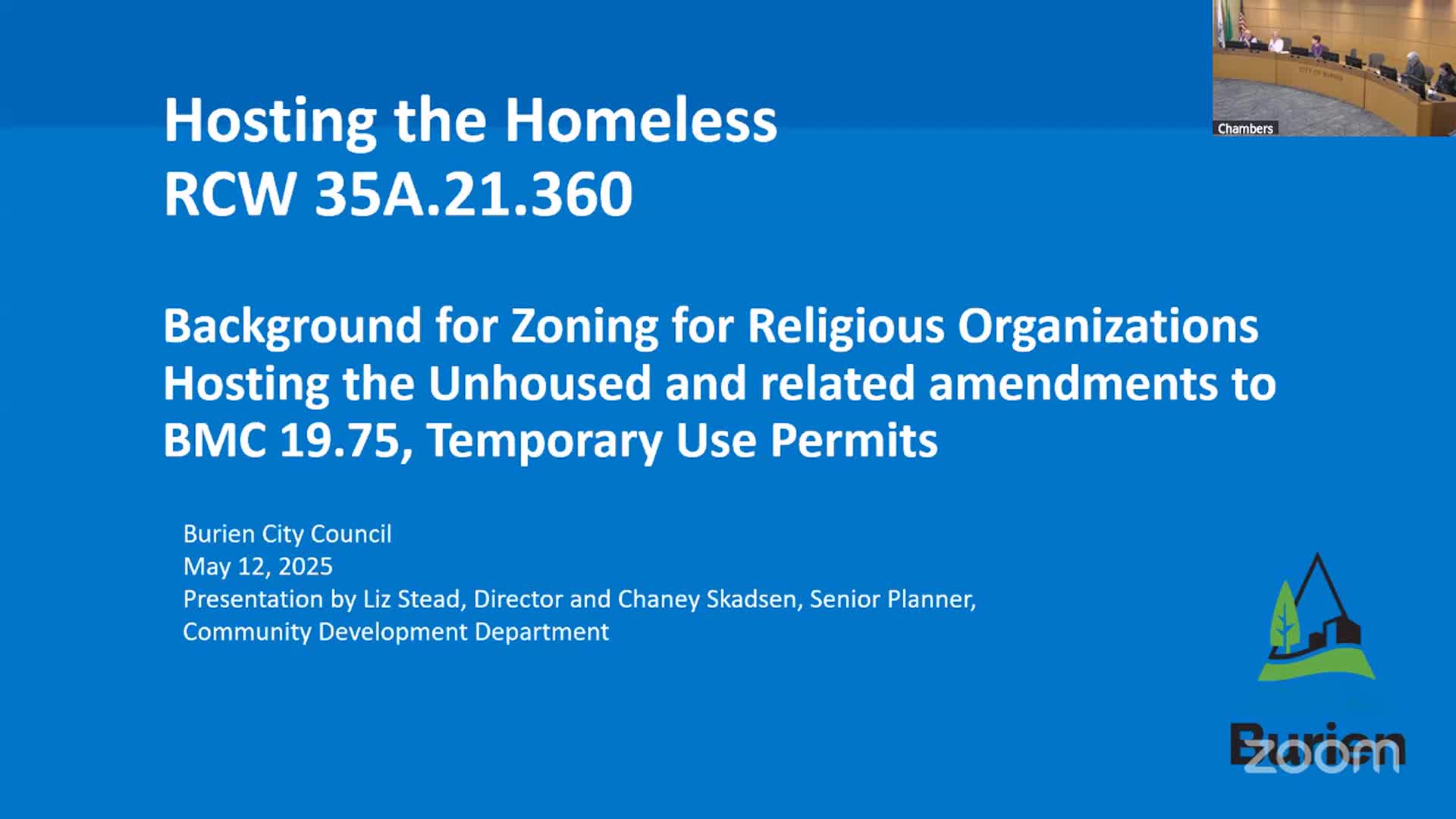
Deputy Mayor Sarah Moore called the Burien City Council into special session on May 12 for a staff briefing on House Bill 1754 (codified at RCW 35A.21.360) and to consider whether to revive Ordinance 861 with edits to how the city regulates religious-hosted temporary housing. A motion to untable the ordinance and place the edited measure on next week's consent agenda failed on a tie vote.
Deputy Mayor Sarah Moore opened a May 12 special meeting of the Burien City Council with a staff presentation explaining state rules for religious organizations that want to host people experiencing homelessness under House Bill 1754, codified in RCW 35A.21.360. Liz Ann Chaney, presenter, and a city staff member summarized the four hosting types the law requires cities to allow on religious-owned or controlled property and the limited areas local government may regulate.
The presentation laid out what the statute requires and what Burien can still control: the state law allows outdoor encampments, indoor overnight shelters, temporary small houses, and safe vehicle parking on religious property; it also limits local regulation to matters tied to public health and safety (for example, sanitation, restroom access, lighting, fences and setbacks). "We are very limited in what we can regulate, but we can regulate issues related to public health and safety, specifically through cleanliness and sanitation," the Staff member said during the briefing.
Council Member Linda Akey moved to untable a previously tabled item to bring back Ordinance 861 with a specific revision: replace the word "required" with "encouraged" in Burien Municipal Code (BMC) 19.90.050.6 so that 24-hour onsite staff would be encouraged but not mandatory; Council Member Alex Andrade seconded the motion. The motion to untable and place the revised ordinance on next week's consent agenda failed on a 3-3 vote (Aye: Council Member Linda Akey; Council Member Alex Andrade; Mayor Kevin Schilling. No: Council Member Hugo Garcia; Council Member Jimmy Mata; Council Member Stephanie Mora), and the proposal will not appear on the upcoming consent calendar.
During the staff briefing, presenters summarized several statutory operational limits that the council considered important context: tent encampments must be allowed for a minimum of four months and may occur up to six months per calendar year with at least a three-month separation between encampments on the same site; safe-parking hostings follow the same four- to six-month timing but are limited by on-site parking availability; temporary small houses and indoor overnight shelters can be allowed up to one year; restroom access must be provided for all hosting types; registration in the state Homeless Client Management Information System is required only when public funding is involved; the RCW permits offender background checks but is silent on warrant checks; and local mitigation may address lighting, exterior noise, fencing and setbacks. The presenters also noted that local memoranda of understanding (MOUs) are a mechanism to set rules and code-of-conduct terms for hostings.
Council members asked procedural and legal questions about how the council could proceed given prior litigation related to the topic and about the urgency: staff reminded the council that an interim zoning ordinance adopted in December 2024 expires June 9, 2025. The City Attorney provided a parliamentary ruling when asked whether a simple majority was required to take the motion from the table: the City Attorney said a simple majority is sufficient to take an item from the table and to reconsider.
The council did not adopt any ordinance at this meeting. Staff told the council that, procedurally, the council may place the matter back on a future agenda through the City Manager's agenda-setting process and that any new or revised local ordinance must be crafted to comply with the state RCW. The interim ordinance remains in effect until its statutory expiration date unless the council acts earlier.
What happened next: because the motion to untable failed, Ordinance 861 as revised did not go to the consent agenda; staff and council will need to decide whether to pursue a different procedural route before the interim ordinance expires on June 9, 2025.