Get Full Government Meeting Transcripts, Videos, & Alerts Forever!
Get email alerts on the Lodging Tax topic
No spam. Unsubscribe anytime.
Council approves revised 2025 lodging-tax funding recommendations after debate on Quincy Square
Summary
The Bremerton City Council accepted the Lodging Tax Advisory Committee's revised 2025 funding recommendations, approving $433,500 in allocations after council and public debate about Quincy Square, hotel capacity and conflicts of interest. The motion passed 5–0 with two abstentions.
The Bremerton City Council voted Wednesday to accept the Lodging Tax Advisory Committee's (LTAC) revised 2025 funding recommendations, approving $433,500 in lodging-tax allocations and remanding the LTAC’s exhibit A distribution to implementation.
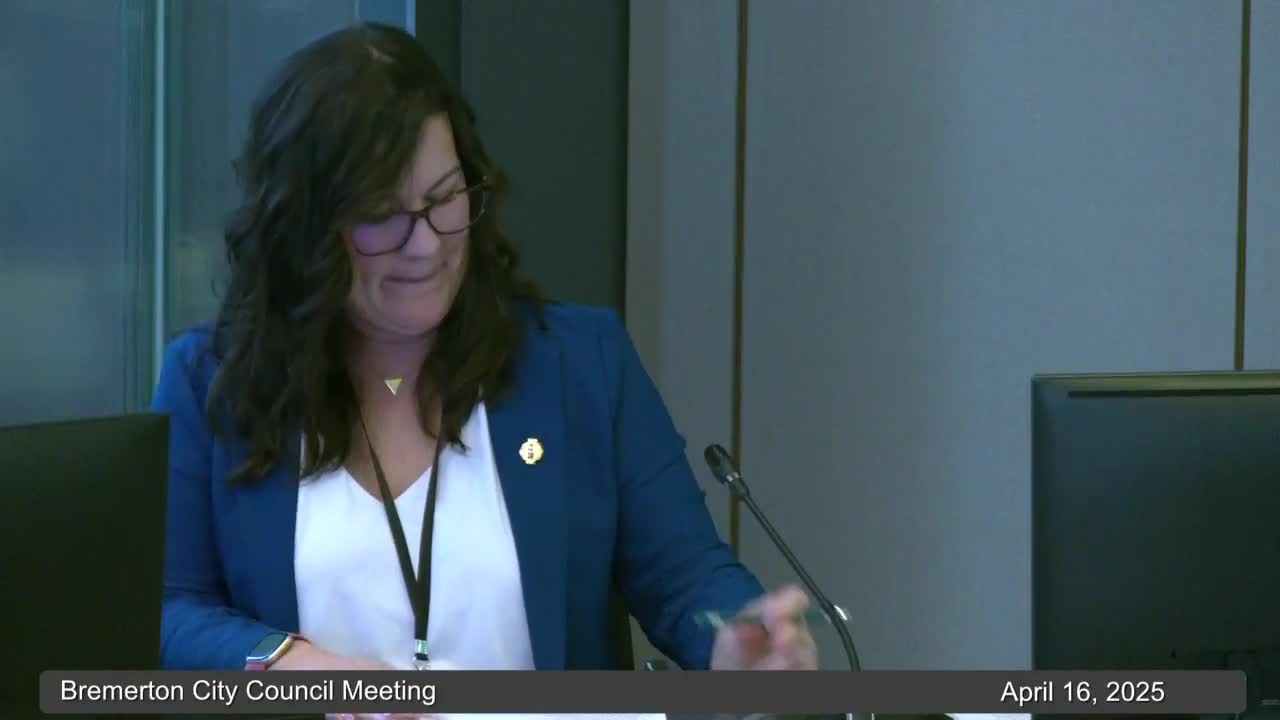
The vote followed public comment and extended council debate about whether LTAC funding appropriately produces “heads and beds” — the statute’s stated purpose — and whether the city should fund the city-led Quincy Square operations. Councilmember Jennifer Chamberlain, LTAC chair, moved to adopt the committee’s recommendations; the motion passed with five yes votes and two abstentions.
Why it matters: Lodging-tax revenues are restricted under state law (RCW 67.28) to activities that draw visitors who stay overnight. Council discussion focused on whether recommended grants would generate hotel stays in Bremerton or primarily support events or facilities that do not produce measurable overnight stays.
LTAC background and recommendation: Chamberlain told the council LTAC members interviewed applicants and recommended partial funding for all applicants because available funds were far smaller than requests. "We had $433,500 allocated, as opposed to the over $1,000,000 requested," Chamberlain said, summarizing the committee’s challenge.
Council discussion: Vice President Radlowski questioned specific applications and the committee’s interpretation of the statute, saying some proposals overstated room-night impacts and cited examples of events that would not draw the hotel stays LTAC is intended to support. "A one-day event does not put 4,000 people in hotel rooms," Radlowski said, adding the city does not have that many rooms downtown.
Councilmember Frey, who has experience as both an LTAC applicant and committee member, supported Chamberlain’s facilitation but warned that conflicts of interest are inherent in the state statute’s composition of LTAC. Frey said she was "disappointed in the lack of vision and experience in the administration" after an application from the city to operate Quincy Square was submitted after LTAC had finalized recommendations. "I was also very concerned ... that an application came from the city, to operate Quincy Square, after the committee had made recommendations," she said.
Quincy Square and city application: Council and LTAC members described a later city application seeking $45,000 to develop an operational plan for Quincy Square. LTAC ultimately recommended that Quincy Square receive funding; Chamberlain said council had proposed that change and LTAC remanded the recommendations for that adjustment.
Public comment: Jose Camacho of Friends of Smith's Cove told council he objected to public money supporting private development interests and said the city is funneling funds to those developers. The city’s staff later clarified for the record that the City of Bremerton is the applicant for the Quincy Square amount.
Vote and procedural follow-up: The motion to accept LTAC’s revised recommendations passed 5 yes, 0 no, 2 abstain. Recorded yes votes were Councilmember Frey, Councilmember Reblewski, Councilmember Mokler, Councilmember Chamberlain and President Younger. Councilmembers Coughlin and Goodnough abstained. Councilmembers Chamberlain, Frey and Vice President Radlowski indicated they will meet to propose process changes for the next LTAC cycle.
What the vote does not do: Acceptance directs staff to implement the LTAC allocations as recommended in exhibit A; it does not itself change the underlying state statute or the city’s lodging-tax ordinance. Councilmembers said they will pursue procedural changes to how LTAC and city staff coordinate future applications.
Votes at a glance: Accept LTAC’s 2025 revised funding recommendations (per Exhibit A) — motion moved by Councilmember Jennifer Chamberlain; second not specified; outcome approved; tally 5 yes, 0 no, 2 abstain.
Next steps: Councilmembers Chamberlain, Frey and Vice President Radlowski said they will meet to draft protocol changes for future LTAC cycles, including clearer documentation on hotel-room impact estimates and timing for city applications.